
• Mail us: support@drtimpearce.com
  • Trustpilot
Dr Tim Pearce, eLearningDr Tim Pearce, eLearningDr Tim Pearce, eLearning Dr Tim Pearce, eLearning
  • eLearning Courses
        • ELEARNING COURSES

        • Techniques
          • BOTOX® Foundation Course
          • Pro Tox
          • Dermal Fillers Foundation Course
          • 8D Lip Design
          • Julie Horne Directs, Dr Tim Injects – February 2023
          • Eyelash Enhancement Serum Course
          • Anatomy360
          • Art Codes
        • Complications
          • Botulinum Toxin Complications Mastery
          • Dermal Filler Complications Mastery
          • Elective Lip Reversal
        • Profinity
        • Wellness
          • How To Introduce Longevity To Your Aesthetics Clinic
        • Marketing
          • DCAM 2.0
          • Canva Mastery: A Step-by-Step Guide
          • Email Marketing Course
          • Industry Photography Secrets
          • How to find your voice with video
        • Other Services
          • DPP for V300 Service
        • Packages
          • Foundation eLearning Package – SAVE 10%
          • Complications eLearning Package – SAVE 10%
          • Techniques eLearning Package – SAVE 20%
          • Marketing eLearning Package – SAVE 20%
          • Full eLearning Package – SAVE 35%
        • Reviews and Testimonials
        • FAQ – Online Courses
  • Downloads
        • Complications
          • 13 Extra Risky Injection Areas: Facial Vessel Map
          • Aspirating Experiment Test Results
          • Bruising Checklist: Prevent & Minimise Bruises from Injectables
          • Dermal Filler Complications: The Essential Guide
          • Delayed Onset Nodules: How To Diagnose And Treat
          • Diagnosing Complications: 7 Steps To Great Advice
          • Emergency Reversal Protocol
          • How To Avoid Causing a Lateral Rectus Palsy From Botulinum Toxins
          • Hyalase Consent Form: Downloadable Template
          • Lumps in Lips Guide: How to Diagnose, Manage & Treat
          • Tear Trough Oedema Protocol
          • Does Covid-19 Vaccine Cause Dermal Filler Reactions?
        • Injection Techniques
          • 26 Essential Injection Patterns For Botulinum Toxin
          • Botox Calculator
          • BOTOX Lesson – Gummy Smile
          • BOTOX Lesson – Hooded Eyes
          • Frequently Used Filler Volumes Facial Map
          • How To Improve Your Needle Control: 6-Step Blueprint
          • How to Prepare BOTOX – Step by Step Guide
        • Consultation Skills
          • Body Dysmorphia & Modification Checklist
          • Is It Safe To Treat? 5-Step Contraindication Check List
          • Medical Model For Cosmetic Procedures: An Essential Guide
        • Lips
          • Lip Consultation Question Checklist
          • Lip Anatomy Lesson
          • Common Needle/Cannula Choices For Lips
          • Lip Filler Aftercare Pack for Your Patients
          • Lip Design Blueprint – 4 Steps To Perfect Lip Augmentation
          • Master the Basics of Julie Horne’s Lip Technique
        • Longevity
          • Does HRT Increase Cancer Risk? Guide for Clinicians
          • Educating Patients About How Sugar Exacerbates Aging
          • How to Reduce Biological Age for Your Patients
        • Business & Marketing
          • Annual Profit Calculator
          • 5 Steps to Create a Successful Aesthetics Business
          • Injector’s Cheat Sheet – 7 Social Media Post Types
          • 7 Deadly Hashtag Sins
          • 7 Secret Locations to get Instagram Followers
          • 9 Video Marketing Mistakes
          • 15 Easy Instagram Reels Ideas
          • 3 Time-Saving Hacks for Social Media
          • Personal Branding Starter Kit
          • Value Audit Template: Price-per-1ml
          • World’s Top 5 Filler Brands – Survey Results
  • Products
    • Artistic Anatomy Poster Collection
    • Top 3 Posters Bundle
    • Original Anatomy Poster
    • Beautiful Lip Anatomy Poster
    • Download Pack – Forms & Leaflets
  • Blog
    • Meet the Writers
  • About
    • Dr Tim Pearce
    • Miranda Pearce
    • Careers & Recruitment
    • Webinars
    • Become a Model
  • Contact
  • Login

Login

Understanding Deep Fat Pads: Anatomy, Consultations & Treatment

Blogs

  • ALL
  • Complications
  • Injection Techniques
  • Consultation Skills
  • Lips
  • Business & Marketing
You may be interested
Understanding Deep Fat Pads: Anatomy, Consultations & Treatment

Understanding Deep Fat Pads: Anatomy, Consultations & Treatment

May 7, 2026

Antioxidants/Redox and the Skin – What You Need To Know

Antioxidants/Redox and the Skin – What You Need To Know

May 5, 2026

Why 80% of Facial Ageing is Structural: Fat Pads & Ligaments

Why 80% of Facial Ageing is Structural: Fat Pads & Ligaments

April 30, 2026

Hack your health : telomeres epigenetics and the science of longevity

Hack your health : telomeres epigenetics and the science of longevity

April 28, 2026

Deep Fat Pads: Understanding Facial Volume Architecture for Natural Dermal Filler Results

Deep Fat Pads: Understanding Facial Volume Architecture for Natural Dermal Filler Results

April 23, 2026

Understanding Deep Fat Pads: Anatomy, Consultations & TreatmentDr Tim Pearce
May 7, 2026

Why Anatomical Knowledge Transforms Both Consultations and Treatment Design

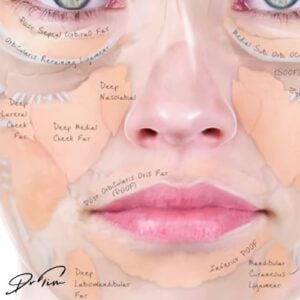
Complete anatomical diagram of deep facial fat pads from forehead through chin showing SOUF, buccal fat, deep nasolabial, deep cheek, deep chin compartments with orbicularis, zygomatic, mandibular, and platysma retaining ligaments for comprehensive dermal filler treatment designThe fat pads of the face divide into superficial and deep compartments with the SMAS serving as the primary division between these two layers, though the mid-face presents more complexity than this simple description suggests since some deep fat pads can lie on top of muscles due to an unusual roof tile effect that changes the typical anatomical layering you might expect. Understanding these deep fat compartments and knowing when to inject them versus the superficial layer becomes essential for treatment planning, and the knowledge fundamentally changes how you conduct consultations since patients respond very differently when they understand the anatomical basis for what they see rather than just being told they need treatment.

Fat pads perform three primary roles in facial anatomy starting with the purely biochemical function of producing energy when needed, though this isn’t the aspect we focus on in aesthetic practice where the functional component matters more since fat pads provide support for muscles so they don’t sag or stretch as easily while also creating points of leverage where smaller muscle contractions can pull more tissue and dampening muscle movement so contractions aren’t overly overt. This creates a harmonizing effect that leads into the aesthetic category where these fat pads create visual differences that we interpret as beauty, which functions essentially as a projection of health where fat pads in the right place at the right volume convey a sense of a healthy individual, making facial appearance a social survival mechanism where looking healthy maximizes opportunities.

The forehead and periorbital deep fat compartments

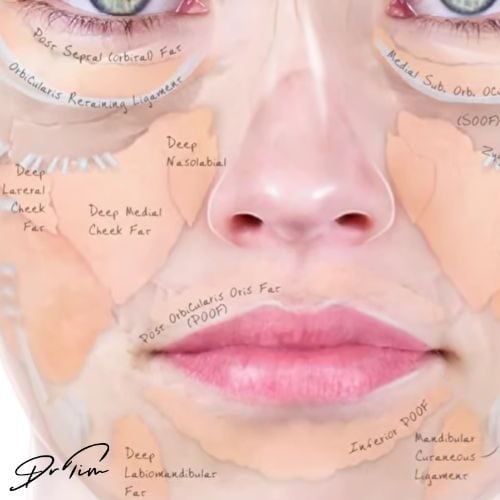
Some papers discuss four or five compartments just in the forehead including occasionally a very small one referenced as the subprocerus or galeal fat pad, along with a subfrontal deep fat pad compartment underneath the frontalis that’s divided into two frontal septums creating two subfrontal fat pads between the inferior and middle frontal septum, then three subfrontal fat pads in the medial frontal septum, and three deep fat pads superior to the medial frontal septum, which adds up to five deep fat pads underneath the frontalis muscle. This becomes very important for injections where we’re shaping the forehead or restoring a more youthful contour, and around the eyes we focus mainly on the SOOF which is the suborbicularis oculi fat pad actually divided into lateral and medial compartments, and this anatomy becomes essential for tear trough treatment since this is effectively what we’re restoring when we treat that area.

Mid-face complexity and the unusual roof tile architecture

The mid-face presents more anatomical complexity than you’ll find in most internet images showing two main fat pads including the buccal fat pad which extends underneath the zygoma into the temple, along with the deep medial cheek fat pad, though more detailed descriptions also include the deep lateral cheek fat pad and the deep nasolabial fat compartment located in the pre-maxillary space. This deep nasolabial fat pad lies on top of the levator labii superioris alaeque nasi muscle which represents a crucial difference in mid-face anatomy compared to the lateral face since deep fat pads can lie on top of muscles rather than always beneath them, and this roof tile effect creates an unusual layering pattern where even though a fat pad is classified as deep there may sometimes be muscles underneath it.

Lower face fat pads and treatment design

Many textbooks don’t discuss the deep fat pads much in the lower face but with deeper investigation you’ll find evidence including particularly the retro orbicularis oris fat pad which becomes relevant when you look at very old faces especially if they’ve lost volume where you can tell there’s much less volume in the whole structure around the mouth. This knowledge proves useful for holistic restorations when you’re trying to take years off someone by treating these deep fat pads including the deep chin fat medially underneath the mentalis muscle and the deep labiomental fat pad lateral to that, and these components stabilize the chin position since deep cannula treatments can help restore the chin which functions like the cherry on the bottom giving you that heart-shaped face when the chin ends at the low point.

Making the decision between deep and superficial injection layers

In many places you often start with deep injections since when you’re looking at a face you’re restoring the underlying structure and those are often the deeper fat pads, though you’re injecting all of them so if you’ve got a crease or you want to create more projection you’ll layer it doing some injections deep and some superficial. The foundational work tends to be deeper treatments but there’s definitely a mixture of both, and you make that aesthetic judgment as you progress through the procedure where a first pass might go deep and then you pick up smaller details with more superficial cannula work in certain parts of the face.

Using fat pad knowledge to build trust in consultations

The first helpful aspect in consultations centers on giving patients an anatomical basis for what they see, and if they can relate a deficit which makes them feel a certain way to anatomical change that you can directly repair by replacing lost volume that creates a very neat story in the mind of someone who wants to look natural. This makes discussing fat pads incredibly useful in consultations, and there’s also the importance of having a sound basis for your treatment recommendations since most injectors need to present a case about why you’re going to treat a patient in a certain way to win their trust. Presenting that case based on as many fundamental ideas as you can gather with anatomy being one of the most important fundamental reasons to treat someone creates the foundation for patient confidence in your recommendations.

Treatment design guided by actual fat pad volumes

Once you understand the anatomy of fat pads it becomes clear where you need to inject and how much you need to inject, and taking temples as an example the deep temple fat pad and the buccal fat pad form quite a large structure measuring about fifteen milliliters in normal youth though it shrinks as you get older. If you’re recommending a treatment and discussing volumes it’s very useful to know that your normal buccal fat pad is fifteen milliliters and shrinks significantly with aging, so if you put two milliliters in that’s not actually a very large treatment but it helps you know where you’re injecting, why you’re injecting, and how much based on understanding the properties of the fat pad with temple treatments ranging from about half a milliliter on each side up to two milliliters, though you can probably go as high as four milliliters each side in some people if not higher.

The relationship between fat pads and ligaments creating visible aging

Fat changes represent one of the primary alterations in facial aging but where it gets interesting involves relating them to ligaments since ligaments attach skin to the surface running through these fat pads, and the fat pads create potential spaces which change as you get older where lost volume or excess volume combined with ligaments means you can see little dips in the skin where it’s held on. This becomes one of the main features of aging where the relationship between superficial fat, deep fat, and ligaments probably accounts for seventy to eighty percent of what you’re seeing in terms of aging, and when you’ve got a good explanation of how they relate together you know much more about how to guide treatment plans and explain why you’re recommending more holistic and beautiful natural results treating the face as a whole rather than just individual lines and wrinkles.

Most shadows in your face are basically ligaments where the orbicularis oculi retaining ligament creates your tear trough, your zygomatic ligament crosses your cheek, the nasolabial fold has an attachment ligament, the melolabial fold comes from the mandibular retaining ligament, and these are all break points where fat pads shift causing shadows. Instead of assuming you’re the authority and patients should just listen, present a case as if you’re trying to convince a colleague why they should have treatment, and your trust levels go through the roof because they’re actually learning something and while they’re learning you’re demonstrating your authority and knowledge.

Ready to master deep fat pad anatomy and transform your consultation approach?

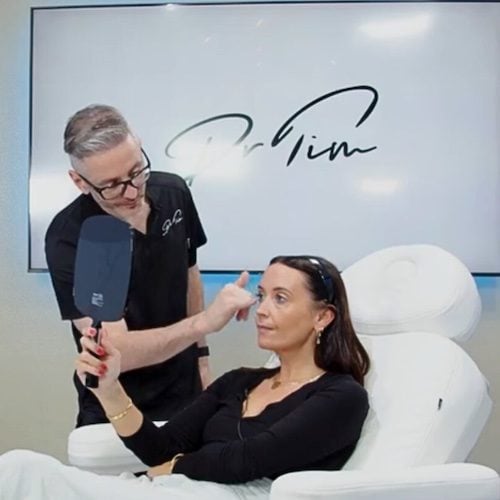
Join Dr. Tim's upcoming webinar where you'll explore the specific locations and volumes of deep fat compartments, understand when to inject deep versus superficial layers, and develop the anatomical communication skills that build patient trust and improve treatment outcomes.

Register for the Free Webinar →

Learn to see facial anatomy the way expert injectors do, enabling treatment plans based on structural understanding rather than surface-level symptom chasing.

Anatomy Webinar
Dr Tim Consultation Anatomy

Dr Tim Pearce eLearning

Dr Tim Pearce MBChB BSc (Hons) MRCGP founded his eLearning concept in 2016 in order to provide readily accessible BOTOX® and dermal filler online courses for fellow Medical Aesthetics practitioners. His objective was to raise standards within the industry – a principle which remains just as relevant today.

Our exclusive video-led courses are designed to build confidence, knowledge and technique at every stage, working from foundation level to advanced treatments and management of complications.

Thousands of delegates have benefited from the courses and we’re highly rated on Trustpilot. For more information or to discuss which course is right for you, please get in touch with our friendly team.

Share This Article
Facebook Twitter Pinterest Linkedin
Prev Post

Related Articles

Antioxidants/Redox and the Skin – What You Need To Know Bestseller

Antioxidants/Redox and the Skin – What You Need To Know

May 5, 2026

Antioxidants/Redox and the Skin – What You Need To Know
By Andrea Callaway
May 5, 2026

Antioxidants/Redox and the Skin – What You Need To Know

READ MORE
Why 80% of Facial Ageing is Structural: Fat Pads & Ligaments Bestseller

Why 80% of Facial Ageing is Structural: Fat Pads & Ligaments

April 30, 2026

Why 80% of Facial Ageing is Structural: Fat Pads & Ligaments
By Andrea Callaway
April 30, 2026

Why 80% of Facial Ageing is Structural: Fat Pads & Ligaments

READ MORE
Hack your health : telomeres epigenetics and the science of longevity Bestseller

Hack your health : telomeres epigenetics and the science of longevity

April 28, 2026

Hack your health : telomeres epigenetics and the science of longevity
By Andrea Callaway
April 28, 2026

Hack your health : telomeres epigenetics and the science of longevity

READ MORE

Add your Comment

Popular Courses

BOTOX® Foundation Course

BOTOX® Foundation Course

Pro Tox

Pro Tox

8D Lip Design

8D Lip Design

SEE MORE

CONTACT US

    contact injection
    Dr Tim Pearce

    Improve your medical
    aesthetics business

    • Home
    • Courses
    • About
    • Contact
    • Dr Tim Limited Terms and Conditions of Sale
    • Privacy Policy
    • Website Terms Of Use
    • Careers
    Login Dr Tim Pearce Login
    © Copyright Dr Tim Ltd, 2025
    We use cookies on our website to give you the most relevant experience by remembering your preferences and repeat visits. Read More. By clicking “Accept All”, you consent to the use of ALL the cookies. However, you may visit "Cookie Settings" to provide a controlled consent.
    Cookie Settings Reject All Accept All
    Manage consent

    Privacy Overview

    This website uses cookies to improve your experience while you navigate through the website. Out of these, the cookies that are categorized as necessary are stored on your browser as they are essential for the working of basic functionalities of the website. We also use third-party cookies that help us analyze and understand how you use this website. These cookies will be stored in your browser only with your consent. You also have the option to opt-out of these cookies. But opting out of some of these cookies may affect your browsing experience.
    Necessary
    Always Enabled
    Necessary cookies are absolutely essential for the website to function properly. These cookies ensure basic functionalities and security features of the website, anonymously.
    CookieDurationDescription
    cookielawinfo-checkbox-analytics11 monthsThis cookie is set by GDPR Cookie Consent plugin. The cookie is used to store the user consent for the cookies in the category "Analytics".
    cookielawinfo-checkbox-functional11 monthsThe cookie is set by GDPR cookie consent to record the user consent for the cookies in the category "Functional".
    cookielawinfo-checkbox-necessary11 monthsThis cookie is set by GDPR Cookie Consent plugin. The cookies is used to store the user consent for the cookies in the category "Necessary".
    cookielawinfo-checkbox-others11 monthsThis cookie is set by GDPR Cookie Consent plugin. The cookie is used to store the user consent for the cookies in the category "Other.
    cookielawinfo-checkbox-performance11 monthsThis cookie is set by GDPR Cookie Consent plugin. The cookie is used to store the user consent for the cookies in the category "Performance".
    viewed_cookie_policy11 monthsThe cookie is set by the GDPR Cookie Consent plugin and is used to store whether or not user has consented to the use of cookies. It does not store any personal data.
    Functional
    Functional cookies help to perform certain functionalities like sharing the content of the website on social media platforms, collect feedbacks, and other third-party features.
    Performance
    Performance cookies are used to understand and analyze the key performance indexes of the website which helps in delivering a better user experience for the visitors.
    Analytics
    Analytical cookies are used to understand how visitors interact with the website. These cookies help provide information on metrics the number of visitors, bounce rate, traffic source, etc.
    Advertisement
    Advertisement cookies are used to provide visitors with relevant ads and marketing campaigns. These cookies track visitors across websites and collect information to provide customized ads.
    Others
    Other uncategorized cookies are those that are being analyzed and have not been classified into a category as yet.
    SAVE & ACCEPT