


FREE Complications Webinar
Want to overcome your fear of complications and confidently master anatomy?
Join us for one of Dr Tim's FREE upcoming webinars.
Check dates here and save your spot
 Dr Tim Pearce
 The claim that 80% of ageing in terms of what you see relates to the relationship between fat pads and ligaments represents a fundamental shift in how practitioners understand facial aesthetics and treatment design, moving beyond surface-level interventions to address the mechanical structures that control the surface of the skin and determine whether someone looks five years older or ten years older. Superficial fat pads combined with deep fat pads and the ligaments that run through them control the proportions and relative size of facial features, and when someone ages visibly what you’re actually seeing is predominantly what’s happening with these structures as they change their positions and volumes over time.
The fundamental principle of a ligament centers on its role as the structure that attaches the surface of the skin to deep underlying anatomy including the deep fascia which can be positioned just above the bone or in some cases directly on a muscle, holding the skin in place relative to the foundational skeletal and muscular architecture. Thinking of ligaments as trees provides a useful conceptual model where their roots anchor into solid structures like the deep fascia or periosteum, with their trunk essentially passing upwards until crossing the SMAS, and above this layer you have the retinaculum cutis where the branches and leaves integrate into the top layer connecting all these components through the ligament structure.
Understanding this general architecture with deep and solid foundations where the roots are positioned, followed by a thin segment that then branches out to cause stability in the top layer through all those connections, helps clarify much more about how volume that supports these structures makes a substantial difference in appearance and aging patterns. The fat pads both deep and superficial encase ligaments and provide support to the skin, creating a mechanical relationship between fat pad and ligament that becomes essential for understanding lifting as a concept in aesthetic treatment.
Using a simple physical model helps visualize how skin, ligaments, and fat work together during youth compared to age, starting with little sticks that represent ligaments running from the periosteum at the deep layer through the deep fat until reaching the next layer which is the SMAS. On top of the SMAS you have the superficial layer and the ligaments keep running through that tissue, in some cases inserting directly into the dermis which represents your top layer, creating a structure with these two fat compartments that in an older person with very little support shows loads of movement when you manipulate the surface.
Imagining placing volume underneath these structures with balloons to represent fat pads creates a much more stable architecture that simply does not want to lean as much because of the fat pads supporting the ligament framework throughout the tissue layers. When you decrease the volume of these fat pads by letting the air out of the balloons you see a natural descent occur, and this deflation demonstrates that when you reinflate the structures because the ligaments are so firmly attached the natural position is to pull up where they stand up straight which means the skin also gets pulled back into position.
Volume and lifting link together through the ligaments in this mechanical relationship, and once you understand this connection between volume and the way that volume causes a natural pulling of tissue upwards because when you inflate something the ligament naturally wants to stand up straight you can explain to patients why volume and lifting connect directly. Seeing this for yourself when you do a cheek treatment and replace volume shows how jowls improve, demonstrating that dermal fillers possess a lifting capability through the ligaments that goes beyond simple volumization.
The deflation causes tissue descent but the ligaments don’t let go since they’re still attached to the skin, and as tissue descends because you’re losing volume what you see are the shadows caused by the ligaments holding onto the skin where they maintain their attachment points. The three first signs you typically see are tear trough, nasolabial fold, and melolabial fold, occurring because the tissue above is falling in areas where there isn’t an attachment point and where there is an attachment the ligament holds on creating the visible shadow that marks aging patterns.
Understanding where these ligaments sit in the face requires first understanding the functions your face serves, with basically two and arguably three functions where the third one takes on a more philosophical dimension. The first function centers on eating where the muscles of mastication running from the masseter all the way to the zygoma along with your superficial temporalis muscle and many other muscles involved with chewing create a strong rigid structure at the side of the face needed for stable mastication, stabilizing that whole structure during chewing which explains what the lateral part of your face accomplishes.
Many more skin attachments exist in this lateral region and the ligaments are much stronger with much less movement here than in the middle part of your face, where the middle section serves communication and sensory functions requiring much more movement to express yourself since movement becomes very important for humans in terms of communication. We have many more places where movement gets facilitated by areas where the skin is not attached to bone, but those are also the same areas that shift as you get older causing the signs of aging that we recognize and attempt to treat.
The third philosophical reason centers on appearance functioning as a social tool that enables access to the power of society, where people around you treat you according to how you look which is why humans are driven to maintain their appearance. Whether we say it’s for ourselves or recognize that you feel better when you look better, the real reason comes down to survival skills providing a mechanism by which you can better tap into the power of the society around you because they pay more attention or respect you more depending on various factors.
Looking at the distribution of ligaments before getting too focused on individual ligaments helps understanding substantially, and when you actually examine this distribution most of them fall on an angle between the lateral and anterior face. This change in the function of the face from communication-focused to mastication-focused gets overlaid by the anatomy where this line of ligaments forms that boundary, starting with the superior temple septum and then moving to the orbicularis oculi retaining ligament with particular emphasis on the lateral orbital thickening which falls directly on this line.
The zygomatic cutaneous ligament represents by far the strongest aspect of this system and sits right on the angle of the zygoma along this line, following underneath along the masseter where you have the upper masseteric cutaneous ligaments and then the mandibular septum beneath that continuing onwards to finally meet with the mandibular cutaneous ligament. This line of ligaments holds the anterior face in place and represents the architectural boundary between the functional zones of communication and mastication that define facial structure.
The superficial and deep fat pads work together with the SMAS and the dermis and the ligaments that hold all those structures to the skin, basically functioning as a unit where all of them work together to form the signs of aging which practitioners usually attempt to treat with injectables. As soon as you develop that clear picture and can start articulating it to your patients it affects both how your consultations proceed and how your treatment design evolves, because you’ll be thinking about those principles instead of just addressing a shadow that you can’t explain since you should now understand why those shadows appear where they do.
The mechanical understanding of how these structures interact provides the foundation for confident treatment planning where you can predict outcomes and explain to patients the anatomical basis for their visible aging, creating trust through education while designing treatments that address the actual structural changes happening beneath the surface. Fat pads and ligaments working as an integrated system account for the vast majority of visible facial aging, and recognizing this relationship transforms how you approach every consultation and every treatment plan you develop for patients seeking aesthetic improvement.
Join us for one of Dr Tim's FREE upcoming webinars.
Check dates here and save your spot
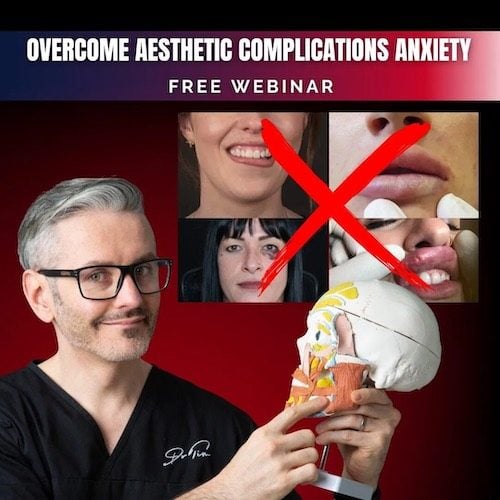
Dr Tim Pearce MBChB BSc (Hons) MRCGP founded his eLearning concept in 2016 in order to provide readily accessible BOTOX® and dermal filler online courses for fellow Medical Aesthetics practitioners. His objective was to raise standards within the industry – a principle which remains just as relevant today.
Our exclusive video-led courses are designed to build confidence, knowledge and technique at every stage, working from foundation level to advanced treatments and management of complications.
Thousands of delegates have benefited from the courses and we’re highly rated on Trustpilot. For more information or to discuss which course is right for you, please get in touch with our friendly team.