
![Upper Facial Muscle Balance: Frontalis & Brow Depressors <br>[Asymmetry Series: Part 2A]](https://drtimpearce.com/wp-content/uploads/2026/01/Jude-Harford-Nurse-Practitioner.jpg)


Note:
This article was written by a guest contributor from our community. The views and clinical opinions expressed here belong to the author and do not necessarily reflect the opinions or endorsements of Dr Tim Ltd.
 Dr Tim Pearce
 MD
MDDr. Dima Maraqa is a dentist and aesthetic practitioner based in Amman, Jordan, specializing in non-surgical facial aesthetics since 2016. She has a strong passion for the science and technology behind every procedure she performs. She believes that true beauty starts with knowledge, precision, and evidence-based techniques. Her approach focuses on achieving natural, safe, and long-lasting results for every patient.
https://www.instagram.com/dimamaraqa
In the previous article, Hybrid Smart Biology was introduced as a conceptual framework for interpreting tissue behaviour through the interaction of layered anatomy, biological context, and time.
As aesthetic practice continues to evolve, there is increasing emphasis not only on understanding tissue, but on applying this understanding within clinical decision-making. This involves interpreting variability, adapting to dynamic tissue states, and recognising that outcomes may be influenced by multiple interacting factors rather than a single intervention.
This article explores how Hybrid Smart Biology may be applied in clinical reasoning, with particular focus on treatment planning, sequencing, and variability in response.
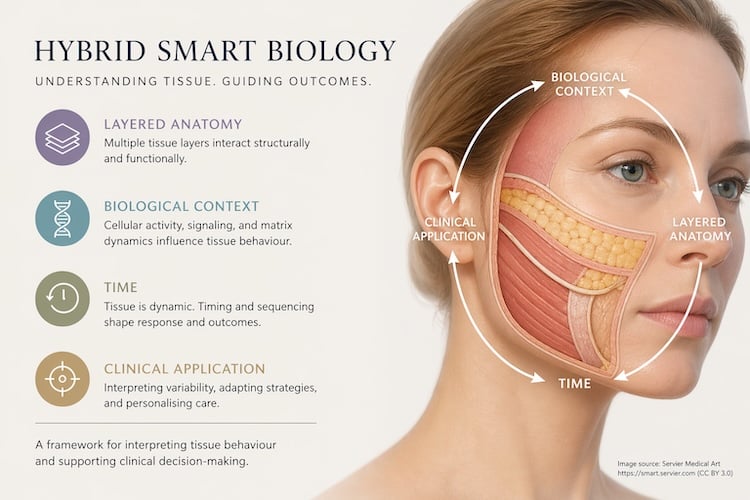
Clinical decision-making in aesthetic practice often extends beyond identifying a single deficit, such as volume loss or skin laxity. Instead, clinicians may be required to interpret how structural, mechanical, and biological factors interact within a given patient.
These interactions may not always be linear or predictable. Structural support, tissue quality, and biological signalling may influence one another, and their relative contribution may vary between individuals.
From this perspective, treatment planning may be understood as a process of interpretation rather than correction, where clinicians consider not only what to treat, but when and in what context.
Changes observed in patients undergoing medically supported or lifestyle-driven weight loss have been increasingly discussed in clinical settings. While often described in simplified terms, they may reflect more complex interactions between structural, biological, and temporal factors.
Reduction in adipose tissue may alter mechanical support, particularly within facial fat compartments, leading to changes in contour and tissue positioning. The extent and distribution of these changes may vary depending on the rate of weight loss, baseline tissue characteristics, and individual variability.
In parallel, skin and extracellular matrix adaptation may not occur at the same rate as structural changes. Collagen remodelling, elastic fibre behaviour, and dermal hydration are dynamic processes that may require time to respond to altered mechanical conditions. When structural change occurs more rapidly than biological adaptation, a degree of temporal mismatch may be observed.
From a biological perspective, weight loss—whether achieved through GLP-1 receptor agonists, dietary interventions, or combined approaches—may also be associated with changes in metabolic and inflammatory signalling. Improvements in insulin sensitivity and adipokine profiles have been described, although their direct effects on skin and extracellular matrix remain incompletely understood.
Baseline tissue condition, including prior aging processes and environmental exposure, may further influence how tissue responds. This may help explain variability between patients.
From a Hybrid Smart Biology perspective, these changes may be interpreted not simply as volume loss, but as a shift in coordination between tissue layers over time.
The concept of tissue readiness may become particularly relevant in situations where tissue is undergoing rapid or ongoing change.
Rather than assuming a uniform response to intervention, clinicians may consider whether tissue is in a state that is responsive, adaptable, or potentially less predictable. This may include reflecting on structural stability, biological environment, and timing of intervention.
In such contexts, variability in outcomes may not necessarily reflect treatment choice alone, but also the condition of the tissue at the time of intervention.
Treatment planning may involve consideration of sequencing, timing, and interaction between modalities.
Rather than approaching treatment as a single event, clinicians may adopt a longitudinal perspective, adapting interventions over time based on tissue response. In patients undergoing recent weight loss, considering whether tissue is still adapting may influence outcomes.
Hybrid approaches may be considered as adaptable strategies responding to evolving tissue conditions.
Emerging research may further explore links between metabolic changes, inflammation, extracellular matrix dynamics, and structural aging.
Future models may increasingly integrate biological context into treatment planning, although standardisation remains uncertain and variability is likely to persist.
Applying Hybrid Smart Biology in clinical practice may involve shifting from correction toward interpretation. By considering tissue layers, biology, and time, clinicians may develop more adaptable and individualised approaches.
Outcomes may be influenced not only by intervention, but also by the condition and behaviour of tissue over time.
This article was written by a guest contributor from our community. The views and clinical opinions expressed here belong to the author and do not necessarily reflect the opinions or endorsements of Dr Tim Ltd.
Dr Tim Pearce MBChB BSc (Hons) MRCGP founded his eLearning concept in 2016 in order to provide readily accessible BOTOX® and dermal filler online courses for fellow Medical Aesthetics practitioners. His objective was to raise standards within the industry – a principle which remains just as relevant today.
Our exclusive video-led courses are designed to build confidence, knowledge and technique at every stage, working from foundation level to advanced treatments and management of complications.
Thousands of delegates have benefited from the courses and we’re highly rated on Trustpilot. For more information or to discuss which course is right for you, please get in touch with our friendly team.


![Upper Facial Muscle Balance: Frontalis & Brow Depressors <br>[Asymmetry Series: Part 2A]](https://drtimpearce.com/wp-content/uploads/2026/01/Jude-Harford-Nurse-Practitioner-405x260.jpg)