
![Upper Facial Muscle Balance: Frontalis & Brow Depressors <br>[Asymmetry Series: Part 2A]](https://drtimpearce.com/wp-content/uploads/2026/01/Jude-Harford-Nurse-Practitioner.jpg)


Note:
This article was written by a guest contributor from our community. The views and clinical opinions expressed here belong to the author and do not necessarily reflect the opinions or endorsements of Dr Tim Ltd.
 Dr Tim Pearce
 MD
MDDr. Dima Maraqa is a dentist and aesthetic practitioner based in Amman, Jordan, specializing in non-surgical facial aesthetics since 2016. She has a strong passion for the science and technology behind every procedure she performs. She believes that true beauty starts with knowledge, precision, and evidence-based techniques. Her approach focuses on achieving natural, safe, and long-lasting results for every patient.
https://www.instagram.com/dimamaraqa
Aesthetic medicine has moved beyond the era of simple volume replacement. Aging is now understood as a complex, multi-layered biological process involving structural collapse, extracellular matrix degradation, cellular senescence, and altered tissue signaling (5). Treating these changes effectively requires more than selecting a product—it requires understanding tissue behavior.
Facial aging is characterized by progressive loss of collagen, reduced fibroblast activity, elastin fragmentation, decreased ECM hydration, impaired microcirculation, and chronic low-grade inflammation (5). These biological changes explain why monotherapy often leads to limited or short-lived results.
Hyaluronic acid is a naturally occurring glycosaminoglycan within the ECM. Injectable HA functions primarily as a mechanical and hydrophilic scaffold, restoring volume, improving viscoelasticity, and supporting mechanotransduction-driven fibroblast activity, without inducing true tissue regeneration (2,4).
PLLA is a biodegradable synthetic polymer that acts as a collagen biostimulator through controlled inflammatory signaling, leading to progressive type I collagen deposition and long-term dermal thickening (1).
Polynucleotides are purified DNA fragments that function as bioregenerative signaling molecules. They enhance fibroblast metabolism, angiogenesis, and extracellular matrix homeostasis while exerting anti-inflammatory effects (3).
The Hybrid Technique represents a shift from product-based correction to biologically intelligent treatment planning (1,2,3). By integrating structural regeneration, biomechanical support, and cellular optimisation, clinicians can address aging at multiple tissue levels in a sequenced manner, as illustrated in Figure 1 and Figure 2.
Hybrid approaches are particularly valuable in several recurring clinical profiles where Smart Biology, rather than volume replacement, determines long-term success. These include early aging with preserved structure but poor skin quality, structural aging with concurrent dermal thinning, fragile anatomical areas such as the periorbital region and neck, and preventive or maintenance-focused patients.
Hybrid treatment planning prioritizes tissue readiness and biological need. Regenerative strategies may prepare tissue for subsequent biomechanical or structural interventions, while deep support may be required first in advanced structural aging. Treatment success is defined by tissue behavior over time rather than immediate contour change.
The evolution of injectable treatments is increasingly guided by advances in regenerative medicine, tissue engineering, and cellular signaling pathways (3,5). Hybrid protocols are expected to become more sequential and longitudinal, focusing on tissue function and biological resilience rather than isolated correction (5).
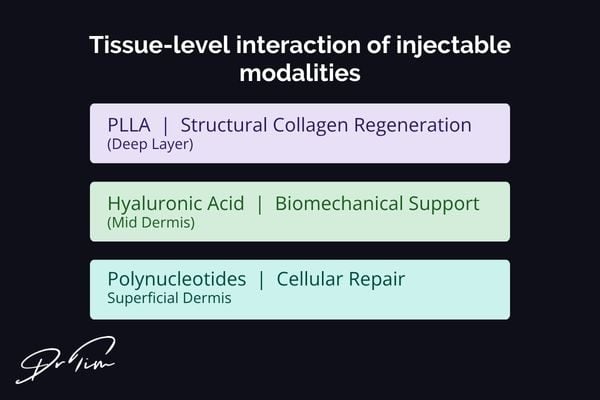
Figure 1. Tissue-level interaction of injectable modalities. PLLA restores deep structural collagen, HA provides mid-dermal biomechanical support, and PN optimizes superficial cellular repair.

Figure 2. Hybrid injectable sequencing based on Smart Biology. Treatment is sequenced according to tissue priority: structural regeneration, biomechanical stabilization, and cellular optimization. Sequencing may vary depending on patient profile and tissue readiness.
Hybrid injectable techniques reflect the transition from filling space to restoring tissue intelligence, aligning aesthetic interventions with biological function rather than visual correction alone.
This article was written by a guest contributor from our community. The views and clinical opinions expressed here belong to the author and do not necessarily reflect the opinions or endorsements of Dr Tim Ltd.
Dr Tim Pearce MBChB BSc (Hons) MRCGP founded his eLearning concept in 2016 in order to provide readily accessible BOTOX® and dermal filler online courses for fellow Medical Aesthetics practitioners. His objective was to raise standards within the industry – a principle which remains just as relevant today.
Our exclusive video-led courses are designed to build confidence, knowledge and technique at every stage, working from foundation level to advanced treatments and management of complications.
Thousands of delegates have benefited from the courses and we’re highly rated on Trustpilot. For more information or to discuss which course is right for you, please get in touch with our friendly team.


![Upper Facial Muscle Balance: Frontalis & Brow Depressors <br>[Asymmetry Series: Part 2A]](https://drtimpearce.com/wp-content/uploads/2026/01/Jude-Harford-Nurse-Practitioner-405x260.jpg)