

Note:
This article was written by a guest contributor from our community. The views and clinical opinions expressed here belong to the author and do not necessarily reflect the opinions or endorsements of Dr Tim Ltd.
 Dr Tim Pearce
 Dr Nallely Mangas is an aesthetics practitioner and surgeon with special interest in facial and body harmony, regenerative treatments and evidence-based practice. She is deeply committed to continuous learning, precision and ethical care. She is passionate about delivering natural refined results that enhance confidence and transform lives, guided by purpose, authenticity and respect.
The use of non-regulated fillers for gluteal augmentation continues to expand in several regions worldwide, particularly in Latin America, despite increasing awareness of associated medical complications. Although severe adverse outcomes related to polymers and unknown injectable substances have been widely reported, the persistence of apparently complication-free patients may contribute to a false perception of safety and normalization of these practices.
To analyze the factors contributing to the continued use of non-regulated fillers in gluteal augmentation, including informal manufacturing, accessibility, perceived safety, asymptomatic patient presentations, and the clinical challenges associated with identifying suspicious or falsely labeled products.
This study was developed as a narrative clinical and public health analysis integrating current literature, clinical observations, and practice-based considerations related to non-regulated fillers used in gluteal augmentation. The analysis explored patient perceptions, delayed complications, survivorship bias, and clinical indicators suggestive of suspicious filler products marketed as hyaluronic acid.
The analysis identified multiple factors contributing to the persistence of non-regulated filler use, including low cost, informal accessibility, social media influence, and the visibility of patients without clinically evident complications. These apparently successful outcomes may reinforce a dangerous perception of safety despite the absence of reliable long-term evidence regarding product composition or biological behavior. Clinical observations also identified several warning signs associated with suspicious filler products, including lack of traceability, poor labeling, inconsistent viscosity, unusual inflammatory reactions, and delayed tissue changes inconsistent with regulated hyaluronic acid products.
Furthermore, the findings suggest that some patients may remain asymptomatic for prolonged periods due to variability in injected material, host immune response, injection technique, and filler volume. However, the absence of immediate or visible complications does not eliminate the possibility of delayed inflammatory, migratory, fibrotic, or immunologic reactions.
The persistence of non-regulated fillers in gluteal augmentation appears to be driven in part by the illusion of safety created by apparently complication-free outcomes. Long asymptomatic periods should not be interpreted as evidence of product safety, particularly when the composition and manufacturing standards of injected substances remain uncertain. Greater awareness regarding delayed complications, product traceability, and ethical patient education is essential to reduce the normalization of unsafe aesthetic practices.
“Visible short-term success may unintentionally normalize unsafe aesthetic practices while obscuring invisible long-term risk.”
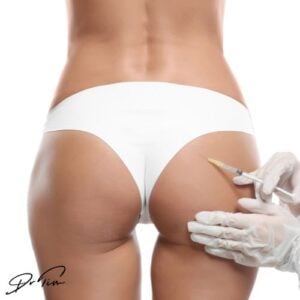 Gluteal augmentation has experienced significant global growth over the past decade, becoming one of the most requested aesthetic procedures worldwide. In parallel with this expansion, the use of non-regulated injectable substances marketed as hyaluronic acid or other soft tissue fillers has increased substantially, particularly in regions with limited regulatory oversight and high demand for low-cost body enhancement procedures.
In Latin America, the accessibility of informal aesthetic markets, combined with strong social pressure surrounding body image and the popularity of curvilinear body proportions, has contributed to the widespread use of non-regulated fillers for gluteal augmentation. Many of these substances are promoted through social media platforms and informal providers, frequently without transparency regarding composition, sterility, traceability, or manufacturing standards.
Severe complications associated with polymers, biopolymers, silicone oils, and unknown injectable materials have been widely documented in the literature, including chronic inflammation, granuloma formation, migration, fibrosis, infection, tissue necrosis, and systemic immune reactions. Despite these known risks, the use of such substances continues to persist.
One possible explanation for this persistence is the existence of patients who remain apparently complication-free following injection. In some cases, individuals injected with non-regulated or unknown substances may remain asymptomatic for prolonged periods, creating a false perception that these products are safe or clinically acceptable. Visible short-term aesthetic success may therefore unintentionally normalize unsafe practices and reinforce public demand.
Importantly, the absence of immediate complications should not be interpreted as evidence of long-term safety. Variability in injected material composition, injection technique, product purity, host immune response, and filler volume may influence clinical outcomes and partially explain why some patients appear stable despite exposure to potentially unsafe substances. Additionally, delayed inflammatory and migratory complications may occur years after the initial procedure, making long-term risk assessment particularly challenging.
Another important concern involves products falsely marketed as regulated hyaluronic acid fillers despite lacking appropriate manufacturing transparency or regulatory approval. Clinicians may encounter situations in which product behavior, inflammatory response, tissue characteristics, or packaging inconsistencies raise suspicion regarding the authenticity or safety of injected materials. However, identifying these products clinically remains difficult in the absence of laboratory analysis or product traceability.
Beyond the clinical implications, the continued use of non-regulated fillers also represents a broader public health and ethical challenge involving accessibility, informal manufacturing, economic pressure, social media influence, and survivorship bias generated by apparently successful outcomes.
Therefore, the aim of this study is to analyze why non-regulated fillers continue to persist in gluteal augmentation despite known risks, with particular focus on the illusion of safety created by asymptomatic patients, delayed complications, informal product accessibility, and clinical red flags suggestive of suspicious or falsely labeled injectable substances.
This study was developed as a narrative clinical and public health analysis focused on the persistence of non-regulated fillers in gluteal augmentation despite well-documented medical risks. The analysis integrates current literature, clinical observations, and practice-based considerations related to suspicious injectable products, asymptomatic patient presentations, delayed complications, and informal aesthetic practices.
A targeted review of the literature was conducted addressing complications associated with polymers, biopolymers, silicone oils, and non-regulated injectable substances used for body contouring and gluteal augmentation. Additional focus was placed on delayed inflammatory reactions, filler migration, foreign body responses, product traceability, and public health concerns associated with informal aesthetic markets.
Relevant literature regarding social media influence, body image pressure, survivorship bias, and patient perception of safety in cosmetic procedures was also reviewed to better understand the social factors contributing to the persistence of these practices.
Clinical observations derived from aesthetic practice and reported patient presentations were analyzed to identify recurring patterns associated with suspicious filler products and apparently complication-free outcomes.
Particular attention was given to:
A conceptual analysis was conducted regarding the role of apparently asymptomatic patients in reinforcing the continued use of non-regulated fillers. The study explored how visible short-term aesthetic success, absence of immediate complications, and social media exposure may contribute to normalization and survivorship bias surrounding unsafe injectable practices.
The analysis identified a series of proposed clinical, procedural, and product-related warning signs suggestive of suspicious or non-regulated filler substances.
These red flags were categorized into:
The purpose of these findings was not to establish definitive product identification, but to support clinical suspicion and improve physician awareness during patient evaluation.
This study does not aim to definitively diagnose product composition or establish that all patients exposed to non-regulated fillers will develop complications. Instead, the analysis emphasizes the unpredictability of these substances and the limitations of using asymptomatic outcomes as evidence of safety.
Special consideration was given to the ethical implications of informal filler use, including patient vulnerability, misinformation, accessibility of suspicious products, and the responsibilities of aesthetic practitioners in patient education and risk prevention.
The broader public health implications associated with normalization of unsafe aesthetic practices through social media and informal markets were also explored.
This article is intended as a conceptual, clinical, and public health-oriented analysis rather than a laboratory-based or quantitative epidemiological study. Its objective is to provide a broader understanding of the factors contributing to the continued persistence of non-regulated fillers in gluteal augmentation and to improve awareness regarding delayed risk, product suspicion, and patient safety.
The analysis demonstrated that the persistence of non-regulated fillers in gluteal augmentation is influenced by a complex interaction of clinical, social, economic, and psychological factors. Despite increasing awareness of severe complications associated with polymers and unknown injectable substances, these practices continue to expand, particularly in environments characterized by informal accessibility, social media influence, and demand for rapid body enhancement.
One of the most significant findings identified was the role of apparently asymptomatic patients in reinforcing the perception that non-regulated fillers may be safe. Visible short-term aesthetic success, particularly in patients without clinically evident complications, appeared to contribute substantially to normalization of these practices and reduction of perceived risk.
The study identified a recurring phenomenon in which patients injected with unknown or non-regulated substances remained clinically asymptomatic for prolonged periods. These outcomes frequently functioned as social evidence supporting the continued use of suspicious fillers despite the absence of reliable information regarding product composition or long-term biological behavior.
The analysis suggested that some individuals exposed to non-regulated injectable materials may remain without clinically evident complications for extended periods. Several factors may contribute to this variability, including:
However, the absence of visible complications was not found to represent reliable evidence of long-term product safety.
“Long asymptomatic periods should not be interpreted as definitive evidence of biological safety.”
The findings reinforced that complications associated with suspicious injectable substances may occur months or years after the initial procedure.
Reported delayed findings included:
These delayed manifestations complicate risk perception, as patients may incorrectly assume that absence of early complications guarantees procedural safety.
The analysis identified multiple indicators capable of raising clinical suspicion regarding falsely labeled or unsafe injectable products.
| Indicator | Clinical Concern |
| Absence of traceability | Unknown product origin |
| Missing batch or lot number | Lack of manufacturing accountability |
| Poor-quality packaging | Possible counterfeit product |
| Lack of regulatory approval | Unknown safety profile |
| Extremely low product cost | Informal or unsafe sourcing |
| Unclear manufacturer information | Reduced product transparency |
| Indicator | Clinical Concern |
| Irregular product viscosity | Non-standardized composition |
| Excessive resistance during injection | Suspicious filler consistency |
| Non-homogeneous gel texture | Product instability |
| Excessive immediate edema | Abnormal inflammatory response |
| Severe disproportionate pain | Possible tissue incompatibility |
| Indicator | Clinical Concern |
| Filler migration | Tissue instability |
| Chronic nodularity | Foreign body response |
| Progressive fibrosis | Chronic inflammation |
| Recurrent swelling | Delayed inflammatory activation |
| Persistent tissue hardness | Non-HA behavior |
| Delayed asymmetry | Product displacement |
The study also identified several contextual factors associated with persistence of non-regulated filler practices:
These factors appeared to contribute significantly to normalization of unsafe practices.
“Apparently successful outcomes may unintentionally reinforce survivorship bias and contribute to the continued normalization of unsafe injectable practices.”
“In many cases, perceived safety is driven more by absence of immediate complications than by scientific evidence.”
“The persistence of non-regulated fillers reflects not only a medical issue, but also a social and public health phenomenon.”
The findings of this analysis suggest that the continued persistence of non-regulated fillers in gluteal augmentation cannot be explained solely by lack of medical awareness. Instead, the phenomenon appears to result from the interaction of accessibility, economic factors, social media influence, body image pressure, informal manufacturing, and the visible presence of apparently complication-free patients.
One of the most important observations identified in this study is the role of the “illusion of safety” created by asymptomatic or apparently successful outcomes. In aesthetic medicine, visible results strongly influence public perception. Patients who undergo gluteal augmentation with suspicious substances and remain clinically stable for prolonged periods may unintentionally function as social proof that these products are safe or acceptable. This effect may significantly reduce perceived risk despite the absence of reliable long-term safety evidence.
The concept of survivorship bias is particularly relevant in this context. Public attention is often disproportionately directed toward visibly successful outcomes rather than toward delayed complications or undocumented adverse reactions. Consequently, patients may underestimate the unpredictability of non-regulated substances, especially when exposed to repeated online testimonials or social media content portraying favorable short-term results.
Importantly, the absence of clinically evident complications does not necessarily indicate biological safety. Variability in product composition, injection technique, immune response, and filler volume may partially explain why some individuals remain asymptomatic while others develop severe inflammatory or migratory complications. Additionally, certain pathological processes may remain subclinical for extended periods before becoming clinically detectable.
The findings also reinforce concerns regarding delayed complications associated with polymers and unknown injectable materials. Unlike regulated hyaluronic acid fillers, many non-regulated substances lack transparency regarding composition, biodegradability, sterility, and tissue behavior. As a result, long-term biological response remains highly unpredictable. Delayed granulomatous inflammation, fibrosis, migration, chronic pain, and recurrent inflammatory episodes may emerge years after injection, complicating both diagnosis and management.
Another important issue highlighted by this study is the increasing difficulty clinicians face in distinguishing authentic regulated fillers from suspicious or falsely labeled products. Informal markets may distribute injectable substances promoted as hyaluronic acid despite lacking manufacturing accountability or regulatory oversight. In these situations, product-related and clinical red flags become critically important for raising suspicion and guiding patient counseling.
From a public health perspective, the normalization of unsafe gluteal augmentation practices represents a growing concern, particularly in regions where aesthetic procedures are highly accessible through informal channels. Economic vulnerability, pressure to achieve socially desirable body standards, and rapid digital dissemination of aesthetic trends may contribute to continued demand despite known risks.
Social media appears to play a dual role within this phenomenon. While digital platforms may increase awareness regarding complications, they may simultaneously amplify unrealistic body expectations and promote apparently successful outcomes without transparency regarding product origin, medical supervision, or long-term consequences. The visibility of “successful” patients may therefore overshadow the medical complexity and unpredictability associated with non-regulated fillers.
Ethically, these findings emphasize the responsibility of aesthetic practitioners to educate patients regarding the limitations of short-term visual outcomes as indicators of safety. Physicians should avoid reinforcing the misconception that absence of immediate complications guarantees long-term biological compatibility. Instead, patient counseling should emphasize uncertainty, delayed risk, and the lack of scientific validation associated with suspicious injectable products.
Several limitations should be acknowledged. This study represents a narrative and conceptual analysis rather than a controlled epidemiological or laboratory-based investigation. Product composition was not chemically verified, and the observations described are based on clinical patterns and literature review rather than prospective clinical trials. Future research evaluating long-term outcomes, inflammatory mechanisms, and composition analysis of suspicious filler products would provide valuable additional insight.
Despite these limitations, this study contributes a broader understanding of why non-regulated fillers continue to persist despite increasing awareness of associated complications. By introducing the concept of the “illusion of safety,” the findings highlight how apparently successful outcomes may unintentionally perpetuate unsafe aesthetic practices and complicate prevention efforts in modern aesthetic medicine.
“The illusion of safety surrounding non-regulated fillers may represent one of the greatest barriers to prevention.”
The persistence of non-regulated fillers in gluteal augmentation reflects a multifactorial clinical and public health challenge extending beyond the presence of known medical complications. While severe adverse outcomes associated with polymers and unknown injectable substances are increasingly recognized, the continued visibility of apparently complication-free patients may create a powerful illusion of safety that contributes to normalization of these practices.
This study suggests that the absence of immediate or clinically evident complications should not be interpreted as proof of long-term product safety. Variability in product composition, host immune response, injection technique, and inflammatory latency may allow certain individuals to remain asymptomatic for prolonged periods despite exposure to potentially unsafe substances. However, delayed biological reactions remain unpredictable, particularly when product traceability and composition are unknown.
The findings also emphasize the importance of recognizing clinical and product-related red flags suggestive of suspicious or falsely labeled fillers. Increased physician awareness regarding packaging inconsistencies, abnormal product behavior, delayed inflammatory findings, and informal distribution practices may improve patient counseling and early clinical suspicion.
Beyond the clinical implications, the normalization of unsafe injectable practices through social media exposure, informal testimonials, economic accessibility, and survivorship bias represents a growing ethical and public health concern. Educational efforts should therefore focus not only on complications themselves, but also on the misleading perception of safety generated by apparently successful outcomes.
As aesthetic medicine continues to expand globally, preserving patient safety requires greater emphasis on transparency, regulation, traceability, and long-term biological understanding of injectable materials. Future studies evaluating delayed outcomes, inflammatory mechanisms, and product composition analysis are necessary to better understand the true long-term impact of non-regulated fillers in gluteal augmentation.
“In aesthetic medicine, the most dangerous complications may not be the ones immediately visible, but the false sense of safety created by those that are not.”
This article was written by a guest contributor from our community. The views and clinical opinions expressed here belong to the author and do not necessarily reflect the opinions or endorsements of Dr Tim Ltd.
Dr Tim Pearce MBChB BSc (Hons) MRCGP founded his eLearning concept in 2016 in order to provide readily accessible BOTOX® and dermal filler online courses for fellow Medical Aesthetics practitioners. His objective was to raise standards within the industry – a principle which remains just as relevant today.
Our exclusive video-led courses are designed to build confidence, knowledge and technique at every stage, working from foundation level to advanced treatments and management of complications.
Thousands of delegates have benefited from the courses and we’re highly rated on Trustpilot. For more information or to discuss which course is right for you, please get in touch with our friendly team.