Note:
This article was written by a guest contributor from our community. The views and clinical opinions expressed here belong to the author and do not necessarily reflect the opinions or endorsements of Dr Tim Ltd.
 Dr Tim Pearce
 Dr Bev Darwin BDS
Beverly Darwin began her career in aesthetics in 2005 as the founder of BeauMedix Clinic UK. Over the years, she has trained extensively across nearly every aspect of aesthetic medicine, gaining comprehensive expertise in both clinical techniques and patient care.
Through experience and results-driven practice, she has refined her focus to the treatments that deliver the most consistent outcomes and that she finds most rewarding to perform. Her approach blends technical skill with a deep understanding of skin health and rejuvenation, reflecting nearly two decades of dedication to the art and science of aesthetics.
https://www.instagram.com/bev_darwin/
An antioxidant is a substance that prevents or slows oxidative damage in cells by neutralising free radicals or other reactive oxygen species, thereby protecting biological molecules such as DNA, proteins, and lipids from oxidation. In aesthetic medicine, it is important to understand which antioxidants are specifically beneficial for skin health.
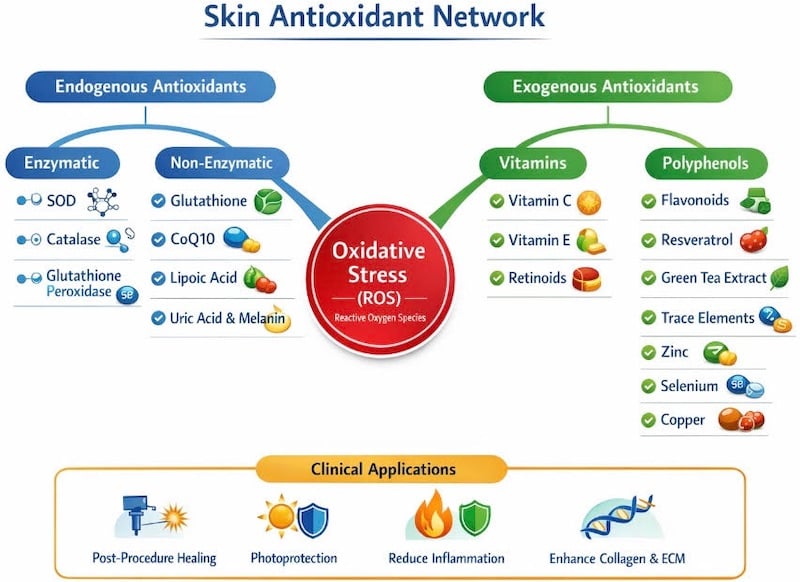
Antioxidants relevant to the skin can be broadly divided into:
Endogenous antioxidants: produced naturally by the human body.
Exogenous antioxidants: obtained from external sources.
The exogenous group is considerably larger. These two groups will now be explored in more detail. In this article I will include some quick reference tables for practitioners to extract to keep in their clinics, if they wish, as this is such a large topic.
Endogenous antioxidants form the skin’s first line of defence against oxidative stress and are essential for maintaining cellular integrity, barrier function, and normal repair processes. These antioxidant systems operate continuously within the skin and work synergistically to neutralise reactive oxygen species generated by intrinsic metabolism and environmental exposure.
The skin possesses multiple endogenous antioxidant systems, including enzymatic and non-enzymatic pathways, which play a critical role in protecting keratinocytes, fibroblasts, melanocytes, and extracellular matrix components from oxidative damage.
1. Enzymatic Endogenous Antioxidants…
These have a high relevance for ageing, inflammation, and post procedure recovery
Superoxide dismutase (SOD)
Catalase
Glutathione peroxidase
CLINICAL RELEVANCE: These decline with age, are reduced by UV exposure and pollution and as they are important for post inflammatory and wound healing processes , it’s important to note that older patients receiving skin treatments may have delayed healing and post recovery because of their decline.
2. Non-Enzymatic Endogenous Antioxidants..
these act as direct free radical scavengers and also support enzymatic systems
Glutathione
Uric acid
Coenzyme Q10 (ubiquinone)
Lipoic acid
Melanin (often overlooked but very relevant in skin)
While endogenous antioxidant systems provide continuous intrinsic protection, they are insufficient to counteract the cumulative oxidative burden imposed by ultraviolet radiation, pollution, lifestyle factors, and aesthetic procedures. Exogenous antioxidants therefore play a crucial complementary role in maintaining skin redox balance.( REDOX discussed later)
Now let’s take a look at the exogenous group of anti-oxidants which are more relative to our clinical work.
Exogenous antioxidants are derived from dietary intake, supplementation, and topical application. This group is considerably larger and more diverse than endogenous antioxidants and includes many compounds with established relevance in aesthetic medicine.
Vitamins
Vitamin C (ascorbic acid)
Vitamin E (tocopherols)
Vitamin A derivatives (retinoids, carotenoids)
Polyphenols
Flavonoids
Resveratrol
Green tea catechins
Carotenoids
β-carotene
Lycopene
Lutein
Trace Elements (Cofactors)
Zinc
Selenium
Copper
What is REDOX?
Reduction = gain of electrons
Oxidation = loss of electrons
Why REDOX matters to skin..
Cell energy production.. mitochondria rely on redox reactions
Antioxidants work by donating electrons to neutralise free radicals
Inflammation and ageing are strongly influenced by redox balance
Wound healing and skin repair depend on controlled redox signalling
What is OXIDATIVE STRESS?
Oxidative stress occurs when there is an imbalance between oxidants and antioxidants in favour of oxidants.
Oxidants = reactive oxygen species (ROS) / free radicals
Antioxidants = molecules that neutralise ROS by donating electrons
This is fundamentally a REDOX imbalance 👍
Free radicals are electron-deficient molecules that:
Steal electrons from healthy cells
Trigger chain reactions of oxidation
Damage:
Cell membranes (lipid peroxidation)
Proteins (enzyme dysfunction)
DNA (accelerated ageing, impaired repair)
In SKIN, this translates to:
Fine lines & wrinkles
Loss of elasticity
Pigmentation irregularities
Impaired barrier function
Chronic inflammation
UV radiation ( ❗ primary extrinsic ageing factor ❗ )
Pollution & cigarette smoke
Inflammation (acne, rosacea, dermatitis)
Poor sleep & psychological stress
Aggressive aesthetic treatments without adequate antioxidant support
Antioxidants donate electrons without becoming unstable themselves, effectively terminating free-radical chain reactions and reducing OXIDATIVE STRESS.
Important skin antioxidants:
Vitamin C (ascorbic acid) – collagen synthesis, brightening, UV protection
Vitamin E (tocopherol) – lipid membrane protection
Glutathione – intracellular master antioxidant
Niacinamide – supports redox balance and barrier repair
Polyphenols (green tea, resveratol)
NB. Antioxidants often work synergistically (eg Vitamin C regenerates Vitamin E)
Not all oxidation is bad! Controlled redox reactions are essential for:
Cell signalling
Wound healing
Immune defence
Collagen remodelling post-procedure
⚠ Problems arise when oxidation is excessive or chronic, overwhelming antioxidant capacity.
❗ This is why:
Over-treating skin
Excessive peels/lasers without recovery
Poor post-procedure antioxidant care
…can actually accelerate ageing, not reverse it ❗
Understanding REDOX helps explain:
Why antioxidant priming improves procedure outcomes
Why post-treatment skincare is critical
Why chronic inflammation leads to premature ageing
Why combined internal +topical antioxidant strategy is more effective than either modality in isolation.
Modern aesthetic medicine aims to restore redox balance, not eliminate oxidation entirely ❗ REDOX balance strongly influences whether skin repairs, regenerates, or prematurely ages. ❗
| Antioxidant | Function | Clinical Relevance |
| Superoxide dismutase (SOD) | Converts superoxide radicals into hydrogen peroxide | Declines with age and UV exposure; supports post-procedure healing |
| Catalase | Breaks down hydrogen peroxide into water and oxygen | Protective against photodamage and oxidative inflammation |
| Glutathione peroxidase | Reduces peroxides, supports cellular redox balance | Dependent on selenium; reduced levels in chronic inflammation or systemic illness |
| Antioxidant | Function | Clinical Relevance |
| Glutathione | Direct free radical scavenger and cofactor for enzymes | Depleted by UV, pollution, and ageing; topical or systemic support may assist recovery |
| Coenzyme Q10 (ubiquinone) | Mitochondrial antioxidant, reduces lipid peroxidation | Topical Q10 may enhance energy metabolism in dermal fibroblasts |
| Lipoic acid | Scavenges ROS, regenerates vitamins C and E | Useful in oxidative stress from laser or chemical peels |
| Uric acid & melanin | Neutralise radicals; melanin also filters UV | Important for photoprotection; melanin declines in certain conditions or post-procedure |
| Vitamin | Function | Clinical Relevance |
| Vitamin C | Collagen synthesis, ROS scavenging | Topical use brightens skin, supports healing, enhances photoprotection |
| Vitamin E (tocopherols) | Lipid membrane protection | Synergistic with Vitamin C; protects against UV-induced oxidative stress |
| Vitamin A derivatives (retinoids, carotenoids) | Regulate epidermal differentiation, neutralise ROS | Improve fine lines, pigmentation, and photodamage; often used in combination with aesthetic procedures |
| Carotenoid | Function | Clinical Relevance |
| β-carotene | Precursor of vitamin A, neutralises singlet oxygen | Oral supplementation may enhance photoprotection |
| Lycopene | Strong ROS scavenger | Particularly effective against UV-induced oxidative damage |
| Lutein | Filters high-energy light, antioxidant | May protect dermal fibroblasts and reduce oxidative stress |
Vitamin C
🟢 T – strong evidence (photoprotection, collagen, antioxidant)
🔴 O – supports systemic antioxidant network & glutathione recycling
➡ T + O
Vitamin E (α-tocopherol)
🟢 T – synergistic with Vit C, lipid membrane protection
🔴 O – systemic antioxidant, supports skin barrier
➡ T + O
Vitamin A (retinoids / carotenoids)
🟢 T – gold standard for skin ageing (retinoic acid, retinal)
🔴 O – via carotenoids (not retinoic acid directly)
➡ T + O (different biological roles)
Flavonoids (polyphenols)
🟢 T – limited but supportive (surface antioxidant/anti-inflammatory)
🔴 O – primary effective route
➡ O (primary) + T (adjunct)
Resveratrol
🟢 T – antioxidant, anti-inflammatory (stability dependent)
🔴 O – poor bioavailability but systemic signalling effects
➡ T + O (modest evidence)
Green tea catechins (EGCG)
🟢 T – good evidence (UV protection, anti-inflammatory)
🔴 O – strong systemic antioxidant & anti-inflammatory effects
➡ T + O
β-Carotene
🟢 T – minimal benefit
🔴 O – primary effective route (photoprotection over time)
➡ O only
Lycopene
🟢 T – negligible penetration
🔴 O – strong evidence for systemic & skin photoprotection
➡ O only
Lutein
🟢 T – emerging but limited evidence
🔴 O – primary route (skin & eye antioxidant)
➡ O (primary) ± T (adjunct)
Zinc
🟢 T – anti-inflammatory, barrier support
🔴 O – enzyme function, immune & antioxidant roles
➡ T + O
Selenium
🟢 T – no meaningful evidence
🔴 O – essential for glutathione peroxidase
➡ O only
Copper
🟢 T – minimal relevance
🔴 O – essential trace element (SOD, collagen cross-linking)
➡ O Only
“Topical antioxidants primarily protect against environmental oxidative stress, whereas oral antioxidants support intracellular endogenous antioxidant systems.”
Clinical Application in Aesthetic Practice
Antioxidants support healing after procedures (lasers, microneedling, chemical peels).
They reduce photodamage and minimise inflammation, improving treatment outcomes.
Combination therapy (endogenous support + exogenous supplementation/topicals) is often most effective.
Choosing evidence-based antioxidants can enhance long-term skin health and appearance.
Glutathione (GSH) is the body’s master intracellular antioxidant
Naturally produced in the liver
Crucial for:
Redox balance
Detoxification
Melanin regulation (via tyrosinase inhibition & eumelanin shift)
Skin cells do use glutathione, but delivery is the challenge. As Glutathione is a large topic on its own I have set out a table below for aestheticians to refer to below showing modes of delivery and their relevance …
(This will be of particular interest to those practitioners delivering Glutathione by IV/IM)
| Route | Bioavailability | Skin Relevance | Professional Verdict |
| IV | High systemic | Indirect | Adjunct only |
| IM | Moderate systemic | Indirect | Limited benefit |
| Oral (standard) | Poor | Minimal | Not effective |
| Oral (liposomal / S-acetyl) | Moderate | Mild support | Long-term adjunct |
| Topical | Very poor | Minimal | Not recommended |
| Microneedling | Unclear | Experimental | Caution |
| Mesotherapy | Local | Short-term glow | Adjunct only |
| Precursors (NAC etc.) | High endogenous | Best overall | Preferred |
Glutathione is:
Biologically important
Clinically useful systemically (not topically)
Over-marketed for skin
✴ For skin improvement, it works best when:
✔ Endogenous production is supported & boosted with NAC, Glycine, Vitamin C, Selenium (oral delivery)
✔ Used alongside vitamins C, A and E plus Ferulic acid (topicals) + SPF
✔ Not sold as a miracle whitening agent
The topicals do not increase intracellular glutathione, but they do protect the skin from depletion and support the same anti-oxidant network. So together, these reduce oxidative load, allowing endogenous glutathione to be preserved rather than consumed.
“The efficacy of topical antioxidants such as vitamin C, vitamin E, ferulic acid, niacinamide and copper peptides is supported by extensive in-vitro, in-vivo and clinical research.”
Masaki H. Role of antioxidants in the skin: anti-aging effects. Journal of Dermatological Science. 2010;58(2):85–90
Thiele JJ, Hsieh SN, Ekanayake-Mudiyanselage S. Vitamin E in human skin: organ-specific physiology and considerations for its use in dermatology. Molecular Aspects of Medicine. 2005;26(5–6):397–412.
Rinnerthaler M, et al. Oxidative stress in aging human skin. Biomolecules. 2015;5(2):545_589
This article was written by a guest contributor from our community. The views and clinical opinions expressed here belong to the author and do not necessarily reflect the opinions or endorsements of Dr Tim Ltd.
Dr Tim Pearce MBChB BSc (Hons) MRCGP founded his eLearning concept in 2016 in order to provide readily accessible BOTOX® and dermal filler online courses for fellow Medical Aesthetics practitioners. His objective was to raise standards within the industry – a principle which remains just as relevant today.
Our exclusive video-led courses are designed to build confidence, knowledge and technique at every stage, working from foundation level to advanced treatments and management of complications.
Thousands of delegates have benefited from the courses and we’re highly rated on Trustpilot. For more information or to discuss which course is right for you, please get in touch with our friendly team.