


• Mail us: support@drtimpearce.com
  • Trustpilot
Dr Tim Pearce, eLearningDr Tim Pearce, eLearningDr Tim Pearce, eLearning Dr Tim Pearce, eLearning
  • eLearning Courses
        • ELEARNING COURSES

        • Techniques
          • BOTOX® Foundation Course
          • Pro Tox
          • Dermal Fillers Foundation Course
          • 8D Lip Design
          • Julie Horne Directs, Dr Tim Injects – February 2023
          • Eyelash Enhancement Serum Course
          • Anatomy360
          • Art Codes
        • Complications
          • Botulinum Toxin Complications Mastery
          • Dermal Filler Complications Mastery
          • Elective Lip Reversal
        • Profinity
        • Wellness
          • How To Introduce Longevity To Your Aesthetics Clinic
        • Marketing
          • DCAM 2.0
          • Canva Mastery: A Step-by-Step Guide
          • Email Marketing Course
          • Industry Photography Secrets
          • How to find your voice with video
        • Other Services
          • DPP for V300 Service
        • Packages
          • Foundation eLearning Package – SAVE 10%
          • Complications eLearning Package – SAVE 10%
          • Techniques eLearning Package – SAVE 20%
          • Marketing eLearning Package – SAVE 20%
          • Full eLearning Package – SAVE 35%
        • Reviews and Testimonials
        • FAQ – Online Courses
  • Downloads
        • Complications
          • 13 Extra Risky Injection Areas: Facial Vessel Map
          • Aspirating Experiment Test Results
          • Bruising Checklist: Prevent & Minimise Bruises from Injectables
          • Dermal Filler Complications: The Essential Guide
          • Delayed Onset Nodules: How To Diagnose And Treat
          • Diagnosing Complications: 7 Steps To Great Advice
          • Emergency Reversal Protocol
          • How To Avoid Causing a Lateral Rectus Palsy From Botulinum Toxins
          • Hyalase Consent Form: Downloadable Template
          • Lumps in Lips Guide: How to Diagnose, Manage & Treat
          • Tear Trough Oedema Protocol
          • Does Covid-19 Vaccine Cause Dermal Filler Reactions?
        • Injection Techniques
          • 26 Essential Injection Patterns For Botulinum Toxin
          • Botox Calculator
          • BOTOX Lesson – Gummy Smile
          • BOTOX Lesson – Hooded Eyes
          • Frequently Used Filler Volumes Facial Map
          • How To Improve Your Needle Control: 6-Step Blueprint
          • How to Prepare BOTOX – Step by Step Guide
        • Consultation Skills
          • Body Dysmorphia & Modification Checklist
          • Is It Safe To Treat? 5-Step Contraindication Check List
          • Medical Model For Cosmetic Procedures: An Essential Guide
        • Lips
          • Lip Consultation Question Checklist
          • Lip Anatomy Lesson
          • Common Needle/Cannula Choices For Lips
          • Lip Filler Aftercare Pack for Your Patients
          • Lip Design Blueprint – 4 Steps To Perfect Lip Augmentation
          • Master the Basics of Julie Horne’s Lip Technique
        • Longevity
          • Does HRT Increase Cancer Risk? Guide for Clinicians
          • Educating Patients About How Sugar Exacerbates Aging
          • How to Reduce Biological Age for Your Patients
        • Business & Marketing
          • Annual Profit Calculator
          • 5 Steps to Create a Successful Aesthetics Business
          • Injector’s Cheat Sheet – 7 Social Media Post Types
          • 7 Deadly Hashtag Sins
          • 7 Secret Locations to get Instagram Followers
          • 9 Video Marketing Mistakes
          • 15 Easy Instagram Reels Ideas
          • 3 Time-Saving Hacks for Social Media
          • Personal Branding Starter Kit
          • Value Audit Template: Price-per-1ml
          • World’s Top 5 Filler Brands – Survey Results
  • Products
    • Artistic Anatomy Poster Collection
    • Top 3 Posters Bundle
    • Original Anatomy Poster
    • Beautiful Lip Anatomy Poster
    • Download Pack – Forms & Leaflets
  • Blog
    • Meet the Writers
  • About
    • Dr Tim Pearce
    • Miranda Pearce
    • Careers & Recruitment
    • Webinars
    • Become a Model
  • Contact
  • Login

Login

Multiple Causes of Vascular Occlusion and Necrosis

Blogs

  • ALL
  • Complications
  • Injection Techniques
  • Consultation Skills
  • Lips
  • Business & Marketing
You may be interested
How to reduce the risk of vascular occlusion when injecting the philtrum

How to reduce the risk of vascular occlusion when injecting the philtrum

March 26, 2026

Inflamaging: Where Biology Meets Visible Aging

Inflamaging: Where Biology Meets Visible Aging

March 31, 2026

Bright Light, Better Mood: The Role of Light Therapy in Perinatal and Nonseasonal Depression

Bright Light, Better Mood: The Role of Light Therapy in Perinatal and Nonseasonal Depression

March 19, 2026

Longevity vs. Quick Fixes: Why We Must Stop Selling ‘Units’ and Start Selling ‘Anti-Aging Solutions’

Longevity vs. Quick Fixes: Why We Must Stop Selling ‘Units’ and Start Selling ‘Anti-Aging Solutions’

March 24, 2026

Facial Muscle Anatomy for Botulinum Toxin

Facial Muscle Anatomy for Botulinum Toxin

March 12, 2026

Multiple Causes of Vascular Occlusion and NecrosisDr Tim Pearce
September 23, 2025

Beyond the Obvious: Understanding the Multiple Causes of Vascular Occlusion and Necrosis

Every injector needs to understand what causes vascular occlusion and how to avoid necrosis, but it’s much more nuanced than you might think. While many clinicians believe that putting filler into an artery instantly blocks it and stops blood flow causing a necrotic injury, the reality is far more complex. In fact, there are multiple theories about what can cause vascular compromise – and some of them may surprise you.

The Problem with Traditional Thinking

You might think, like many clinicians, that if you put filler into an artery, you will instantly block it and stop blood flow, causing a necrotic injury. But there’s a problem with this theory. Many surgeons, including Dr. Subbio, have explained that in surgery they often remove whole sections of arteries or tie them off and never untie them – and it doesn’t cause a necrotic injury.

This raises an important question: if complete arterial blockage doesn’t always cause necrosis in surgery, what else is happening when we see tissue death after filler injections?

The answer lies in understanding that necrosis isn’t just about complete blockage of main vessels. Many cases of necrosis where you actually get tissue breakdown have only a delayed capillary refill, not a completely absent capillary refill. This creates a rather confusing situation about what is actually causing the issue.

The reality is probably quite a gray area – significant compromise in blood flow through partial blockage of the main vessel and blockage of some of the smaller vessels, but not complete blockage, can still lead to necrosis. And there are several other mechanisms at play that we need to understand.

Mechanism 1: Pressure on the Capillaries

We know from general medicine that pressure sores occur simply when you put mechanical pressure on the outside of a group of capillaries or vessels. You get these on pressure points around the body – if you leave a patient in bed without moving for long enough, their skin will necrose.

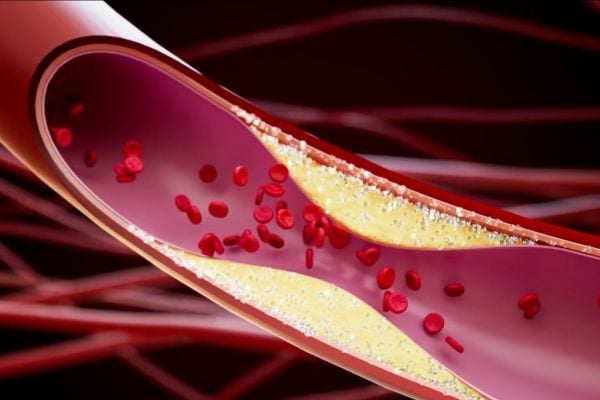
Medical illustration showing blood vessel compression by dermal filler causing external pressure and vasoconstriction
3D illustration demonstrating how dermal filler (yellow) can compress blood vessels externally, leading to vasoconstriction and potential vascular compromise

The same thing happens in certain areas of the face, particularly in the midline for some reason. The chin, nose, and glabella all have a particular propensity to necrose in a different way.

What This Looks Like Clinically

When you see a patient with pressure-induced necrosis, it appears as an area of necrosis that tends to be round and is associated with high-pressure tissues.

  • In the chin: The dermis can feel quite thick in some patients. A circular lesion around the surface of the chin underneath a pressure point is sometimes caused by high volume, high pressure, high G Prime dermal filler products.
  • In the glabella: You might see patients treating lines in the glabella who get a distinct black line that doesn’t track the supratrochlear artery. It’s just over the section they injected, resulting in superficial necrosis. This fits with pressure from the filler on the capillaries rather than the artery itself – otherwise, you’d expect more of the area to be affected.
  • The nose tip – the best example: The tip of the nose has no major arteries in it – it’s essentially a capillary bed. With the Tinkerbell nose tip lift, there are a large number of patients who either have a red nose that persists for several weeks, sometimes with pain. A small subsection of those patients will actually get some mild tissue breakdown – pustules forming, some peeling of the skin.

This tends to be less severe but can become quite severe if the pressure is high enough and left for long enough that none of the dermis gets any blood supply. These cases are unlikely to be caused by intravascular injection – they’re more likely the result of high G Prime products pushing on capillaries.

Mechanism 2: External Compression of Arteries

The next situation is where filler compresses around the outside of the artery. There are some interesting insights from general medicine where occasionally compression of a vessel causes vasoconstriction. When vessels are traumatized either with filler around them on the outside or filler partially inside them, you may trigger an inflammatory process and vascular constriction or spasm that could potentially cause necrosis.

What’s really happening here is the vessel is tightening up due to either mechanical pressure of the filler or a combination of mechanical pressure plus vasoconstriction.

A Revealing Case Study

One particularly memorable case involved a patient who had modeling across an entire face – the whole face looked like it had blood flow restriction after just two nasolabial fold filler injections. On ultrasound, the filler was sitting underneath a vessel, and there was a vessel pumping. The only explanation was that there had been vasoconstriction caused by trauma to the vessel.

Coincidentally – or maybe not coincidentally – the patient also had Raynaud’s syndrome, a phenomenon well known to cause vasoconstriction in the digits. Treatment with Nifedipine led to full recovery.

This case demonstrated that vasoconstriction can clearly cause significant vascular compromise clinically. While the body would likely have eventually kicked in and caused some vasodilation, the combination of vasoconstriction with mechanical pressure could potentially cause necrosis.

Mechanism 3: Venous Occlusion – The Rare but Real Risk

Thankfully, most of our face is a network, which means if you block a particular vein in one area, there are many other ways blood can drain from the area. But you can imagine if drainage is significantly impaired, there wouldn’t be enough of an exit route for new blood to come in, and you could cause some form of necrotic injury from decreased outflow.

The Eye: A Special Case

The easiest place to understand this would probably be in the eye, which is more of a closed system, though it’s quite hard to hit those veins.

A very interesting case from Dr. Patrick Treacy involved a patient injected with Volbella in the nose. This was linked with a venous sinus thrombosis that occurred a few days later, causing blindness. Venous sinus thrombosis is a known cause of blindness in medicine generally, but could it be triggered by a low molecular weight dermal filler that causes blood clotting? This is yet another way that patients may suffer from a type of vascular occlusion – purely about the venous system being affected by intravascular injection.

In other parts of the face, patients might get:

  • A kind of bogginess
  • Swelling
  • Ruddiness (due to decreased oxygen blood flow)

But actual necrosis is less likely with venous occlusion because there are multiple ways out. The eyes, or if the occlusion is large enough, are a different story.

Understanding the Venous Anatomy Risk

Looking at the anatomy helps understand how venous occlusion could potentially affect drainage and cause blindness. The veins that run within the orbit connect quite closely to where the nose is. If you injected enough filler into these veins, an occlusion or blood clot in the basal plexus could potentially cause decreased venous drainage from both eyes.

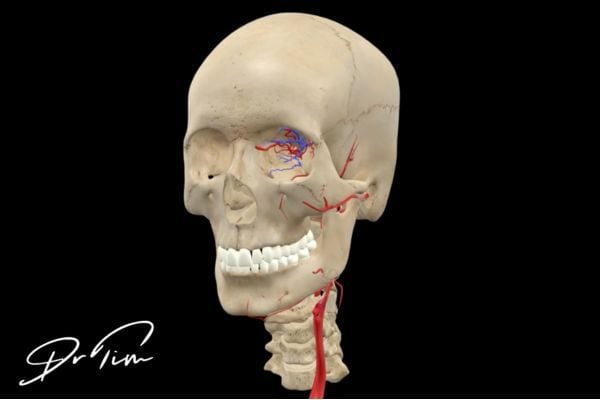
Lateral skull view displaying supraorbital artery pathway and frontal vascular anatomy
The supraorbital artery shares ophthalmic connections – deep bone injections here carry brain and eye complication risks.

This would be the worst-case scenario: the inability for blood to leave the eye means new fresh blood cannot enter either, and the vessels that supply the retina cannot replenish blood flow to the eye.

A blockage or clot in the basal plexus causes:

  1. Decreased drainage from the eye
  2. Inability for fresh blood to enter
  3. Loss of blood supply to the retina
  4. Resulting in blindness

This could be caused by either a low viscosity or high viscosity product injected in the nose, passing into the basal plexus, causing inflammation, clotting, and potentially even infection.

How to Differentiate: Bruise vs. Impending Necrosis

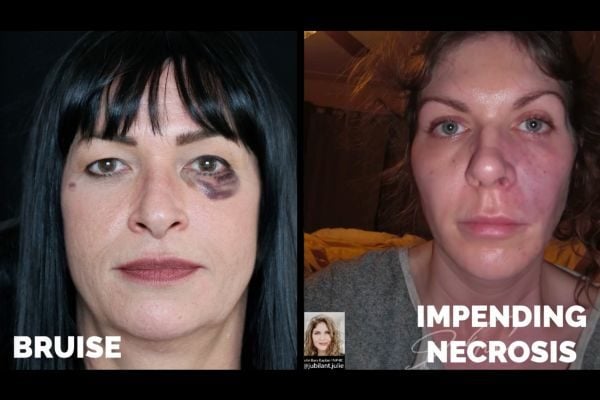
One of the problems clinicians face almost daily is how to tell the difference between a bruise and impending necrosis. Understanding these different mechanisms helps with diagnosis:

Side-by-side clinical photos comparing normal bruising versus impending necrosis after dermal filler injection
Clinical comparison showing normal post-injection bruising (left) versus signs of impending necrosis with mottling and discoloration (right) – critical for early diagnosis and intervention

Pressure Necrosis Signs:

  • Round, localized area of concern
  • In thick dermis areas (chin, nose tip, glabella)
  • Associated with high volumes or firm products
  • May present with persistent redness before progressing

Vascular Compression/Spasm:

  • Broader area of mottling
  • May affect entire regions of the face
  • Patient may have history of vascular conditions (like Raynaud’s)
  • Can respond to vasodilators

Venous Occlusion:

  • Bogginess and swelling
  • Decreased capillary refill but not absent
  • Ruddiness or duskiness to the skin
  • May progress more slowly than arterial occlusion

Prevention Strategies Based on Mechanism

Understanding these different mechanisms allows for targeted prevention:

For Pressure Necrosis:

  • Check tissue compressibility before injecting (especially nose tip and chin)
  • If you squeeze the tissue and there’s minimal space between cartilage/bone and skin, be cautious
  • Use softer products in low volumes
  • Avoid high G Prime products in tight spaces
  • Check product contraindications (many fillers say “contraindicated in the glabella”)

For Vascular Compression:

  • Ask about vascular conditions like Raynaud’s
  • Use gentle injection pressure
  • Avoid overcorrection that could exceed intravascular pressure
  • Consider smaller volumes over multiple sessions

For Venous Occlusion:

  • Be especially careful in the nose area
  • Understand the connection between nasal vessels and the basal plexus
  • Consider using products less likely to cause clotting

Treatment Implications

These different mechanisms also mean different treatment approaches might be needed:

  • Pressure necrosis: May require immediate decompression, massage, and potentially removal of product
  • Vascular spasm: Could benefit from vasodilators like Nifedipine
  • Venous occlusion: May need aggressive anticoagulation in addition to standard treatments

The Bottom Line: It’s More Complex Than We Thought

Many of these mechanisms are theoretical because they’re very hard to prove in real cases about what’s causing the disruption in blood flow. But understanding that vascular compromise isn’t just about “filler in artery = blockage” is crucial for modern aesthetic practice.

The key takeaway is that necrosis can occur through multiple pathways:

  1. Direct arterial occlusion (the traditional understanding)
  2. Pressure on capillary beds
  3. External compression causing vasospasm
  4. Venous occlusion affecting drainage
  5. Combinations of the above

Each mechanism has different risk factors, presentations, and optimal treatments. As aesthetic injectors, we need to think beyond the simple model of arterial blockage and consider all these potential causes when preventing, diagnosing, and treating vascular complications.

Moving Forward with Better Understanding

This more nuanced understanding of vascular occlusion should make us better, safer injectors. By recognizing that different areas of the face have different vulnerabilities – the midline’s susceptibility to pressure necrosis, the potential for vasospasm in susceptible patients, the unique venous drainage risks around the eyes – we can tailor our techniques and product choices accordingly.

Remember: the goal isn’t to make you fearful of complications, but to arm you with knowledge that will help guide decisions that reduce risk. Understanding these multiple mechanisms is what separates practitioners who simply follow protocols from those who truly understand the why behind their clinical decisions.

Anatomy360 - The Ultimate 3D Anatomy Course

Understanding facial anatomy is crucial for precise filler placement and achieving natural, balanced results. Knowledge of anatomical structures and vascular supply not only helps in avoiding complications but also enhances the overall effectiveness of treatments.

Dr Tim Pearce's anatomy course delivers a thorough understanding of facial anatomy through 12 online lessons. Tim says:

“The problem is we’re taught anatomy in 2D textbooks, but real-life anatomy isn’t flat. In order to feel confident with injecting and to get that millimetre by millimetre precision that increases safety, we need more detail. That’s why I’ve created the ultimate Anatomy learning experience specifically for aesthetic injectors. It’s going to help you up-level your anatomy knowledge and boost your injection safety & confidence in a way that no cadaver course could ever.”


Anatomy360 Course
Anatomy360 Course

Dr Tim Pearce eLearning

Dr Tim Pearce MBChB BSc (Hons) MRCGP founded his eLearning concept in 2016 in order to provide readily accessible BOTOX® and dermal filler online courses for fellow Medical Aesthetics practitioners. His objective was to raise standards within the industry – a principle which remains just as relevant today.

Our exclusive video-led courses are designed to build confidence, knowledge and technique at every stage, working from foundation level to advanced treatments and management of complications.

Thousands of delegates have benefited from the courses and we’re highly rated on Trustpilot. For more information or to discuss which course is right for you, please get in touch with our friendly team.

Share This Article
Facebook Twitter Pinterest Linkedin
Prev Post
Next Post

Related Articles

Inflamaging: Where Biology Meets Visible Aging Bestseller

Inflamaging: Where Biology Meets Visible Aging

March 31, 2026

Inflamaging: Where Biology Meets Visible Aging
By Andrea Callaway
March 31, 2026

Inflamaging: Where Biology Meets Visible Aging

READ MORE
How to reduce the risk of vascular occlusion when injecting the philtrum Bestseller

How to reduce the risk of vascular occlusion when injecting the philtrum

March 26, 2026

How to reduce the risk of vascular occlusion when injecting the philtrum
By Andrea Callaway
March 26, 2026

How to reduce the risk of vascular occlusion when injecting the philtrum

READ MORE
Longevity vs. Quick Fixes: Why We Must Stop Selling ‘Units’ and Start Selling ‘Anti-Aging Solutions’ Bestseller

Longevity vs. Quick Fixes: Why We Must Stop Selling ‘Units’ and Start Selling ‘Anti-Aging Solutions’

March 24, 2026

Longevity vs. Quick Fixes: Why We Must Stop Selling ‘Units’ and Start Selling ‘Anti-Aging Solutions’
By Andrea Callaway
March 24, 2026

Longevity vs. Quick Fixes: Why We Must Stop Selling ‘Units’ and Start Selling ‘Anti-Aging Solutions’

READ MORE

Popular Courses

BOTOX® Foundation Course

BOTOX® Foundation Course

Pro Tox

Pro Tox

8D Lip Design

8D Lip Design

SEE MORE
Dr Tim Pearce

Improve your medical
aesthetics business

  • Home
  • Courses
  • About
  • Contact
  • Dr Tim Limited Terms and Conditions of Sale
  • Privacy Policy
  • Website Terms Of Use
  • Careers
Login Dr Tim Pearce Login
© Copyright Dr Tim Ltd, 2025
We use cookies on our website to give you the most relevant experience by remembering your preferences and repeat visits. Read More. By clicking “Accept All”, you consent to the use of ALL the cookies. However, you may visit "Cookie Settings" to provide a controlled consent.
Cookie Settings Reject All Accept All
Manage consent

Privacy Overview

This website uses cookies to improve your experience while you navigate through the website. Out of these, the cookies that are categorized as necessary are stored on your browser as they are essential for the working of basic functionalities of the website. We also use third-party cookies that help us analyze and understand how you use this website. These cookies will be stored in your browser only with your consent. You also have the option to opt-out of these cookies. But opting out of some of these cookies may affect your browsing experience.
Necessary
Always Enabled
Necessary cookies are absolutely essential for the website to function properly. These cookies ensure basic functionalities and security features of the website, anonymously.
CookieDurationDescription
cookielawinfo-checkbox-analytics11 monthsThis cookie is set by GDPR Cookie Consent plugin. The cookie is used to store the user consent for the cookies in the category "Analytics".
cookielawinfo-checkbox-functional11 monthsThe cookie is set by GDPR cookie consent to record the user consent for the cookies in the category "Functional".
cookielawinfo-checkbox-necessary11 monthsThis cookie is set by GDPR Cookie Consent plugin. The cookies is used to store the user consent for the cookies in the category "Necessary".
cookielawinfo-checkbox-others11 monthsThis cookie is set by GDPR Cookie Consent plugin. The cookie is used to store the user consent for the cookies in the category "Other.
cookielawinfo-checkbox-performance11 monthsThis cookie is set by GDPR Cookie Consent plugin. The cookie is used to store the user consent for the cookies in the category "Performance".
viewed_cookie_policy11 monthsThe cookie is set by the GDPR Cookie Consent plugin and is used to store whether or not user has consented to the use of cookies. It does not store any personal data.
Functional
Functional cookies help to perform certain functionalities like sharing the content of the website on social media platforms, collect feedbacks, and other third-party features.
Performance
Performance cookies are used to understand and analyze the key performance indexes of the website which helps in delivering a better user experience for the visitors.
Analytics
Analytical cookies are used to understand how visitors interact with the website. These cookies help provide information on metrics the number of visitors, bounce rate, traffic source, etc.
Advertisement
Advertisement cookies are used to provide visitors with relevant ads and marketing campaigns. These cookies track visitors across websites and collect information to provide customized ads.
Others
Other uncategorized cookies are those that are being analyzed and have not been classified into a category as yet.
SAVE & ACCEPT