You may be interested




 Dr Tim Pearce

Good injection techniques matter! Some practitioners think that performing dermal filler procedures is just about ‘sticking in the needle’, but I am afraid that they are sadly mistaken.
The good news is, if you’re one of them, then you are in the right place to learn why it is about much more than that, so keep reading.
Dr Tim Pearce is here to take you through the foundations of good injection techniques when treating patients with cosmetic injectables such as soft tissue fillers. There is much to consider, so sit back and he will talk about depth of injection, angles, why it’s good to be grounded, aspirating, and the things that can go wrong if you’re not practising good injection techniques.
Dr Tim will be discussing more medical aesthetic training tips as part of his upcoming webinar series, so if you’re looking to increase your CPD-certified learning and want reassurance about how you’re treating patients, then step one is to register for the free webinar by Dr Tim.
What is the foundation of good injection techniques for fillers?
The foundation or 101 when it comes to good injection technique for dermal fillers is knowing the purpose of your injection. This may sound a little odd as surely the purpose is obvious, but is it really? Knowing the purpose of your injection means knowing the outcome that you want to achieve before you start injecting. The ideal is that you have, in your mind, the aesthetic result that you are seeking to end up with, plus how you are going to minimise complications on your journey towards that goal. These two components are the key to helping you to design the rest of your injection technique.
For example, let’s look at the aesthetic result part of the equation. You may say to yourself:
“I want to achieve definition in the vermillion border.”
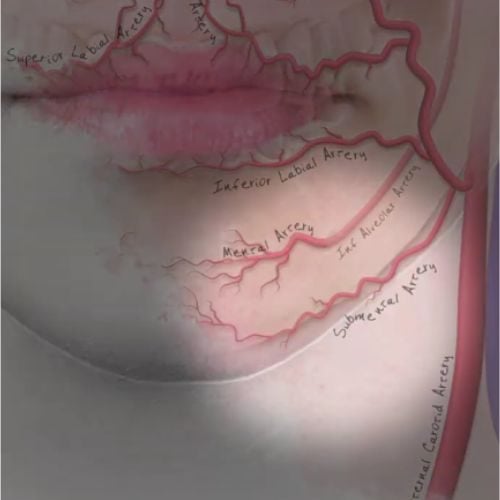
With that in mind, you then start to think about the complications part of the equation. So, the risks you will be trying to avoid are unnecessary bruising, occluding the superior labial artery, or causing pain and discomfort to your patient. Armed with these two parts of the equation, you must now add them together to equal an injection technique which must try to respect the complication risks whilst also achieving the aesthetic result. You do this with a good understanding of the 3D anatomical structure of the area, in this case the lip, so you know where best to inject your filler product.
The key to a good injection technique is this balancing act. If you focus on the aesthetic component, you may overlook the complication risks, but if you worry too much about the potential risks and treat too conservatively, then you won’t achieve the aesthetic result that both you and your patient are aiming for – this is where your technique is a balance so you can safely inject and achieve good results.
Watching experts and their injection techniques
Learning how to achieve a good injection technique starts with training from someone with knowledge and experience who can show you good foundation techniques to start with. This means that you can follow a pattern and understand why you are injecting in a certain place, and why at a certain angle and depth. Only then can you begin to adapt your technique to your own individual style. Eventually you will understand, in detail, the rational for every single placement that you do, every single time you put a needle into a patient.
Observing injection techniques used by others, either in advanced, masterclass or 1-2-1 training or at educational conferences can be a great way to learn different approaches and different examples of treating a particular area, to help you to find your own style. However, there is a caveat to this.
We see many practitioners who train with us and undertake our mentoring programme – the Aesthetic Mastery Programme – who learn a variety of injection techniques to a very high standard of competence. Then, they visit their first aesthetic conference where they may see a key opinion leader (KOL) or well-known, dare we say celebrity practitioner, on a stage who is performing treatments and demonstrating a completely different injection technique to their own. It is at this point that there can be a tendency to lose confidence and feel like their whole world has fallen apart. Don’t let that happen to you.
Remember, it is about understanding why YOU do things – know your road map, your justification for what you are doing and why, and you’re then well on the road to becoming a wiser injector, irrespective of what you see others doing. But that is not to say you won’t pick up some ideas to mull over and explore when watching others at work. Similarly, you don’t want to become a ‘paint-by-numbers’ kind of injector who is just copying techniques without actually understanding what you are doing and why.

How to develop good injection techniques
When embarking on a career in aesthetics, most medical practitioners, be they doctors or nurses, are simply not familiar with injecting the face, even dentists are predominantly only exposed to delivering lidocaine injections for dental blocks. Certainly, most of us are not familiar with sculpting a face with the use of carefully placed dermal filler product via injections. This artistry and eye for beauty is something we develop over time.
It is therefore not surprising that initial training and injection technique is learnt by copying, practising, achieving a result, and knowing why that technique was used to make it work.
Watching other injectors allows you to broaden your understanding and decide what works for you and your patients. This is all well and good, but the next problem arises when you are faced with something which doesn’t fit your mould. If you have learnt an injection technique from one starting point, but the patient in front of you has a slightly different presentation and the aesthetic goal needs altering slightly, then this can often leave a practitioner lost and unsure of where to start as their sense of direction has been thrown out the window. They simply don’t know where to start to get to where they want to go. It takes time to learn about different approaches, different angles, different depths and the rational behind each different product placement. Watching and learning, with a mentor, can help you to grow your own knowledge so that you can approach all treatments without that feeling of being lost, or that the starting point doesn’t follow the technique that you initially learnt by rote.
The key to developing a good injection technique, for you, is that it’s not about knowing the newest technique, or the celebrity KOL’s technique, it’s about knowing and using the BEST technique for you and your patients.
Learn to modify your injection technique so that you can avoid risks each time you perform the same treatment, because learning to perform repeatable techniques which avoid major complications will stand you in good stead throughout your career.
Understanding anatomy
When you start working in aesthetic medicine, there is likely to be a lack of anatomical resolution, and by that we mean understanding both textbook 2D anatomy and the 3D patient sat in front of you. None of us have X-ray eyes, so you won’t be able to see where you are injecting but you can learn to visualise it on a 3D model. Studying anatomy and what is below the surface layers of the skin is paramount for medical aesthetic practitioners.
Another good tip when treating a patient is that you can palpate the face to help you to feel for structures and some of the arteries have a palpable pulse which helps you to locate and of course, avoid them.
The angle and depth of your needle
When delivering a dermal filler treatment, the angle of your needle can make all the difference. To the untrained eye, if you place your needle in a specific spot on the face, chances are that having the needle in a vertical position, at a 90° angle or an even shallower angle will all appear the same, because the needle is in the same place for all of them. Yet, the angle of your injection can make the difference between a safe and a dangerous injection based on the location and pathways of underlying vasculature and nerves.
Similarly, a common mistake which increases the risk of complications is injecting too deeply. By learning your anatomy, your injection technique becomes more than just WHERE am I injecting and more about HOW am I injecting, considering the angle and depth of your needle.
The aesthetic goal
What you already know, intuitively and academically, about beauty can help you to achieve your aesthetic goals. Learning about the art of sculpture, the way the face appears from the build of layers, as well as how to improve and restore youth to a face with specific interactions such as removing a nasolabial fold, will allow you to learn how simple changes can improve the look of the whole face. Find your inner Michelangelo or Rodin and become an artist as you sculpt your patients’ faces.
As you deliver more and more treatments, you will note the changes in the face that you can achieve and like an sculptor with clay in his fingers, you will see the effect that placement of a certain amount of filler in a certain place has on the face, knowing when enough correction has been performed or if more is needed in another place. Just like the sculptor laying on small dollops of clay to craft a masterpiece.
How to inject well
Always have a mental model of the anatomy which is clear in your head, both the two-dimensional and the three-dimensional visualisation, so that you understand depth.
It is important to assume a good position when injecting – to be stable, balanced and without motion. You can do this by starting with your feet, so that you are comfortably stood, with your feet rooted to the ground. Any imbalance in your stance will reflect as an imbalance in your injection technique. Do not place more weight on one side of your body, thinking that you need to lean when you approach a patient as they lay or sit on a couch, stay firmly balanced on both sides of your body.
As well as your feet, you may also wish to stabilise your pelvis against the side of the treatment couch, relax your shoulders, and rest your elbow against something else, such as the head of the bed or the patient’s shoulder, if that is agreeable. Alternatively, you can brace your whole arm with your elbow pushed into your side.
You will have the most control over your injection technique when you only have the movement of your wrist to think about, because the rest of your body is firmly stable. Finally, you can stabilise your hand further by placing your little finger on the patient’s face as you bring the needle into position to treat – think about holding a teacup with your pinky finger out for balance!
Once you are stable, you can inject. Do so decisively, but slowly. Remember, nerves can make you inject too quickly so perhaps think about breaking down the injection into components which you can slowly work through to avoid your nerves getting the better of you. For example, going through the dermis, changing your angle as appropriate for the location, sliding the needle in further, aspirating, checking that the patient is comfortable, injecting a small amount of product, evaluating the response, and then completing the rest of the injection. You do not need to rush.
Best Injection Techniques
If you are concerned about getting your injection technique right, then download Dr Tim’s guide on how to improve needle control when injecting.
How to aspirate effectively
Aspirating – do you, or don’t you? – it is a contentious subject.
Those who do not aspirate when delivering dermal filler injections often believe that aspirating can cause more trauma or additional bruising for the patient because it’s ‘fiddly’ and you risk additional needle movement within the tissue. Dr Tim believes that this is misguided because the risk of not aspirating, before carrying out a treatment, far outweighs the inconvenience of causing more bruising, plus over time you will get better at aspirating thus reducing the risk of additional trauma.
He notes that he has experienced hundreds of positive aspirations in over twelve years of aesthetic practice, may of which were into arteries, so he maintains that aspirating is an important practice for all practitioners to minimise the risk of vascular complications such as vascular occlusion and the risks associated with causing blindness.

Learning how to aspirate effectively, both to minimise additional trauma and produce a meaningful result is an important skill for medical aesthetic practitioners.
For example, if you place your needle into the tissue, aspirate and then move the position of your needle, even by a few millimetres, before embarking on delivering the filler, then your aspiration was pointless.
To achieve a meaningful aspiration, you must have a stable patient, a stable needle, thanks to a stable hand holding the syringe, and deliver your treatment in exactly the same place as you (negatively) aspirated.
Be aware that if you produce a positive aspirate, this may be a full flash of blood or just a few dots in the needle hub, depending on whether you are fully within a vessel. Either way, you are still in a danger zone and it is still a positive aspirate, so start again.
Practical aspirating skills for delivering dermal filler injections
 To aspirate well, it is important to achieve a neutral vector across the syringe so that the plunger is moving backwards, but the syringe barrel is not moving. This cannot usually be achieved if you use one hand to hold the syringe in place and your other hand to pull back on the plunger, however, here are Dr Tim’s top tips.
- Do it one handed. Use your thumb on the hand that is holding the syringe, by hooking your thumb under the flange of the plunger and pushing your thumb backwards away from your other fingers.
- Use two hands, if doing it one handed is too tricky. The secret is to hold the syringe with one hand and learn to push against the flange of the syringe barrel with one finger of the other hand, whilst pulling the plunger away with that thumb. This will even out the forces and the syringe barrel and needle won’t move as the plunger is pulled back.
- Remember, you can aspirate more than once during a treatment. Even though there will be some filler product within the hub of the needle, you can still aspirate again as you move your needle to treat. This is especially useful when treating lips and using thinner hyaluronic acids.
- Know your filler. This will help you to determine how many seconds you need to hold back the plunger to achieve a meaningful aspiration. Thin products take little time, a couple of seconds, to show a result if you are in a vessel.
Aspirating tips
For more information and practical tips on aspirating, we recommend watching Dr Tim’s video on his Aspirating Experiment Test Results: How Quickly Does Your Filler Brand Aspirate…If At All?
Are you still anxious about getting your injection techniques spot on?
If you want to learn more about mastering medical aesthetic treatments and complications, or conquering the anxiety of where to place your needle, then register for Dr Tim’s Wednesday webinar.