
![Upper Facial Muscle Balance: Frontalis & Brow Depressors <br>[Asymmetry Series: Part 2A]](https://drtimpearce.com/wp-content/uploads/2026/01/Jude-Harford-Nurse-Practitioner.jpg)


FREE Complications Webinar
Want to overcome your fear of complications and confidently master anatomy?
Join us for one of Dr Tim's FREE upcoming webinars.
Check dates here and save your spot
 Dr Tim Pearce
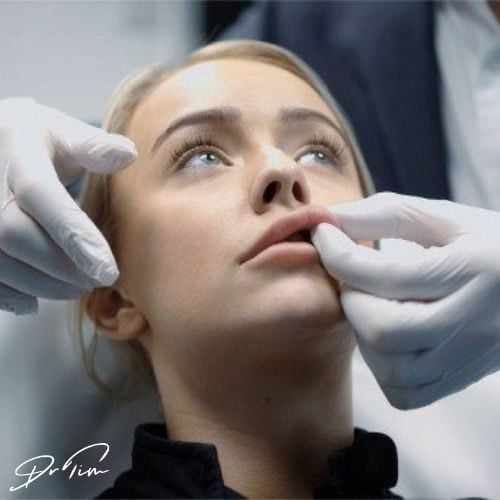 Lumps in the lips after dermal filler procedures are relatively common because they can be caused by many different things where the simple act of putting a needle into the lip tissue can cause a small bruise or hematoma that presents as a lump, and whenever you get blood in the skin it causes an inflammatory response where white blood cells rush to the area to clear up all the debris. A lot of what you’re feeling in early stage lumps represents the inflammatory response to trauma though there are other causes as well, making the interpretation of lumps something that requires a systematic approach based on the timing of when they present after the procedure.
The first thing when interpreting lumps involves understanding that you’ve got to consider them in accordance with the time that they present after the procedure, and you can’t make an assessment without knowing how long it was since the procedure took place making this similar to managing vascular occlusion where if someone comes with delayed capillary refill on day seven with a hematoma and it doesn’t look necrotic it’s probably not a vascular occlusion. If you receive a picture from a patient showing lumpy lips the day you’ve done the treatment then you would reassure and say they need to give it some time since it’s way too early to be diagnosing a reaction or infection or filler lumps that aren’t gonna settle.
A survey of over a hundred clinicians who’d had their lips done showed 80% of people within four days had minimal swelling though a few people went up to two weeks, and the vast majority within a week are getting back to normal. If you’re a week plus and still have lumps you’re in the zone of starting to wonder whether this is either a reaction or infection if they’re getting worse, and if you’re getting to seven days afterwards where day seven is worse than day six that is a red flag where you need to react quickly since it’s quite possibly an infection or reaction though they’re very hard to tell the difference.
The degree of swelling becomes important when trying to distinguish between a reaction and an infection, and the gold standard would be sending a sample to the lab but almost no one will do that since you’re not gonna biopsy or stick something extra into lips. You tend to make a judgement on clinical grounds or treat it as both, and probably the biggest single difference would be that if it’s isolated in one place on the lip that’s more likely infection since if you’re reacting the filler is reacting to your immune system so why would it just pick on one place, whereas an infection could just pick on one place because you might have dragged in a little bit of bacteria with your injection or maybe they licked their lip straight afterwards.
An infection typically presents as gradually increasing swelling usually with a focal point where quite often the filler changes texture and you get a big immune response, and if you feel someone with an infection there’s often a focus that you can feel much firmer where sometimes the filler is a little bit hard in the surrounding areas as well. It should be more painful and swollen, and you might if it’s bad enough start to see some discoloration so a little bit of pustule forming though you should be very concerned about necrosis if you’re seeing a lot of pustules particularly if focused in one place where you’d want normal capillary refill with swollen red and maybe a pustule but not a darkish lip with delayed capillary refill.
Cold sores can be triggered by the procedure and may be related to temperature where the neurons which house cold sores are a little bit more likely to start producing them in temperature changes, and there’s something around the procedure that seems to trigger this process including trauma same as having dry lips or sun on your lips. Some people get a cold sore triggered by the procedure though that doesn’t normally happen the day of but you’d expect it to build up over a day or two and then peak at about seven days, and cold sores are usually in one place where they look like a sore making them distinct from the pattern of vascular occlusion which breaks up along the path of the superior or inferior labial artery.
Lumps that show up weeks later put you in the realm of delayed onset nodules where these lesions are probably caused by the immune system reacting to the filler, and the big debate involves whether there’s bacteria in there where some studies have said yes there’s always some bacteria while others haven’t been able to isolate anything. One theory is a biofilm reaction where those are more like an infection and tend to be localized in one place as one lump that’s troublesome and comes and goes over time, though if you’re reacting to the product it tends to be everything going off at once where those reactions can be because your immune system is hyper-stimulated by something else like a flu-like illness.
The most typical thing is they’re fine for a few months then they get a runny nose or cough and two or three days later their filler all goes lumpy, and if you do nothing a percentage will recover though a percentage will go on and get worse. These are important to treat because chronic long-term inflammation can lead to collagen deposition where those lumps could be permanent, so you don’t want to leave people reacting with an undiagnosed lump for too long since you’d want to treat them sooner to reduce the chance of long-term lumpiness.
You can always give it a bit of time to see the direction it’s going, and if someone’s got a very small lump with a cough or cold and a little bit of swelling but nothing major you could leave that if they’re not too bothered and just monitor it closely. The next step would be antihistamines which are probably slightly safer, and if you’ve ruled out infection which is very important before prescribing steroids you could use those though if they come down on steroids but as soon as the steroids come off they react again you would probably dissolve it.
Lumps that the public are probably most aware of involve the filler either not being placed smoothly or clumping itself afterwards, and the suspicion is many pictures that say the previous practitioner was awful are quite often reactions or infections. There’s a very typical shape where they get little lumps on the inside but no one really injects there so there’s something going on with a degree of reactiveness and maybe something with how the filler moves over time, and quite often there’s been some medical problem that then is dissolved which does solve the problem.
When examining a patient with a lump you want to see is this just one lump or multiple nodules all over the place because that completely sways you into different territory, and you need to assess is there any sign of infection, is the blood flow normal, when was the procedure taken. When you actually feel a lump that’s really helpful because a non-inflammatory nodule should be fairly non-tender to squeeze where it should feel similar to the rest of the lip, and those are the ones you’d feel confident giving a little more of a squeeze to so that they just dissipate where sixty percent of the time they just blend in if you squeeze hard enough.
The question about whether one filler is more prone to lumps is really difficult to answer because mostly we don’t have data on most fillers where the FDA approved ones have some data though the rest relies on experience, and it takes so long to get to know what a product is like because they all look pretty much the same on the day. If you’ve been doing aesthetics for six months unless you’ve been super busy you’re not going to be able to compare with anything where whenever you ask someone which filler they like you get everyone saying they like the filler they currently use because otherwise they wouldn’t be using it, and what you have to lean on is your own ability over time to get to know that particular product where it’s about knowing the properties of your product so that you can predict how it’s likely to play out.
Join us for one of Dr Tim's FREE upcoming webinars.
Check dates here and save your spot
Dr Tim Pearce MBChB BSc (Hons) MRCGP founded his eLearning concept in 2016 in order to provide readily accessible BOTOX® and dermal filler online courses for fellow Medical Aesthetics practitioners. His objective was to raise standards within the industry – a principle which remains just as relevant today.
Our exclusive video-led courses are designed to build confidence, knowledge and technique at every stage, working from foundation level to advanced treatments and management of complications.
Thousands of delegates have benefited from the courses and we’re highly rated on Trustpilot. For more information or to discuss which course is right for you, please get in touch with our friendly team.


![Upper Facial Muscle Balance: Frontalis & Brow Depressors <br>[Asymmetry Series: Part 2A]](https://drtimpearce.com/wp-content/uploads/2026/01/Jude-Harford-Nurse-Practitioner-405x260.jpg)