




FREE Complications Webinar
Want to overcome your fear of complications and confidently master anatomy?
Join us for one of Dr Tim's FREE upcoming webinars.
Check dates here and save your spot
 Dr Tim Pearce
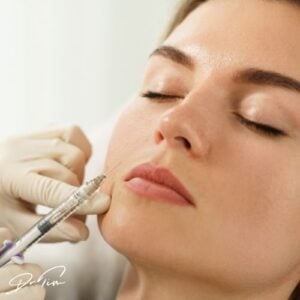 The assumption that one milliliter of filler represents a small, safe amount for lip treatment gets challenged completely when you actually visualise what this volume looks like distributed across smaller than average lips. The scale of the lips relative to the volume of filler matters tremendously in determining whether you achieve the aesthetic outcome you intended, and this becomes particularly important with small lips where the easiest thing to lose during treatment is the shape and detail that make lips beautiful in the first place, since in your effort to achieve proportion you can sacrifice some of the most important aspects of beauty without realizing what’s happening until the procedure is already complete.
Looking at what a typical procedure in terms of volume might look like on some smaller than average lips reveals how quickly space fills up and how little room remains for additional product once you’ve placed even conservative amounts in the standard injection points. Starting with 0.05 milliliters at the Glogau-Klein point suddenly doesn’t look so small anymore when you see it in the context of the entire lip structure, and then adding a linear thread of 0.05 milliliters tracking outwards from the GK point to enhance the vermilion border followed by a vertical injection of another 0.05 milliliters which might be used to invert the lip and try to get more of the pink part of the lip to show creates a situation where two linear threads of 0.05 milliliters would be quite a low volume for many clinicians but already represents a substantial proportion of the available treatment area.
Looking at how much of the lip these initial injections occupy makes you realize there isn’t really a lot of room left for additional product, and adding 0.05 milliliters to the lateral aspect of the vermilion border and another 0.05 milliliters to the lateral aspect of the tubercle creates a scenario where you’re already feeling at this stage that treatment space has become quite limited. The process of adding 0.05 milliliter boluses followed by 0.05 milliliter linear threads and then 0.05 milliliter vertical injections followed by another 0.05 milliliter vertical injection demonstrates how rapidly you consume the available anatomical real estate, and moving to the lateral lip with another 0.05 milliliters shows how even before completing the full milliliter you’re already working in a very constrained environment.
Moving to the lower lip with what would be considered average volumes for common treatment approaches shows 0.05 milliliters on the lower lip angle followed by 0.05 milliliters laterally to create that central dominance followed by 0.05 milliliters in the tubercle, and the visual impact of these boluses appears way bigger than anticipated when you’re planning treatment volumes in the abstract without seeing them in the actual context of small lip anatomy. Repeating the same process on the next side of the lip with 0.05 milliliter linear threads reveals something very interesting about how filler flows directionally out of the bevel of the needle, coming out almost away from the needle upwards from the bevel which provides useful information for understanding product placement patterns during injection.
Placing 0.05 milliliters across the middle portion of the lips in linear threads creates a situation where any injector looking at this might think that all of this looks a little bit messy, which makes you feel a little bit less confident about putting higher volumes in because the product is flowing so easily and covering so much of the lip even though you still haven’t used a full milliliter at this point. Going forward with a couple more vertical injections to reach the target volume creates a scenario where you’re really struggling now for room to find areas to put the filler, and this experience really changes your perception about how much product you can actually place particularly in smaller lips where the limiting factors become apparent much earlier in the treatment process.
The smoothing process that follows injection mirrors what you would do with a patient who had received lip treatment, where you might gently massage the lips to check there are no irregularities, lumps, or bumps that would compromise the aesthetic outcome. Understanding volumes becomes particularly important when dealing with smaller lips because the difference you make is proportionately bigger when lips are smaller, which means it’s easier to create an overtreated look even if you’re using less volume than you might use on larger lips with more accommodating anatomy.
The concept of an overtreated appearance means an unnatural looking result, and what makes people look unnatural involves primarily a loss of natural shape that occurs when you add volume to lips that already have a defined natural architecture. Thinking about smaller lips as having a natural shape and recognizing that the more volume you add, the more it distorts that natural shape helps you understand that lips tend to have limiting factors that differ in different areas, so that a simultaneous injection all the way along the lip will find it harder to lift the middle proportion than the lateral portion which means you get more sausage-shaped lips at the end if you do a harmonious similar volume all the way along the lip without accounting for these anatomical differences.
Many clinicians fear this outcome and notice halfway through a treatment that they’ve actually unfortunately made this problem a reality, which raises the question of what you would do during a procedure if this were to occur. Filler that’s just gone in is usually easier to massage, so you can often make an adjustment during the procedure by reshaping the product distribution before it settles into the tissue, and you can also shape the lips with a sculpting squeeze so that the tubercles dominate better which is essentially doing the same thing by squeezing filler away from the lateral injections towards the medial so that the mid part of the lip dominates and creates more aesthetically pleasing proportions.
Remembering that during the procedure swelling forms a big part of what you see becomes absolutely crucial for making sound clinical decisions, since up to 80 percent in some cases represents just the swelling from the procedure itself rather than the actual location of the filler product. This means that whenever you’re consulting your patients and assessing them during the procedure, you need to remember to take into account swelling as a major confounding factor that can lead you to either under-treat or over-treat depending on how accurately you can distinguish between immediate inflammatory response and actual product placement.
The proportion of visible change that comes from swelling versus filler varies throughout the treatment and in the hours and days that follow, which makes it essential to set proper expectations with patients about how their lips will look immediately after treatment versus how they’ll appear once the inflammatory response has resolved and the true aesthetic outcome becomes visible. Understanding this temporal evolution of appearance helps you avoid the common mistake of trying to achieve the final desired look during the injection session itself, when a substantial portion of what you see will disappear as swelling subsides over the following days.
The demonstration of what one milliliter actually looks like when distributed across smaller lips fundamentally changes how practitioners think about volume recommendations and treatment planning, since the abstract concept of “one mil” translates to very different aesthetic impacts depending on the baseline anatomy you’re working with and the specific distribution pattern you use to place the product. Small lips demand more conservative approaches with careful attention to maintaining natural shape and proportion, recognizing that the limiting factors in different anatomical zones create challenges that don’t exist to the same degree in larger lips with more forgiving anatomy.
Join us for one of Dr Tim's FREE upcoming webinars.
Check dates here and save your spot
Dr Tim Pearce MBChB BSc (Hons) MRCGP founded his eLearning concept in 2016 in order to provide readily accessible BOTOX® and dermal filler online courses for fellow Medical Aesthetics practitioners. His objective was to raise standards within the industry – a principle which remains just as relevant today.
Our exclusive video-led courses are designed to build confidence, knowledge and technique at every stage, working from foundation level to advanced treatments and management of complications.
Thousands of delegates have benefited from the courses and we’re highly rated on Trustpilot. For more information or to discuss which course is right for you, please get in touch with our friendly team.
If you want to increase your knowledge about safe and effective lip filler injectable treatments, Dr Tim Pearce offers a series of fabulous courses, from foundation and upwards:
In addition, browse our FREE downloadable resources.