
You may be interested




 Dr Tim Pearce
 Patient satisfaction with lip filler treatments hinges on factors that extend far beyond technical injection skill, with the consultation and analysis phase determining whether clients leave delighted with natural-looking results or disappointed with duck lips or trout pout appearances they never wanted. The formal analysis stage represents one of the most valuable components of your service that many injectors skip entirely, yet it fundamentally separates practitioners who consistently deliver beautiful outcomes from those who create overdone results.
The consultation process for lip augmentation represents a structured opportunity to establish expertise, justify pricing, and fundamentally shift patient expectations from “I want big lips” to understanding the nuanced approach required for genuinely aesthetic results. When you make lip analysis an official part of your consultation and avoid jumping straight to injecting, patients begin to understand that there’s more to aesthetics than just achieving volume, opening up conversations about the architectural details that actually create beauty.
Creating the foundation for analysis through acknowledgment
The first principle of effective lip analysis involves acknowledging what your patient has already told you about their aesthetic goals, recognizing that most people have picked up ratios and proportions without any formal training because the perception of healthy facial features is essentially built into our DNA. Beauty and health represent the same thing for most people until you enter the realm of fashion and culture where preferences can diverge, but the majority of patients instinctively know when something will make them more beautiful even if they struggle to articulate why.
When a patient references a celebrity with fuller lips or brings a photograph showing the look they want, this represents an opportunity to translate their intuition into scientific justification they can understand and trust. If the celebrity they’ve selected has symmetrical lips while your patient presents with asymmetrical proportions, or if their reference image shows a specific upper-to-lower lip ratio that differs from what they currently have, you can explain precisely what they’re picking up on and how moving closer to that ratio means moving closer to the scientific definition of beauty, even if you may not achieve it completely in a single session.
This approach of bouncing back the science after listening to patient goals creates justification for your treatment plan while validating their instincts. Most patients arrive at correct conclusions on some level even if they can’t explain the underlying principles, allowing you to layer on the additional technical knowledge about proportions, details, contrast, ratios, and curvatures that distinguish expert work from simple volume distribution.
Making analysis comprehensive yet accessible
The detailed work of describing beauty to patients involves articulating concepts around proportion and detail that you should aim to communicate over time depending on what each individual presents with, giving them a conscious understanding of aesthetic principles while positioning yourself as the expert who provided this education. When patients can see that you’re designing an aesthetically beautiful result based on formal training and moving beyond simple filler distribution by volume, the entire conversation shifts away from battles over pricing and volume measurements toward collaboration on achieving optimal outcomes.
This educational component should begin with a genuine compliment before you start discussing areas for improvement, recognizing that some people feel excited when you announce you’re analyzing their lips while others feel defensive and worried about criticism. Starting with something authentically positive that you’ve observed about their natural features sets a collaborative tone that makes patients receptive to hearing about ratios that could be enhanced or asymmetries that could be corrected through strategic filler placement.
Product selection as a strategic consultation component
The relationship between different filler products and the results they produce represents another area where practitioner opinions vary significantly, making it essential that you test products yourself over extended periods and avoid simply accepting marketing claims or colleague recommendations. The challenge with evaluating products immediately after injection stems from the fact that they all appear relatively similar on the day of treatment due to the swelling involved, whether you’ve used one brand over another or selected different viscosities within the same product line.
The most valuable knowledge comes from using a single product as your primary lip filler for approximately a year, giving you the opportunity to see results at multiple follow-up appointments and establish patterns around whether patients lose definition with that particular product compared to alternatives you might try. The biggest variable across different filler products appears to center on the tension between volume and definition, where formulations that excel at producing substantial volume tend to perform less effectively at creating sharp borders and detailed shaping.
This product knowledge becomes particularly relevant when patients have the budget for dual-technique approaches that combine different fillers to achieve both structural definition and satisfying volume, though you’ll never successfully introduce this option unless you’ve conducted a thorough consultation that demonstrates why the additional investment produces meaningfully better outcomes.
Strategic technique selection based on comprehensive assessment
After completing your analysis and discussing product options, you enter the realm of choosing injection techniques specifically built around everything you’ve learned from the patient during the consultation process, recognizing that your technical approach should emerge from patient-specific factors and avoid defaulting to a single preferred method regardless of anatomy. The expert maintains a complete toolkit of techniques comparable to a box full of specialized tools where you select the right instrument for each specific job.
When patients request specific techniques they’ve researched such as Russian lips, you need comprehensive knowledge about the benefits of that vertical injection approach and how to apply it effectively for particular cases without simply performing it because it’s trending on social media. The Russian technique works beautifully in appropriate situations but attempting to use it on someone with very thin lips typically leads to disappointment because there simply isn’t adequate room to create the desired effect with that methodology, requiring you to build volume first and approach the enhancement differently.
The distinction between vertical and horizontal injection techniques carries implications beyond just aesthetic outcomes, affecting safety considerations related to arterial anatomy that you must account for during treatment planning. When you picture vertical injections entering through the pink part of the lip and skirting superficially while progressively moving away from the most likely position of the arterial supply behind the orbicularis oris muscle, you can understand why this differs significantly from horizontal injections that run right over and adjacent to the artery while staying in that plane for the entire journey of the needle.
Tailoring approach for specific patient populations
The psychology of older patients seeking lip treatments tends toward a more defensive mindset where people are seeking certainty and restoration without dramatic enhancement, often expressing fear around looking “done” or drawing negative attention through changes their friends might interpret as trying too hard to appear younger. These patients frequently describe concerns about appearing as mutton dressed as lamb, wanting instead to stay in alignment with their established identity while simply addressing signs of aging that make them uncomfortable.
This defensive psychology often leads patients to request the wrong treatments out of fear, asking only for upper lip line corrections while refusing body-of-the-lip enhancement that would actually create harmonious results and prevent the Homer Simpson appearance that develops when you treat lines in isolation. When you treat vertical lip lines without addressing the underlying volume loss in the lip body itself, the overall facial shape changes in ways that make patients look treated despite their desire to avoid that exact outcome.
For male patients seeking lip enhancement without feminization, the technical approach requires adjustments that preserve masculine characteristics while achieving the hydration and refinement they’re actually seeking. The key differences involve keeping lips flatter and avoiding the pillowy fullness appropriate for female patients, making injection points slightly wider to create a more squared appearance, and being extremely conservative with any Cupid’s bow definition that could read as feminine on masculine faces.
When treating male lips, you should consider how the enhancement fits with chin width and overall lower face proportions, recognizing that the angles and relationships between facial features differ from female anatomy where you might reference nose width as your boundary guide. The goal centers on hydration and natural maintenance without dramatic augmentation, avoiding techniques like heavy vertical columns that work beautifully on female patients but risk creating an inappropriately feminine appearance when applied to male anatomy.
Why consultation mastery changes your practice trajectory
The practitioners who build sustainable, profitable aesthetic practices distinguish themselves through consultation excellence that goes beyond technical injection skill alone, creating patient experiences where people understand they’re receiving sophisticated facial analysis from a trained expert who offers more than commodity filler by the syringe. This transformation from transactional provider to trusted aesthetic consultant happens when you invest the time to make lip analysis an official consultation stage, explain the science behind beauty in accessible terms, and design treatment plans that address both immediate requests and underlying anatomical factors patients haven’t yet learned to articulate.
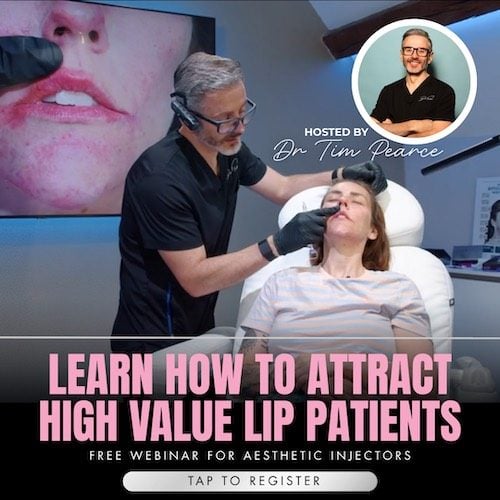
Want to overcome your fear of complications, confidently master anatomy and 10x your skills as a lip injector? Join us for one of Dr Tim’s FREE upcoming webinars. Check dates here and save your spot >
Watch the full Aesthetics Mastery Show
6 Expert Tips For Lip Injectors
Is it safe to inject the lips vertically? In this Aesthetics Mastery Show, Dr Tim shares 6 tips that every lip injector should know. He covers how to inject safely to avoid the arteries, different techniques, plus his advice for the perfect lip consultation so that you can feel confident and your patients can feel at ease ahead of their procedure.
You can also subscribe to our YouTube channel for really useful regular tips and advice. 
Dr Tim Pearce eLearning
Dr Tim Pearce MBChB BSc (Hons) MRCGP founded his eLearning concept in 2016 in order to provide readily accessible BOTOX® and dermal filler online courses for fellow Medical Aesthetics practitioners. His objective was to raise standards within the industry – a principle which remains just as relevant today.
Our exclusive video-led courses are designed to build confidence, knowledge and technique at every stage, working from foundation level to advanced treatments and management of complications.
Thousands of delegates have benefited from the courses and we’re highly rated on Trustpilot. For more information or to discuss which course is right for you, please get in touch with our friendly team.