


• Mail us: support@drtimpearce.com
  • Trustpilot
Dr Tim Pearce, eLearningDr Tim Pearce, eLearningDr Tim Pearce, eLearning Dr Tim Pearce, eLearning
  • eLearning Courses
        • ELEARNING COURSES

        • Techniques
          • BOTOX® Foundation Course
          • Pro Tox
          • Dermal Fillers Foundation Course
          • 8D Lip Design
          • Julie Horne Directs, Dr Tim Injects – February 2023
          • Eyelash Enhancement Serum Course
          • Anatomy360
          • Art Codes
        • Complications
          • Botulinum Toxin Complications Mastery
          • Dermal Filler Complications Mastery
          • Elective Lip Reversal
        • Profinity
        • Wellness
          • How To Introduce Longevity To Your Aesthetics Clinic
        • Marketing
          • DCAM 2.0
          • Canva Mastery: A Step-by-Step Guide
          • Email Marketing Course
          • Industry Photography Secrets
          • How to find your voice with video
        • Other Services
          • DPP for V300 Service
        • Packages
          • Foundation eLearning Package – SAVE 10%
          • Complications eLearning Package – SAVE 10%
          • Techniques eLearning Package – SAVE 20%
          • Marketing eLearning Package – SAVE 20%
          • Full eLearning Package – SAVE 35%
        • Reviews and Testimonials
        • FAQ – Online Courses
  • Downloads
        • Complications
          • 13 Extra Risky Injection Areas: Facial Vessel Map
          • Aspirating Experiment Test Results
          • Bruising Checklist: Prevent & Minimise Bruises from Injectables
          • Dermal Filler Complications: The Essential Guide
          • Delayed Onset Nodules: How To Diagnose And Treat
          • Diagnosing Complications: 7 Steps To Great Advice
          • Emergency Reversal Protocol
          • How To Avoid Causing a Lateral Rectus Palsy From Botulinum Toxins
          • Hyalase Consent Form: Downloadable Template
          • Lumps in Lips Guide: How to Diagnose, Manage & Treat
          • Tear Trough Oedema Protocol
          • Does Covid-19 Vaccine Cause Dermal Filler Reactions?
        • Injection Techniques
          • 26 Essential Injection Patterns For Botulinum Toxin
          • Botox Calculator
          • BOTOX Lesson – Gummy Smile
          • BOTOX Lesson – Hooded Eyes
          • Frequently Used Filler Volumes Facial Map
          • How To Improve Your Needle Control: 6-Step Blueprint
          • How to Prepare BOTOX – Step by Step Guide
        • Consultation Skills
          • Body Dysmorphia & Modification Checklist
          • Is It Safe To Treat? 5-Step Contraindication Check List
          • Medical Model For Cosmetic Procedures: An Essential Guide
        • Lips
          • Lip Consultation Question Checklist
          • Lip Anatomy Lesson
          • Common Needle/Cannula Choices For Lips
          • Lip Filler Aftercare Pack for Your Patients
          • Lip Design Blueprint – 4 Steps To Perfect Lip Augmentation
          • Master the Basics of Julie Horne’s Lip Technique
        • Longevity
          • Does HRT Increase Cancer Risk? Guide for Clinicians
          • Educating Patients About How Sugar Exacerbates Aging
          • How to Reduce Biological Age for Your Patients
        • Business & Marketing
          • Annual Profit Calculator
          • 5 Steps to Create a Successful Aesthetics Business
          • Injector’s Cheat Sheet – 7 Social Media Post Types
          • 7 Deadly Hashtag Sins
          • 7 Secret Locations to get Instagram Followers
          • 9 Video Marketing Mistakes
          • 15 Easy Instagram Reels Ideas
          • 3 Time-Saving Hacks for Social Media
          • Personal Branding Starter Kit
          • Value Audit Template: Price-per-1ml
          • World’s Top 5 Filler Brands – Survey Results
  • Products
    • Artistic Anatomy Poster Collection
    • Top 3 Posters Bundle
    • Original Anatomy Poster
    • Beautiful Lip Anatomy Poster
    • Download Pack – Forms & Leaflets
  • Blog
    • Meet the Writers
  • Podcasts
  • About
    • Dr Tim Pearce
    • Miranda Pearce
    • Careers & Recruitment
    • Webinars
    • Become a Model
  • Contact
  • Login

Login

Vascular Occlusion and Necrosis Prevention: The Ultimate Safety System for Aesthetic Injectors

Blogs

  • ALL
  • Complications
  • Injection Techniques
  • Consultation Skills
  • Lips
  • Business & Marketing
You may be interested
Platelet-Rich Plasma (PRP) and Platelet-Rich Fibrin (PRF) in Skin Rejuvenation After 40

Platelet-Rich Plasma (PRP) and Platelet-Rich Fibrin (PRF) in Skin Rejuvenation After 40

January 27, 2026

Restoration of Older Lips: The Psychology, Aesthetics, and Anatomy You Need to Understand

Restoration of Older Lips: The Psychology, Aesthetics, and Anatomy You Need to Understand

January 22, 2026

New Technologies in the Field of Facial Aesthetics and Body Contouring

New Technologies in the Field of Facial Aesthetics and Body Contouring

January 20, 2026

Why I Still Treat Tear Troughs: A Response to Dr. Gavin Chan’s Viral Video

Why I Still Treat Tear Troughs: A Response to Dr. Gavin Chan’s Viral Video

January 15, 2026

Laser Platforms vs. Standalone Systems in Clinic Practice

Laser Platforms vs. Standalone Systems in Clinic Practice

January 13, 2026

Vascular Occlusion and Necrosis Prevention: The Ultimate Safety System for Aesthetic InjectorsDr Tim Pearce
October 21, 2025

For aesthetic practitioners, few scenarios trigger more anxiety than the thought of a vascular occlusion progressing to tissue necrosis. This is the nightmare complication that keeps injectors up at night – the mental image of black necrotic tissue, an angry patient, and the knowledge that more could have been done. But here’s the empowering truth: with the right systems in place, you can become virtually bulletproof as an injector.

Understanding the Cellular Violence of Necrosis

Before we discuss prevention strategies, it’s crucial to understand exactly what happens at the cellular level when necrosis occurs. This isn’t simply a gradual deterioration of tissue function – it’s a much more violent and destructive process.

The Cascade of Cellular Destruction

When you reduce blood flow to tissue, the lack of oxygen triggers a catastrophic series of events within cells. As oxygen levels decrease, cells can no longer produce ATP – the universal currency of cellular energy. Without this single unit of energy, cells lose their ability to regulate themselves, leading to their own destruction.

The destructive process includes:

  • Loss of membrane control: Cells can no longer maintain their membrane gradients
  • Sodium influx: Uncontrolled sodium rushes into the cell
  • Water accumulation: Increased water causes the cell itself to swell
  • Endoplasmic reticulum damage: The rough endoplasmic reticulum also swells due to inability to control ion balances
  • Calcium influx: Triggered by membrane dysfunction, creating mechanical stress
  • Enzyme activation: The most violent aspect – activation of the cell’s own digestive enzymes

In healthy conditions, cells continuously break down molecules in a controlled way within controlled compartments. However, when calcium floods in due to loss of membrane control, the cell’s destructive enzymes activate and literally begin digesting the cell from within.

Ultimately, this causes leakage of all the cell’s contents, including these destructive enzymes, into surrounding tissue. This destroys neighboring cells as well – much like a factory that explodes and leaks toxic waste into the environment, causing damage to nearby structures. This is far more serious than simply slowly dying from lack of oxygen; significantly more damage occurs in the process.

The Track Record: Zero Necrosis from 27 Vascular Occlusions

In my personal career, I’ve had zero cases of necrosis, though I have experienced a vascular occlusion that was diagnosed and treated to prevent any adverse outcome. In my clinic, with multiple clinicians over 15 years of operation, we’ve had 27 vascular occlusions. The encouraging news? Every single one was diagnosed and treated appropriately, resulting in zero necrotic wounds.

This demonstrates a critical principle: Necrotic wounds are what we’re truly trying to avoid, not just vascular occlusions themselves. This distinction matters because you need a different system to prevent necrosis than you do to prevent vascular occlusion.

Developing a strategy that prevents vascular occlusion is quite narrow compared with a comprehensive strategy that prevents necrosis. This is the key message you must internalize: focus your safety systems on preventing necrosis, not just preventing occlusions.

How Much Time Do You Actually Have?

One of the most anxiety-provoking aspects of vascular occlusions is the fear of running out of time. Understanding the actual timeline provides perspective and reduces panic.

The Timeline from Occlusion to Necrosis

Evidence from various sources shows:

  • Severed limbs: Reattachment has been successful up to 8 hours after complete dissection from the body, proving tissue can survive several hours without blood supply
  • Pressure sores: The earliest signs of pressure necrosis develop at around 2 hours when oxygen supply is reduced to nearly zero
  • Clinical observations: Pustules often form within 24 hours of blockage, and even at this stage, many case reports show restoration of blood flow resulting in no necrosis

The practical reality: You have hours, not days, to address the problem. If you diagnose immediately in the clinic, you’re in the best possible position to take action – but only if you’ve injected something you can actually dissolve.

The Aviation Industry Model: Multiple Safety Layers

When examining other fields that have successfully reduced risk, like the aviation industry or operating theaters, one pattern emerges consistently: it’s never just one thing that makes the system safe.

Why Single Safety Measures Fail

Consider aspiration as an example. This test has been proven to detect intravascular placement in approximately 30-50% of cases, depending on the study. You can increase sensitivity to potentially 80% by optimizing all variables, but this still isn’t enough to reduce risk to zero.

The solution: You need many additional steps to reduce risk. Over your career, collect as many different safety steps as possible and never rely on a single step.

Think of a pilot preparing for takeoff with passengers on board – they go through detailed checklists of items they’ve verified to reduce risk. This is just one of many checklists that ultimately result in the remarkable achievement of flying passengers around the world in pressurized aluminum tubes with virtually zero fatalities.

The Real Case That Changed Everything

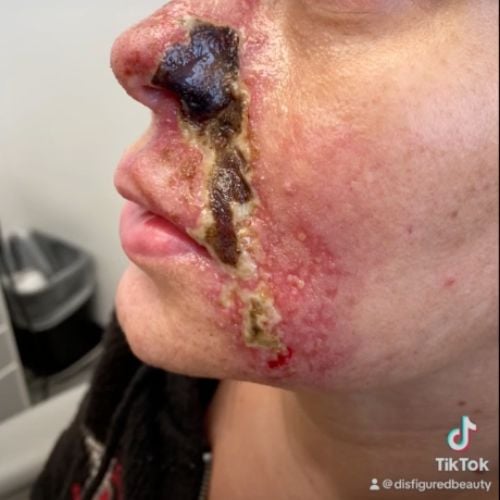
Let me share a real case that illustrates these principles powerfully. This patient, who can be followed @dysfiguredbeauty on TikTok commented on one of my YouTube videos and had her horrible experience detailed in the Daily Mail.

Severe tissue necrosis on nose and cheek following filler injection showing black necrotic tissue and wound progression
Severe case of tissue necrosis following dermal filler injection, demonstrating the importance of using reversible products and having emergency protocols in place for vascular occlusions

What Happened

Based on the available information and photographs, this patient was injected with a non-reversible dermal filler – calcium hydroxylapatite. The patient appears to have been treated with a cannula, and after the procedure, they developed pain followed by tissue breakdown over time. In the end, she suffered a horrific injury resulting in loss of a portion of her nose. She now wears a prosthesis to enable her to live a relatively normal life.

Cases like this drive me to discuss these topics so other injectors can make better decisions.

The Cannula Paradox: Lower Probability, Higher Consequence

Cannulas present an interesting safety profile that every injector must understand.

The Cannula Risk-Benefit Profile

Advantages:

  • Overall, cannulas have a lower probability of vascular occlusion than needles
  • Approximately four to five times safer in terms of getting into vessels
  • Harder to enter vessels due to blunt tip

Disadvantages:

  • When you do get into a vessel, you tend to stay in the vessel
  • You tend to inject more product in one place due to cannulas having only one entry point
  • Depending on where you’re injecting, you spend more time in that particular point
  • The size of the vascular occlusion is bigger when occlusions do occur, even though they’re far less likely

The Non-Reversible Product Problem

Now combine the cannula characteristics with additional risk factors – the dangerous combination:

  • Using an irreversible product (something you cannot dissolve with hyaluronidase)
  • Using something thick and stodgy like calcium hydroxylapatite
  • Product that’s very hard to massage
  • Result: You’re much more likely to be in a situation where nothing can be done in time to prevent tissue death

The Overrepresentation of Severe Cases

In my humble opinion, calcium hydroxylapatite is overrepresented in the most severe cases of necrotic injury. The reason is simple: there is one significant safety feature missing – you cannot reverse it.

This does not mean it’s not an appropriate product for some patients, but it should be reserved for a small minority – potentially those who are allergic to hyaluronic acid.

Building Your Bulletproof Safety System

Based on everything discussed, here’s how to construct a comprehensive safety system:

Layer 1: Product Selection

Primary principle: Use reversible products whenever possible

  • Hyaluronic acid fillers should be your default choice
  • Reserve non-reversible products (like calcium hydroxylapatite) for rare cases:
    • Patients with confirmed hyaluronic acid allergy
    • Situations where benefits clearly outweigh risks
  • Remember: We now have HA-based products that last 12-18 months, eliminating the longevity argument for non-reversible fillers

Layer 2: Technique Optimization

Implement multiple safety techniques:

  • Master aspiration technique and optimize all variables
  • Understand that aspiration alone is insufficient (30-80% sensitivity)
  • Use appropriate instruments for the treatment area
  • Consider cannula vs. needle based on area-specific risks
  • Inject slowly and observe tissue response
  • Use small aliquots rather than large boluses

Layer 3: Anatomical Knowledge

Deep understanding of:

  • Three-dimensional facial anatomy
  • Major vessel locations and danger zones
  • Anastomotic connections between vessels
  • High-risk areas (glabella, nose, nasolabial folds)
  • Individual anatomical variations

Layer 4: Recognition Systems

Early detection capabilities:

  • Know the signs of vascular compromise
  • Pain recognition and interpretation
  • Blanching and color changes
  • Capillary refill time assessment
  • Understanding that symptoms may appear hours after injection

Layer 5: Emergency Preparedness

Have protocols ready:

  • Hyaluronidase immediately available
  • Clear treatment protocols
  • Emergency contact numbers
  • Network of colleagues for support
  • Additional hyaluronidase sources identified

Layer 6: Patient Communication

Before treatment:

  • Discuss risks honestly
  • Explain why you’ve chosen specific products
  • Set realistic expectations
  • Ensure informed consent

After treatment:

  • Clear instructions for monitoring
  • 24/7 contact availability
  • Instructions for recognizing problems
  • Immediate response protocols

The Timeline Reality Check

Understanding what happens and when provides crucial perspective:

Hours 0-2: Early warning signs may appear

  • Pain during or immediately after injection
  • Blanching or color changes
  • Immediate diagnosis allows best intervention

Hours 2-8: Window of opportunity

  • Tissue can survive without blood supply
  • Intervention still highly effective
  • This is your critical action window

Hours 8-24: Tissue breakdown begins

  • Pustules may form
  • Blood flow restoration still possible
  • Necrosis may still be preventable

Beyond 24 hours: Increased risk

  • Tissue damage more likely
  • Intervention becomes more complex
  • Full necrosis more probable

The key takeaway: You have time to act if you diagnose promptly and have the right tools available.

Why This System Works

This multi-layered approach succeeds because:

  1. No single point of failure: If one safety measure fails, others catch the problem
  2. Product reversibility: The ultimate safety net for hyaluronic acid complications
  3. Time awareness: Understanding you have hours, not minutes, reduces panic
  4. Early detection: Systems in place to identify problems immediately
  5. Prepared response: Protocols ready for immediate implementation

The Bottom Line for Practitioners

Vascular occlusions will occasionally occur – even to the most skilled injectors using the best techniques. The goal isn’t perfection in preventing every occlusion; the goal is a system that ensures zero necrotic outcomes.

Your safety system should include:

  • Preferential use of reversible products
  • Multiple layers of safety checks
  • Deep anatomical knowledge
  • Early recognition capabilities
  • Immediate access to hyaluronidase
  • Clear emergency protocols
  • Honest patient communication

Moving Forward Without Fear

The anxiety around vascular occlusions can be paralyzing, preventing practitioners from growing their practices and serving more patients. But when you understand the cellular process, know the timeline, and have multiple safety systems in place, you can move forward with confidence.

The nightmare scenario of a patient with necrosis, knowing you could have done more, is avoidable. It’s not about being the most skilled injector or never having complications. It’s about having the right systems in place to catch problems early and having the right tools – particularly reversible products – to fix them before permanent damage occurs.

Ready to master advanced facial anatomy and develop real confidence in high-risk injection areas?

Join our exclusive webinar where we dive deep into safe injection techniques and complication management.

Click here to save your free spot on the next webinar >

Filler Complications eLearning Courses

If you want to increase your confidence by learning how to handle complications, Dr Tim Pearce offers a series of comprehensive courses that are highly rated by our delegates:
  • Botulinum Toxin Complications Mastery
  • Dermal Filler Complications Mastery
  • Elective Lip Reversal
All include certificates on completion, which you can display in your clinic. In addition, browse our FREE downloadable resources on complications.

Dr Tim Pearce eLearning

Dr Tim Pearce MBChB BSc (Hons) MRCGP founded his eLearning concept in 2016 in order to provide readily accessible BOTOX® and dermal filler online courses for fellow Medical Aesthetics practitioners. His objective was to raise standards within the industry – a principle which remains just as relevant today.

Our exclusive video-led courses are designed to build confidence, knowledge and technique at every stage, working from foundation level to advanced treatments and management of complications.

Thousands of delegates have benefited from the courses and we’re highly rated on Trustpilot. For more information or to discuss which course is right for you, please get in touch with our friendly team.


Share This Article
Facebook Twitter Pinterest Linkedin
Prev Post
Next Post

Related Articles

Platelet-Rich Plasma (PRP) and Platelet-Rich Fibrin (PRF) in Skin Rejuvenation After 40 Bestseller

Platelet-Rich Plasma (PRP) and Platelet-Rich Fibrin (PRF) in Skin Rejuvenation After 40

January 27, 2026

Platelet-Rich Plasma (PRP) and Platelet-Rich Fibrin (PRF) in Skin Rejuvenation After 40
By Andrea Callaway
January 27, 2026

Platelet-Rich Plasma (PRP) and Platelet-Rich Fibrin (PRF) in Skin Rejuvenation After 40

READ MORE
Restoration of Older Lips: The Psychology, Aesthetics, and Anatomy You Need to Understand Bestseller

Restoration of Older Lips: The Psychology, Aesthetics, and Anatomy You Need to Understand

January 22, 2026

Restoration of Older Lips: The Psychology, Aesthetics, and Anatomy You Need to Understand
By Andrea Callaway
January 22, 2026

Restoration of Older Lips: The Psychology, Aesthetics, and Anatomy You Need to Understand

READ MORE
New Technologies in the Field of Facial Aesthetics and Body Contouring Bestseller

New Technologies in the Field of Facial Aesthetics and Body Contouring

January 20, 2026

New Technologies in the Field of Facial Aesthetics and Body Contouring
By Andrea Callaway
January 20, 2026

New Technologies in the Field of Facial Aesthetics and Body Contouring

READ MORE

Popular Courses

BOTOX® Foundation Course

BOTOX® Foundation Course

Pro Tox

Pro Tox

8D Lip Design

8D Lip Design

SEE MORE

CONTACT US

    contact injection
    Dr Tim Pearce

    Improve your medical
    aesthetics business

    • Home
    • Courses
    • About
    • Contact
    • Dr Tim Limited Terms and Conditions of Sale
    • Privacy Policy
    • Website Terms Of Use
    • Careers
    Login Dr Tim Pearce Login
    © Copyright Dr Tim Ltd, 2025
    We use cookies on our website to give you the most relevant experience by remembering your preferences and repeat visits. Read More. By clicking “Accept All”, you consent to the use of ALL the cookies. However, you may visit "Cookie Settings" to provide a controlled consent.
    Cookie Settings Reject All Accept All
    Manage consent

    Privacy Overview

    This website uses cookies to improve your experience while you navigate through the website. Out of these, the cookies that are categorized as necessary are stored on your browser as they are essential for the working of basic functionalities of the website. We also use third-party cookies that help us analyze and understand how you use this website. These cookies will be stored in your browser only with your consent. You also have the option to opt-out of these cookies. But opting out of some of these cookies may affect your browsing experience.
    Necessary
    Always Enabled
    Necessary cookies are absolutely essential for the website to function properly. These cookies ensure basic functionalities and security features of the website, anonymously.
    CookieDurationDescription
    cookielawinfo-checkbox-analytics11 monthsThis cookie is set by GDPR Cookie Consent plugin. The cookie is used to store the user consent for the cookies in the category "Analytics".
    cookielawinfo-checkbox-functional11 monthsThe cookie is set by GDPR cookie consent to record the user consent for the cookies in the category "Functional".
    cookielawinfo-checkbox-necessary11 monthsThis cookie is set by GDPR Cookie Consent plugin. The cookies is used to store the user consent for the cookies in the category "Necessary".
    cookielawinfo-checkbox-others11 monthsThis cookie is set by GDPR Cookie Consent plugin. The cookie is used to store the user consent for the cookies in the category "Other.
    cookielawinfo-checkbox-performance11 monthsThis cookie is set by GDPR Cookie Consent plugin. The cookie is used to store the user consent for the cookies in the category "Performance".
    viewed_cookie_policy11 monthsThe cookie is set by the GDPR Cookie Consent plugin and is used to store whether or not user has consented to the use of cookies. It does not store any personal data.
    Functional
    Functional cookies help to perform certain functionalities like sharing the content of the website on social media platforms, collect feedbacks, and other third-party features.
    Performance
    Performance cookies are used to understand and analyze the key performance indexes of the website which helps in delivering a better user experience for the visitors.
    Analytics
    Analytical cookies are used to understand how visitors interact with the website. These cookies help provide information on metrics the number of visitors, bounce rate, traffic source, etc.
    Advertisement
    Advertisement cookies are used to provide visitors with relevant ads and marketing campaigns. These cookies track visitors across websites and collect information to provide customized ads.
    Others
    Other uncategorized cookies are those that are being analyzed and have not been classified into a category as yet.
    SAVE & ACCEPT