


• Mail us: support@drtimpearce.com
  • Trustpilot
Dr Tim Pearce, eLearningDr Tim Pearce, eLearningDr Tim Pearce, eLearning Dr Tim Pearce, eLearning
  • eLearning Courses
        • ELEARNING COURSES

        • Techniques
          • BOTOX® Foundation Course
          • Pro Tox
          • Dermal Fillers Foundation Course
          • 8D Lip Design
          • Julie Horne Directs, Dr Tim Injects – February 2023
          • Eyelash Enhancement Serum Course
          • Anatomy360
          • Art Codes
        • Complications
          • Botulinum Toxin Complications Mastery
          • Dermal Filler Complications Mastery
          • Elective Lip Reversal
        • Profinity
        • Wellness
          • How To Introduce Longevity To Your Aesthetics Clinic
        • Marketing
          • DCAM 2.0
          • Canva Mastery: A Step-by-Step Guide
          • Email Marketing Course
          • Industry Photography Secrets
          • How to find your voice with video
        • Other Services
          • DPP for V300 Service
        • Packages
          • Foundation eLearning Package – SAVE 10%
          • Complications eLearning Package – SAVE 10%
          • Techniques eLearning Package – SAVE 20%
          • Marketing eLearning Package – SAVE 20%
          • Full eLearning Package – SAVE 35%
        • Reviews and Testimonials
        • FAQ – Online Courses
  • Downloads
        • Complications
          • 13 Extra Risky Injection Areas: Facial Vessel Map
          • Aspirating Experiment Test Results
          • Bruising Checklist: Prevent & Minimise Bruises from Injectables
          • Dermal Filler Complications: The Essential Guide
          • Delayed Onset Nodules: How To Diagnose And Treat
          • Diagnosing Complications: 7 Steps To Great Advice
          • Emergency Reversal Protocol
          • How To Avoid Causing a Lateral Rectus Palsy From Botulinum Toxins
          • Hyalase Consent Form: Downloadable Template
          • Lumps in Lips Guide: How to Diagnose, Manage & Treat
          • Tear Trough Oedema Protocol
          • Does Covid-19 Vaccine Cause Dermal Filler Reactions?
        • Injection Techniques
          • 26 Essential Injection Patterns For Botulinum Toxin
          • Botox Calculator
          • BOTOX Lesson – Gummy Smile
          • BOTOX Lesson – Hooded Eyes
          • Frequently Used Filler Volumes Facial Map
          • How To Improve Your Needle Control: 6-Step Blueprint
          • How to Prepare BOTOX – Step by Step Guide
        • Consultation Skills
          • Body Dysmorphia & Modification Checklist
          • Is It Safe To Treat? 5-Step Contraindication Check List
          • Medical Model For Cosmetic Procedures: An Essential Guide
        • Lips
          • Lip Consultation Question Checklist
          • Lip Anatomy Lesson
          • Common Needle/Cannula Choices For Lips
          • Lip Filler Aftercare Pack for Your Patients
          • Lip Design Blueprint – 4 Steps To Perfect Lip Augmentation
          • Master the Basics of Julie Horne’s Lip Technique
        • Longevity
          • Does HRT Increase Cancer Risk? Guide for Clinicians
          • Educating Patients About How Sugar Exacerbates Aging
          • How to Reduce Biological Age for Your Patients
        • Business & Marketing
          • Annual Profit Calculator
          • 5 Steps to Create a Successful Aesthetics Business
          • Injector’s Cheat Sheet – 7 Social Media Post Types
          • 7 Deadly Hashtag Sins
          • 7 Secret Locations to get Instagram Followers
          • 9 Video Marketing Mistakes
          • 15 Easy Instagram Reels Ideas
          • 3 Time-Saving Hacks for Social Media
          • Personal Branding Starter Kit
          • Value Audit Template: Price-per-1ml
          • World’s Top 5 Filler Brands – Survey Results
  • Products
    • Artistic Anatomy Poster Collection
    • Top 3 Posters Bundle
    • Original Anatomy Poster
    • Beautiful Lip Anatomy Poster
    • Download Pack – Forms & Leaflets
  • Blog
    • Meet the Writers
  • About
    • Dr Tim Pearce
    • Miranda Pearce
    • Careers & Recruitment
    • Webinars
    • Become a Model
  • Contact
  • Login

Login

Temple Filler Brow Drop: Cannula Complications

Blogs

  • ALL
  • Complications
  • Injection Techniques
  • Consultation Skills
  • Lips
  • Business & Marketing
You may be interested
Facial Muscle Anatomy for Botulinum Toxin

Facial Muscle Anatomy for Botulinum Toxin

March 12, 2026

Biostimulators vs. Energy-Based Devices: Clinical Guide to Long-Term Skin Rejuvenation

Biostimulators vs. Energy-Based Devices: Clinical Guide to Long-Term Skin Rejuvenation

March 17, 2026

When stress becomes visible: physiology of visceral fat accumulation

When stress becomes visible: physiology of visceral fat accumulation

March 10, 2026

30 Seconds of Cold Water Exposure Reduced Sickness Absence by 29%

30 Seconds of Cold Water Exposure Reduced Sickness Absence by 29%

March 5, 2026

3D Lip Anatomy: Why Millimeter Precision Prevents Vascular Occlusion

3D Lip Anatomy: Why Millimeter Precision Prevents Vascular Occlusion

February 26, 2026

Temple Filler Brow Drop: Cannula ComplicationsDr Tim Pearce
September 18, 2025

Understanding Nerve Complications from Cannula Injections

When it comes to temple volumization with dermal fillers, aesthetic injectors often rely on cannulas for their perceived safety benefits. However, a recent case has shed light on a concerning complication that every practitioner needs to understand: permanent brow ptosis caused by facial nerve injury during cannula-based temple filler treatments.

The Case That Changed Everything

brow drop temple filler complication
Patient demonstrating permanent brow drop (ptosis) several months after temple filler treatment with cannula – a serious complication from facial nerve injury

Recently, we came across an alarming case of a patient who suffered from a temple volumization procedure performed with a cannula. The patient experienced immediate brow asymmetry that everyone initially thought would recover. Unfortunately, several months later, the patient still lacks movement on one side of their face. This permanent neuropraxia has become a wake-up call for the aesthetic industry about the potential risks of cannula use in the temple region.

Understanding the Anatomy: The Frontal Branch of the Facial Nerve

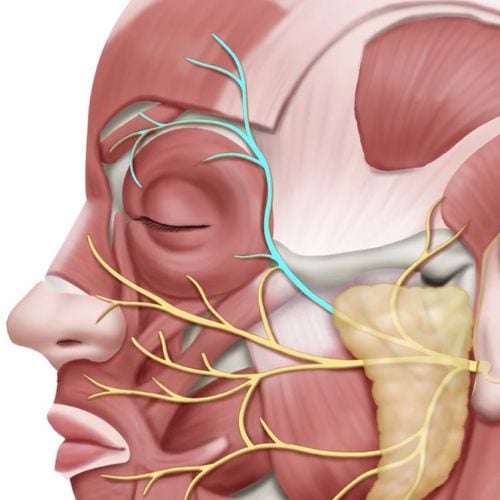
To comprehend how this devastating complication can occur, we need to examine the anatomy of the frontal branch of the facial nerve. This critical nerve emerges from underneath the zygoma, passes through the masseter muscle, travels on top of the muscle fascia, and then makes its way up into the temple.

3D anatomical illustration showing frontal branch of facial nerve pathway through temple region with surrounding muscles
The frontal branch of the facial nerve (shown in blue/teal) passes through the temple region between deep and superficial fascia, making it vulnerable during cannula-based filler injections

When the nerve enters the temple region, it ascends through the tissue layers and eventually passes into the exact zone where many practitioners place their cannula for revolumization. The space between the deep and superficial fascia, where the nerve resides, is precisely where we’re depositing filler and where complications can arise.

Types of Nerve Injury: From Temporary to Permanent

1. Lidocaine-Induced Neuropraxia (Most Common)

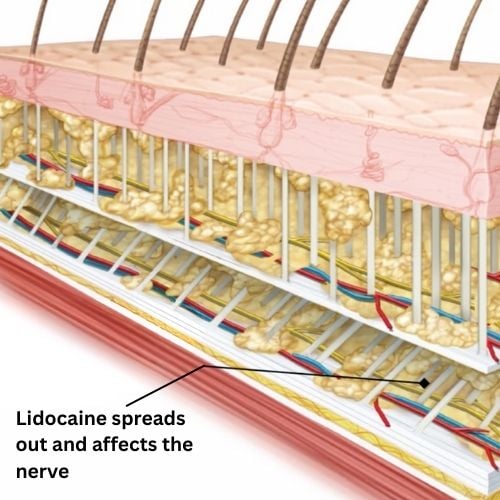
The most frequent type of nerve effect is actually temporary and caused by the lidocaine in the filler. When lidocaine spreads through the interfascial space where the nerve sits, it blocks the sodium channels on the nerves, preventing impulses from getting through. This happens in a large proportion of temple treatments and typically wears off within hours – sometimes taking up to eight hours for complete recovery.

Cross-sectional diagram showing how lidocaine spreads through tissue layers and affects nerve function
Anatomical cross-section demonstrating how lidocaine from dermal fillers spreads through interfascial spaces and temporarily blocks nerve conduction, causing temporary neuropraxia

2. Compression Neuropraxia

The second type occurs when the cannula damages the nerve through compression. If you’re unlucky enough to prod, pull, or compress a nerve with your cannula, you can temporarily stop it from working. This is similar to what happens when you sit too long in one position and get a “dead leg” – the nerve compression affects its function, causing temporary decreased activity. This type of injury is probably the most common nerve injury seen after dermal fillers, particularly with cannulas.

3. Severe Nerve Damage (Axonotmesis)

The most concerning type of injury occurs when the nerve is more severely damaged – potentially torn or broken. Moving a large instrument like a cannula in and out of tissue layers makes you much more likely to encounter and engage with the nerve. If you’re relatively rough or just unlucky, you might tear or break the nerve, causing axonotmesis. This can result in months of recovery time or, worst case scenario, permanent injury if the nerve is severed.

Why Cannulas Pose Unique Risks in the Temple

When using cannula treatments in the temple, you cover a much larger area with your instrument compared to techniques like the gunshot method with needles. This extensive movement through tissue layers significantly increases your chances of:

  • Encountering the facial nerve
  • Poking or prodding nerve structures
  • Potentially tearing or breaking delicate nerve fibers

While cannulas are often believed to be safer for avoiding blood vessels and preventing vascular occlusion, they may not be appropriate for all areas of the face – especially when used roughly in regions with delicate nerve anatomy.

Key Diagnostic Indicators

Understanding when to worry is crucial for proper patient management. The timing of symptom onset provides vital diagnostic information:

  • Immediate weakness during the procedure : More likely indicates severe nerve injury
  • Gradual onset over minutes to hours : Often suggests lidocaine effect or mild compression
  • Symptoms appearing 24-48 hours post-procedure : May indicate inflammation-related compression

The key differentiator is that continuous compression without release can cause much longer-lasting neuropraxia, making early recognition and intervention critical.

The Surprising History: Intentional Nerve Freezing

Interestingly, facial nerves have been intentionally affected for aesthetic purposes in the past. A treatment called “Frotox” involved cryo-neuromodulation using focused cold nitrous oxide to freeze the nerve, causing temporary neuropraxia. This would restrict frontalis muscle contraction long enough to improve lines and wrinkles, similar to botulinum toxin treatment. However, this controlled approach is vastly different from accidental nerve injury during filler procedures.

Clinical Observations: An Uptick in Temple Complications

Anecdotally, there’s been a significant increase in complications from temple treatments recently. While it’s impossible to determine without proper studies whether this is random variation or related to more practitioners performing these procedures, the pattern is concerning.

In clinical practice, we’ve now observed:

  • Compression of veins causing swelling and protruding vessels
  • Vascular occlusions of the superficial temporal artery with cannulas

Interestingly, complications from the gunshot technique with needles in the same area have been notably absent in comparison.

Best Practices for Safer Temple Injections

If Using Cannulas:

The crucial factor in preventing nerve injury is technique. Think of it like diffusing a bomb – every movement must be:

  1. Tiny and smooth : Make small, controlled movements through the tissue
  2. Gentle pressure only : If you encounter any resistance, stop immediately
  3. Find easier paths : Never force the cannula through tissue
  4. Create space first : Deposit a small amount of filler to open the area before moving the cannula freely
  5. Minimize passes : Reduce the number of times you move through the tissue

The Golden Rule:

Be extra gentle when using a cannula in the temple area. The gentler your technique, the less likely you are to cause nerve damage. Once you’ve opened up the area with a little filler so the cannula slides easily, you can pass in and out without putting pressure on additional structures.

Patient Communication is Essential

Given that brow heaviness is quite common even in uncomplicated procedures (due to temporary lidocaine effects), proper patient education is crucial:

  • Pre-treatment warning : Always inform patients that temporary brow heaviness is common
  • Set expectations : Explain that this can last up to 8 hours post-procedure
  • Emergency protocols : Provide clear instructions on when to seek immediate help
  • Document everything : Record any unusual sensations or resistance during the procedure

When to Worry: Red Flags for Permanent Injury

Practitioners should be particularly concerned if:

  • Muscle weakness occurs immediately during the procedure
  • Patients report severe, sharp, or electric shock sensations
  • Weakness persists beyond 8-12 hours post-treatment
  • Progressive worsening of symptoms occurs
  • Any signs of complete muscle paralysis appear

The Bigger Picture: Technique Selection Matters

While both cannula and needle techniques have their advocates, the key is understanding that no technique is universally safer. The temple’s complex anatomy, with its intricate network of nerves and vessels, demands respect regardless of your chosen approach. What matters most is:

  • Thorough anatomical knowledge
  • Gentle, controlled technique
  • Appropriate patient selection
  • Immediate recognition of complications
  • Proper management protocols

Moving Forward: Learning from Complications

This case of permanent brow ptosis serves as a crucial reminder that even “safer” techniques carry risks. As aesthetic practitioners, we must:

  1. Continuously update our anatomical knowledge
  2. Practice gentle injection techniques
  3. Maintain open communication with patients
  4. Document and share complication cases for collective learning
  5. Choose techniques based on individual patient anatomy rather than blanket preferences

Conclusion

Temple filler treatments using cannulas aren’t inherently dangerous, but they require exceptional care and technique. The potential for nerve injury – ranging from temporary lidocaine effects to permanent nerve damage – must be respected and understood by every injector performing these procedures.

Remember: the difference between a temporary inconvenience and a permanent disability often comes down to injection technique. When working in high-risk areas like the temple, there’s no such thing as being too gentle or too careful.

The case discussed here isn’t meant to discourage temple volumization but rather to emphasize the critical importance of proper technique, anatomical knowledge, and respect for the delicate structures we work around every day.

Anatomy360 - The Ultimate 3D Anatomy Course

Understanding facial anatomy is crucial for precise filler placement and achieving natural, balanced results. Knowledge of anatomical structures and vascular supply not only helps in avoiding complications but also enhances the overall effectiveness of treatments.

Dr Tim Pearce's anatomy course delivers a thorough understanding of facial anatomy through 12 online lessons. Tim says:

“The problem is we’re taught anatomy in 2D textbooks, but real-life anatomy isn’t flat. In order to feel confident with injecting and to get that millimetre by millimetre precision that increases safety, we need more detail. That’s why I’ve created the ultimate Anatomy learning experience specifically for aesthetic injectors. It’s going to help you up-level your anatomy knowledge and boost your injection safety & confidence in a way that no cadaver course could ever.”


Anatomy360 Course
Anatomy360 Course

Dr Tim Pearce eLearning

Dr Tim Pearce MBChB BSc (Hons) MRCGP founded his eLearning concept in 2016 in order to provide readily accessible BOTOX® and dermal filler online courses for fellow Medical Aesthetics practitioners. His objective was to raise standards within the industry – a principle which remains just as relevant today.

Our exclusive video-led courses are designed to build confidence, knowledge and technique at every stage, working from foundation level to advanced treatments and management of complications.

Thousands of delegates have benefited from the courses and we’re highly rated on Trustpilot. For more information or to discuss which course is right for you, please get in touch with our friendly team.

Share This Article
Facebook Twitter Pinterest Linkedin
Prev Post
Next Post

Related Articles

Biostimulators vs. Energy-Based Devices: Clinical Guide to Long-Term Skin Rejuvenation Bestseller

Biostimulators vs. Energy-Based Devices: Clinical Guide to Long-Term Skin Rejuvenation

March 17, 2026

Biostimulators vs. Energy-Based Devices: Clinical Guide to Long-Term Skin Rejuvenation
By Andrea Callaway
March 17, 2026

Biostimulators vs. Energy-Based Devices: Clinical Guide to Long-Term Skin Rejuvenation

READ MORE
Facial Muscle Anatomy for Botulinum Toxin Bestseller

Facial Muscle Anatomy for Botulinum Toxin

March 12, 2026

Facial Muscle Anatomy for Botulinum Toxin
By Andrea Callaway
March 12, 2026

Facial Muscle Anatomy for Botulinum Toxin

READ MORE
When stress becomes visible: physiology of visceral fat accumulation Bestseller

When stress becomes visible: physiology of visceral fat accumulation

March 10, 2026

When stress becomes visible: physiology of visceral fat accumulation
By Andrea Callaway
March 10, 2026

When stress becomes visible: physiology of visceral fat accumulation

READ MORE

Popular Courses

BOTOX® Foundation Course

BOTOX® Foundation Course

Pro Tox

Pro Tox

8D Lip Design

8D Lip Design

SEE MORE

CONTACT US

    contact injection
    Dr Tim Pearce

    Improve your medical
    aesthetics business

    • Home
    • Courses
    • About
    • Contact
    • Dr Tim Limited Terms and Conditions of Sale
    • Privacy Policy
    • Website Terms Of Use
    • Careers
    Login Dr Tim Pearce Login
    © Copyright Dr Tim Ltd, 2025
    We use cookies on our website to give you the most relevant experience by remembering your preferences and repeat visits. Read More. By clicking “Accept All”, you consent to the use of ALL the cookies. However, you may visit "Cookie Settings" to provide a controlled consent.
    Cookie Settings Reject All Accept All
    Manage consent

    Privacy Overview

    This website uses cookies to improve your experience while you navigate through the website. Out of these, the cookies that are categorized as necessary are stored on your browser as they are essential for the working of basic functionalities of the website. We also use third-party cookies that help us analyze and understand how you use this website. These cookies will be stored in your browser only with your consent. You also have the option to opt-out of these cookies. But opting out of some of these cookies may affect your browsing experience.
    Necessary
    Always Enabled
    Necessary cookies are absolutely essential for the website to function properly. These cookies ensure basic functionalities and security features of the website, anonymously.
    CookieDurationDescription
    cookielawinfo-checkbox-analytics11 monthsThis cookie is set by GDPR Cookie Consent plugin. The cookie is used to store the user consent for the cookies in the category "Analytics".
    cookielawinfo-checkbox-functional11 monthsThe cookie is set by GDPR cookie consent to record the user consent for the cookies in the category "Functional".
    cookielawinfo-checkbox-necessary11 monthsThis cookie is set by GDPR Cookie Consent plugin. The cookies is used to store the user consent for the cookies in the category "Necessary".
    cookielawinfo-checkbox-others11 monthsThis cookie is set by GDPR Cookie Consent plugin. The cookie is used to store the user consent for the cookies in the category "Other.
    cookielawinfo-checkbox-performance11 monthsThis cookie is set by GDPR Cookie Consent plugin. The cookie is used to store the user consent for the cookies in the category "Performance".
    viewed_cookie_policy11 monthsThe cookie is set by the GDPR Cookie Consent plugin and is used to store whether or not user has consented to the use of cookies. It does not store any personal data.
    Functional
    Functional cookies help to perform certain functionalities like sharing the content of the website on social media platforms, collect feedbacks, and other third-party features.
    Performance
    Performance cookies are used to understand and analyze the key performance indexes of the website which helps in delivering a better user experience for the visitors.
    Analytics
    Analytical cookies are used to understand how visitors interact with the website. These cookies help provide information on metrics the number of visitors, bounce rate, traffic source, etc.
    Advertisement
    Advertisement cookies are used to provide visitors with relevant ads and marketing campaigns. These cookies track visitors across websites and collect information to provide customized ads.
    Others
    Other uncategorized cookies are those that are being analyzed and have not been classified into a category as yet.
    SAVE & ACCEPT