
You may be interested




 Dr Tim Pearce

Following safety steps when delivering cosmetic injectables can lower your risk of causing complications, ultimately making you a safer injector. But you cannot rely on one single safety step or be 100% safe.
In this blog, Dr Tim Pearce shares five safety mistakes that aesthetic clinicians may make that can lead to patient injury, side effects, complications, or general patient disappointment and the inevitable one-star review.
To be among the first to receive exclusive updates on the launch of Dr Tim’s new movement, featuring an immersive 3D learning experience, comprehensive Botox lessons, and much more, simply sign up here to join the priority waiting list.
What can happen if you are not focused on safety in aesthetic practice?
If you do not practice with safety in mine, you are not only increasing your risk of causing complications, including the fear or a vascular inclusion, but more readily, you will increase the day-to-day ‘noise rate’ of negative outcomes, warns Dr Tim.
That can include more incidences and complaints related to bruising or swelling, for example. You will find that you include more ‘leg work’ for yourself and any front-of-house staff you employ while you reassure anxious patients, explain and talk through problems, such as putting a patient’s mind at rest that a bruise will resolve etc.
Focusing on safety (and not relying on one solution alone) to reduce ALL your complication rates, trying to make everything as safe as possible, will lead to a more easily run clinic. There will be less emotion in your day-to-day work as patients will leave happy, with the result that they were expecting, and you will not have to deal with negative consequences.
There is a lot to be gained through precision and risk reduction; it might feel like a lot of extra work, but it will reward you and save time after each procedure is complete.
Aspirating does not make you 100% safe
 The first mistake is to believe that aspirating makes you 100% safe. The viewpoint of those who do not aspirate, or are anti-aspiration and do not practise it, is that it can give false reassurance to aesthetic injectors because they believe they do not need to worry about other safety steps.
If you aspirate and you get a negative result, it does not mean that you are not in a vessel, it simply means there is a lower probability that you are in a vessel at that moment, explains Dr Tim. There are a lot of other things you should be doing, as well as aspirating, to make yourself safe, and the real secret to safer injecting is to layer several safety steps each time you inject.
Not aspirating does not make you 100% safe
The opposite, and second mistake, is to believe that you are 100% safe by not aspirating because you have heard others suggesting that it “does not work”. The likelihood of not aspirating is that the injector will be relying on another ‘safety measure’ like continuously moving the needle throughout the procedure.
This is a flawed logic because you will be unaware of what proportion of your dermal filler is placed within different layers of the skin, and how much you can inject before it becomes a risk, without knowing the volume of the vessels, how many different entry points or how much movement you require, or how widely to spread the product for it to be safe. The fixative thinking assumes that “as long as I’m moving, that means I’m safe”. Sadly, this is a lottery and likely a surefire method to end up causing a vascular occlusion because you do not have all the safety parameters in place and are relying on one – continuous movement.
You can liken the use of aspiration as a safety measure for dermal filler injections to wearing a seatbelt in a car; the seat belt, on its own, will not stop you from having an accident or from being killed in the event of an accident, it merely reduces the risk. You must safely drive the vehicle too, but wearing the seatbelt is one of many safety steps that reduce the risk of a more tragic accident. Of course, if you were to drive into a lake, wearing a seat belt could be a disadvantage, but we all accept on balance that wearing a seat belt every time we get into a car is better than not wearing one. This is the same reason why we should still aspirate, urges Dr Tim, despite it not being 100% effective at detecting an intravascular injection. But use it alongside other safety steps, just like the seatbelt.
For more on the aspiration debate, read Increase your injection safety with this aspiration trick and How many seconds should you aspirate for when injecting fillers?
Relying on anatomy does not make you 100% safe
Even so-called best-of-the-best, world-famous injectors fall foul of relying purely on anatomy, emphasises Dr Tim. You may witness an aesthetic clinician demonstrating on stage at a convention who deposits a full 1ml of dermal filler into a patient’s forehead, in one bolus because they believe the arteries never run on the periosteum in the forehead. Dr Tim agrees that this thinking is commonly true, and it is very unlikely that you would find a large vessel in the middle of the forehead, so most of the time you would probably get away with a bolus and massage, but now and then, you will meet a patient who does not fit the textbook.
To reinforce this, Dr Tim explains that after posting a piece online about anatomy learning, he was contacted by American oral & maxillofacial surgeon, Patricia Oyole who sent him a picture of a forehead she dissected which showed the full periosteum covered in vessels – quite a shocking image, especially if you have been relying on there never being a vessel in that location. The lesson here is that relying on the statistical probability of where vessels should be located is never enough for a lifetime’s worth of clinical practice. You must always inject in a way that makes it safer just in case there is some aberrant anatomy.
This applies in all facial areas where anatomy may deviate from the norm. Other examples noted by Dr Tim include thinking you will never find a blood vessel on the periosteum of the cheek, or that injecting on the midline of the chin is safe, or in the temple. We cannot rely solely on textbook anatomy.
Remember you can buy Dr Tim’s limited edition facial anatomy posters as a helpful tool to understand the paths of the facial vasculature.

Relying on ultrasound does not make you 100% safe
It can be very tempting to rely on ultrasound as a safety measure because you can be led to believe that if you have a look, and see that there are no vessels present, you can inject without worry. But the truth is, many reported cases of vascular occlusions happened straight after an ultrasound scan was performed.
Small changes in the position of the ultrasound probe or user error can make it possible to perform a scan and miss seeing a vessel, especially in a patient with aberrant anatomy. As noted previously, you cannot rely on only one type of safety measure.
Checking capillary refill does not make you 100% safe
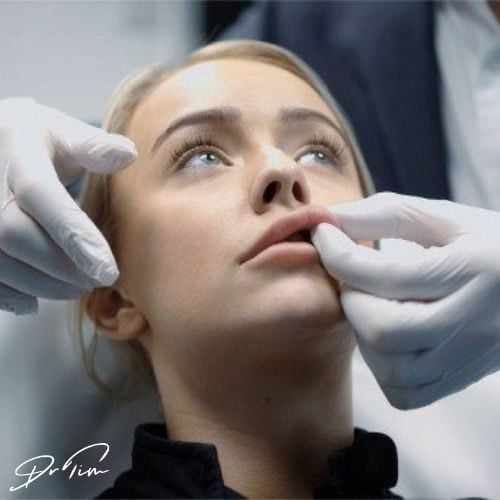
If you diagnose a vascular occlusion immediately, it will place you in a very good position to prevent necrosis, especially if you have used a reversible, hyaluronic acid dermal filler product as opposed to one of the non-reversible-based ingredients available. It is vital to get the diagnosis of vascular occlusion right from the start though, reminds Dr Tim, and that usually involves a capillary refill test (CRT).
When he had his first vascular occlusion case, many years ago, he remembers noting that the capillary refill initially looked normal. As he gently pushed on the lip it seemed fine, but as he increased the pressure, because he could sense that something was not right, and kept pushing harder and for longer, it became obvious that the vessel was compromised.
Capillary refill tests must be performed properly for them to give reliable feedback, otherwise, they can mislead. Dr Tim refers to a video posted recently by Dr Subbio where he demonstrated a misleading normal capillary refill check. As his camera panned out, it was revealed that the normal capillary refill was on a piece of skin that had already been removed from the patient during a surgical procedure. This demonstrated, unambiguously, that it is not cardiac output that is refilling the skin in this situation, and that the capillary refill that you are seeing in some cases, if you are only pressing gently, is probably just some blood in the venous system that swishes in and out superficially, appearing as blood flow. Therefore, it is crucial to perform a decent capillary refill test using adequate pressure and time.
Dr Tim recommends using the force of the full palm of your hand, pushing, and pressing firmly on the patient for 5 to 10 seconds and then releasing, ensuring you do so in bright light so you can see the direction of blood flow. Similarly, he advises using a control zone for comparison, for example, compressing both sides of the lip, even if you are only concerned with one side, or both cheeks etc. Upon release, you can observe where the blood flow is last to return to. CRTs are an extremely helpful test and are readily used by nearly all aesthetic clinicians, but they are no good if not performed properly.
All of these safety steps are useful, but they are best used in combination, and not in isolation.
Dr Tim loves to receive questions, comments, and data on clinical practice experiences from his followers. You can find Dr Tim Pearce on Instagram.
Aesthetics Mastery Show
PERMANENT brow ptosis from a cannula?! Temple filler safety tips & cannula advice
Dr Tim says:
“I believe you can get through your whole injection career without ever causing a necrotic injury, but there’s a few safety steps some injectors miss that can really lower your risk of complications.”
Watch the full Aesthetics Mastery Show here.
Commenting on the YouTube video,
@sunnygirlrn commented:
“Thanks for always keeping safety at the forefront of your education.”
@Juststop358 said:
“The clip about belt. Is prob the nerdiest most ridiculous but brilliant for those smart enough to understand haha”
We agree! Fast forward 2 mins 47 seconds in to see this section:
See more feedback and comments from practitioners and clients on our YouTube channel – feel free to join the debate!
You can also subscribe to our YouTube channel for really useful regular tips and advice. 
3D Anatomy Learning Experience

In the next few weeks, Dr Tim Pearce is going to be launching something amazing that involves an incredible 3D learning experience for injectors, a community of clinicians on the same mission as you to help you achieve your goals, and exclusive online access to him and his team. Be the first to join the movement by joining the priority waiting list.
Dermal Filler eLearning Courses
If you want to increase your knowledge about safe and effective dermal filler injectable treatments, Dr Tim Pearce offers a series of fabulous courses. The foundation level is a popular starting point, with many delegates continuing to complications courses focused around safety, including how to minimise the risk and how to handle things if the worst occurs:
Both give CPD and certificates on completion and are highly rated by our delegates.
In addition, browse our FREE downloadable resources.
Dr Tim Pearce eLearning
Dr Tim Pearce MBChB BSc (Hons) MRCGP founded his eLearning concept in 2016 in order to provide readily accessible BOTOX® and dermal filler online courses for fellow Medical Aesthetics practitioners. His objective was to raise standards within the industry – a principle which remains just as relevant today.
Our exclusive video-led courses are designed to build confidence, knowledge and technique at every stage, working from foundation level to advanced treatments and management of complications.
Thousands of delegates have benefited from the courses and we’re highly rated on Trustpilot. For more information or to discuss which course is right for you, please get in touch with our friendly team.





Comment (1)
Meta Dermatology
Feb 20, 2024This is an incredibly informative and detailed post on the importance of safety in aesthetic practice. I appreciate the emphasis on the need to layer multiple safety steps, rather than relying on a single measure, and the use of relatable analogies like the seatbelt example. Thank you for sharing your expertise and helping to promote safe practices in the industry.
Comments are closed.