
You may be interested




 Dr Tim Pearce
 Lip filler migration…do those words bring you out in a cold sweat? You are not alone, it is shaping up to be a significant problem and something that you need to understand and manage, whether it is your patient or someone else’s.
Even safe, low volume injectors many find a small percentage of their patients come back years later and complain about filler migration.
In this blog, Dr Tim Pearce shares everything you need to know about lip filler migration including the causes, ways to treat, and prevention.
Do you feel anxious about causing complications? Many clinicians feel so overwhelmed with the thought of causing a vascular occlusion that it stops them growing their aesthetics business. Dr Tim is currently hosting a webinar series to help you overcome your fear of complications so that you can uplevel your knowledge, and increase your CPD-certified learning to build a successful aesthetics business. Sign up here >>
How can you fix the ‘beak effect’ on the upper lip? ?
 Some aesthetic clinicians, especially at the start of their careers tend to try and solve problems in unsustainable ways, and by this, Dr Tim explains that you might think that adding a little bit more filler should get the definition back in the lip, in someone who has a beak-like migration pattern; unfortunately, this is a short-term strategy, and it will likely make the problem worse.
Your patient may even want you to do that and specifically request more filler, but this is not a good strategy, and you must be honest with patients. When there is filler migration present, the gold standard is reversal using hyaluronidase (for hyaluronic acid-based products); although waiting for the filler to naturally breakdown can be an option.
It is worth remembering that waiting could be a very long game because dermal filler can last for up to a decade in some people. Dr Tim believes that as aesthetic clinicians, we are going to have to get used to the idea that reversals are a normal part of the management for many patients, particularly in those who do not break down filler products quickly.
Does filler last different lengths of time in different people?
The short answer is, yes. The spectrum of longevity is huge, with significant extremes. Dr Tim had a patient who completely broke down 12mls of dermal filler in approximately a month; a very sad situation he recollects, and very expensive for his clinic as he refunded the patient.
Other patients may come back to you ten years after treatment and still have product evident. As injectors, we need to educate our patients about longevity of fillers and what is possible in between those two extremes.
Are old and migrated fillers more difficult to remove?
Dr Tim’s experience is quite the opposite, he believes that the older a product, often the quicker it breaks down when treated with hyaluronidase, in comparison with more recently placed product.
There is one issue with fillers that break down slowly over time – you get an increase in perceived volume. Dr Tim imagines that this is happening due to the fraying of the hyaluronic acid chains into smaller components, smaller sugars that are more dissolvable. These smaller sugars may attract more moisture to the area, thus, as they are fraying, they cause a oedematous result, but if you use some hyaluronidase, it dissolves quickly.
Is the classic ‘duck lip’ a sign that filler is migrating?
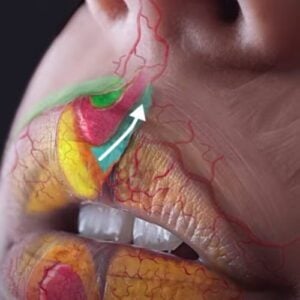 The so-called duck lip is a projection from the side view – you get a triangular shape as the lips are projecting forwards. Dr Tim notes that this happens with repeated filler treatments over time. A patient may start with 0.5ml on their first treatment, achieving a nice show of the pink lip and a little projection. Gradually, over time, it starts to shift slightly due to the movement of the mouth – as orbicularis oris contracts making the lips smaller, the patient will be naturally squeezing filler away from the pink lip and into the white lip, travelling inferior to or underneath the orbicularis oris muscle and collecting in the white lip.
If the patient is retreated 6-12 months later, the same process will happen again, and over several years, you will eventually notice the unnatural projection in the lip that has increased beyond that of a normal treatment outcome.
In the aesthetic sector, the emotional and financial drivers in lip filler treatments are often not to stop the process, reverse and start again, but instead practitioners will see if they can do a little tweak, repeat, and hopefully the patient will be happy for another year. However, if every aesthetic injector takes this approach, over the course of several years, the result is patients who are over projected with an unflattering result that neither they nor the practitioner intended from day one.
How can you tell if it is the filler that is migrating or just filler that has been badly placed?
Of course, it is easy to blame injectors for bad injecting, however, Dr Tim suspects a lot of the issues related to migration are due to the properties of the filler product over time. Even a good injector can have a good result for two or three years but then it can start to drift away from the desired result.
It is likely that the patient will tell you immediately if the injection technique was ‘bad’ because no one is seeking a migrated lip pattern from the start, so if it does not look pretty, most patients will rapidly complain about it.
The length of time between the treatment and the patient being unhappy is a rough guide as to whether it was a bad injection technique or whether it is product migration, because migration tends to happen slowly over time, often years and in line with repeated treatments and a slow, gradual accumulation of a bad result.
How does injection placement impact the risk of filler migration?
It is important to know your anatomy – there are structures within the lip that you can use to fend off the chance of filler migration. Dr Tim highlights the importance of the insertion of orbicularis oris into the vermilion border that forms a natural wall between one of the areas that we are most afraid of causing migration into – the white lip.
There are only two compartments where filler migration is an issue, into the posterior side of the lip that produces the over projection and beak shape, or into the white lip where you lose the definition in the vermilion border and end up with a rounded, shapeless top lip – the Homer Simpson or monkey look.
Both outcomes are at risk with different injection techniques. For example, if you use a cannula, you are more likely to find the lip filler deposition is more posterior in the lip and that makes it more likely that it will migrate underneath the orbicularis oris muscle to cause over projection, particularly with repeated treatments. However, if you are more superficial and closer to the white lip, using injection techniques such as the four-millimetre technique, you are on top of the orbicularis oris muscle, which is a prime location for causing a loss of definition to the vermilion border and a migrated look.
The harder you try to define a border the more filler is right up against an area where it might easily migrate. The most important thing is the placement of your needle – in the little space anterior to the insertion of orbicularis oris. If you spend most of the time with your needle there, you are much less likely to get filler overflowing into the white lip. Be aware that the harder you try, in terms of creating or augmenting a border, the more volume that you are placing and the more likely that some of that will spill over with time.
Once a product has migrated, does it ever dissolve on its own or should you dissolve it?
This depends on when the filler was placed. Dr Tim has seen a few patients four or five years after having a lip procedure, having not had further treatment since, who have developed migration within the last eighteen months or so. For those patients, it does not make sense to wait any longer as the migration has been present for some time, thus, reversal is advised.
If, however, a patient was badly injected perhaps a month ago and they really do not want to have a reversal, waiting may be the best option for them as you might see a difference in the next six months. If any migration is causing a significant psychological or medical harm to a patient, then they would benefit from reversal, rather than from waiting.
Check out Dr Tim’s Lip Design Blueprint, the 4 steps experts use to plan the perfect lip augmentation.
Have you ever had lip filler migration – either with your own patient or someone who came to you for a fix? Why not share your experience with Dr Tim and his followers? You can find Dr Tim Pearce on Instagram.
Aesthetics Mastery Show
For more insight, watch the latest episode of the Aesthetics Mastery Show, where Dr Tim shares everything you need to know about lip migration including causes and prevention; so that you’re ready any time when you are faced with migrated lip filler, whether that’s your own patient or someone else’s who has come to you for a fix.
The show has thousands of views already, plus comments and feedback from other practitioners:
“I find more migration initially in patients who swell significantly. I believe the swelling can act to displace the product in some cases. Because of this, I have taken to premedicating patients with an antihistamine like Zyrtec. It seems to be useful. What are your thoughts on this? Thanks for helping us all keep our patients safe and happy.”
As well as appreciation:
“Thanks for another great vid Doc you always keep it real”
Is your worst nightmare causing a VO?
If you want to be a great injector then you need to get over your fear of complications. Register here for the next webinar to help you overcome your complications anxiety >>
Subscribe to our YouTube channel for really useful regular tips and advice. 
Dr Tim Pearce eLearning
Dr Tim Pearce MBChB BSc (Hons) MRCGP founded his eLearning concept in 2016 in order to provide readily accessible BOTOX® and dermal filler online courses for fellow Medical Aesthetics practitioners. His objective was to raise standards within the industry – a principle which remains just as relevant today.
Our exclusive video-led courses are designed to build confidence, knowledge and technique at every stage, working from foundation level to advanced treatments and management of complications.
Thousands of delegates have benefited from the courses and we’re highly rated on Trustpilot. For more information or to discuss which course is right for you, please get in touch with our friendly team.