
FREE Complications Webinar
Want to overcome your fear of complications and confidently master anatomy?
Join us for one of Dr Tim's FREE upcoming webinars.
Check dates here and save your spot
 Dr Tim Pearce
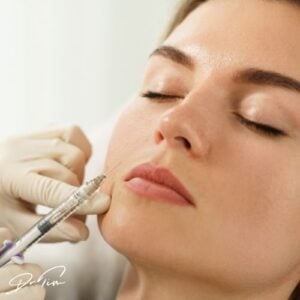
Small lips create one of the harder treatment-planning challenges in aesthetic practice, because the patient typically wants more volume than the existing anatomy comfortably allows, and the temptation to chase a bigger result in one sitting is the precise route by which the patient ends up looking worse than when they walked in. The working principle is to get a good result on the day, preserve the option of adding more volume in a more controlled way at a follow-up, and never trade the natural beauty of the lip’s existing detail for a unit of additional fullness that erases that detail in the process.
The diagnostic question to ask before any needle goes near the lip is what makes the patient prettier when you move her lip with your fingers, because the answer points directly at where the volume needs to go. Elevation in the middle of the upper lip and the central third of the lower lip is usually the strongest aesthetic move. The more you study what happens when the lateral lip is elevated, the more obvious it becomes that you do not want to do that, because the lateral lower lip lifted produces a sad appearance and the lateral upper lip lifted produces a snarl. The work that actually beautifies these lips lives in generating height and projection in the middle third while preserving the existing detail elsewhere.
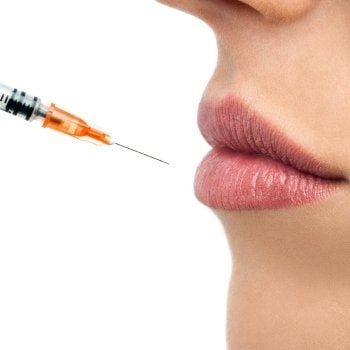
A needle-based approach to the lip offers two main injection types, and they produce meaningfully different results. Horizontal injections add volume, while vertical injections add volume along with vertical height, which makes the vertical injection the workhorse when elevation is the aesthetic goal. In this small-lip case the existing vermilion border is already well defined, so the work is to preserve that border rather than build it, which means the entry point sits inside the pink rather than near the border itself.
A vertical injection is harder to perform in a thinner lip simply because there is less space inside the lip body for the needle to travel cleanly. Rotating the patient’s lip upward gives you more working room, which makes the vertical approach more achievable on a smaller lip than it would otherwise be. The trade-off worth being aware of is that rotation may pull the superior labial artery out with the lip tissue, and you can sometimes feel or see it underneath, occasionally even seeing it pulsate, so this is a moment to check carefully. Depth awareness protects you here because at the right superficial level you remain above the artery regardless of how the lip is positioned.
One of the harder aspects of vertical injection is that the needle is straight while the lip is curved, which means a long pass along the lip body fights the natural geometry. A practical workaround is to add a slight curve to the needle by placing a small kink at the top, or a series of small kinks that produce a gentle curve along the shaft, which lets the needle follow the arc of the lip more easily. The technique is to clamp the needle inside a sterile swab soaked in a cleansing agent and curve it with a pair of pliers.
The bevel orientation matters during the curved pass, with bevel down being preferred because it reduces the chance of filler bubbling up to the surface as the needle travels along the arc. Surface bubbles of the product are a known outcome of this kind of injection and resolve with a small massage, but reducing the risk in the first place produces a cleaner result on the day.
The insertion point sits where the pink is starting, never through the white part of the lip. The older tenting or fencing technique that drove needles straight through the white lip went directly through the line of the arteriols and produced visible bleeding trickling down the patient’s face, which is exactly the picture that filled Instagram feeds in 2012. The modern approach respects the depth and entry that minimises swelling and bruising.
Depth control is the single most important thing in lip work, and the depth has to be held consistently along the entire length of the pass. The needle does not drift deeper as it travels, which is why depth checks happen repeatedly throughout the injection rather than just at the entry point. The aim is to stay in the most superficial plane available, with each pass repeatedly verified against that depth before any product is delivered.
Aspiration through the needle is debated, with many injectors choosing not to aspirate in the lip given that everything else has been done correctly. Aspiration is not particularly risky to skip in the lip if depth, entry, and product placement are all handled, but it remains a useful default for any injector with it built into their muscle memory. A linear thread on the way out delivering approximately 0.05 ml per pass is the working dose for this kind of fine vertical enhancement.
Where a second pass is needed in the same area, using the same entry hole reduces total trauma and likely swelling. The second pass enters fractionally laterally rather than along the identical track, which expands the treated zone without multiplying the bruising risk. Watching where the product flows during the injection itself is part of the live diagnostic process, with product visible tracking along the vermilion border on the way out telling you something about the tissue planes and informing what happens next.
Product flow is also the cue to stop, because if you see filler beginning to bubble up towards the surface that is the moment to halt the injection rather than push more in. There is a counter-instinct worth holding alongside this, which is that stopping too early can mean missing the additional border definition that comes from carrying the injection a little further along, with this being something to learn from injecting alongside Julie Horne. The finishing technique includes a small squeeze where the filler has emerged, so that no product is maintaining the openness of the needle hole.
Filler does not necessarily flow to the place you want it. It flows to the low-pressure points within the lip, which may not exactly match the shape you are trying to create. A small sculpting massage at the end of the injection moulds the product into the shape you want, removes any distracting lumps or bumps, and produces a better result than relying on the natural flow path of the product alone.
This is also where the practitioner’s eye needs to manage the swelling-versus-product question carefully, because what you see in the first 30 seconds after injection is mostly product, while everything you see beyond that point is increasingly swelling rather than the product itself. Holding a mental note of how the lip looked immediately after each pass is the way to keep your assessment honest as the swelling sets in across the rest of the appointment.
Side-to-side symmetry comes from giving each side equal time and equal injection sequence so that the swelling on both sides is comparable when you assess. Early in a career it is common to spend longer on one side and find the dramatic swelling makes accurate symmetry assessment impossible, with the fix being to replicate the movement and the volume on each side and then give equal time before judging the difference.
The middle third work continues into the lower lip with attention to the central tubercle, with a vertical injection placed over the tubercle delivering approximately 0.05 ml in a careful pass. A small total volume is intentional in a small lip because the result will look stronger immediately after injection than it will after settling, and erring towards understatement preserves the option of adding more later without committing to an irreversible overcorrection.
The aesthetic case for restricting the work to the middle third comes down to curves. Feminine lip beauty is built on the curves of the tubercles, and treatment that enhances those curves makes the lip more beautiful even at very small total volumes. Lateral injections show more pink but reduce the visible curvature, which produces a bigger-looking lip that is actually less attractive. The lateral pull test, where the lip is gently spread laterally, makes the loss of curvature visible in real time as the curves decrease and the tubercle definition disappears.
A tiny technical tweak around the middle elevation matters here. If the mid part of the upper lip sits slightly higher than the lateral part it produces a subtle frown appearance, while bringing the mid section down very slightly relative to the lateral produces a more positive expression. The adjustment is small but the perceptual effect is real.
Where additional volume is genuinely indicated beyond the initial vertical work, the same approach extends to one or two further passes in the middle third, with the angle changed to produce roundness rather than further aversion. A volume injection rather than an aversion injection here delivers a small amount of filler next to the everted section so the lip sits round and full while preserving the shape built earlier. The lips should look like they are falling out of the mouth, because evolutionarily that is what they are, with the visible oral mucosa being the part of the inner mouth that has evolved outward.
The product choice influences how cautiously you need to work. With something like V-lift, 1 ml is genuinely difficult to use in a way that creates too much shape or too much volume, which makes it forgiving on a small lip. More voluminous products require considerably more restraint with the same total volume, because the visible result for each 0.05 ml pass is greater and the risk of overcorrection is higher.
Join us for one of Dr Tim's FREE upcoming webinars.
Check dates here and save your spot
If you want to increase your knowledge about safe and effective lip filler injectable treatments, Dr Tim Pearce offers a series of fabulous courses, from foundation and upwards:
In addition, browse our FREE downloadable resources.
Dr Tim Pearce MBChB BSc (Hons) MRCGP founded his eLearning concept in 2016 in order to provide readily accessible BOTOX® and dermal filler online courses for fellow Medical Aesthetics practitioners. His objective was to raise standards within the industry – a principle which remains just as relevant today.
Our exclusive video-led courses are designed to build confidence, knowledge and technique at every stage, working from foundation level to advanced treatments and management of complications.
Thousands of delegates have benefited from the courses and we’re highly rated on Trustpilot. For more information or to discuss which course is right for you, please get in touch with our friendly team.