



Note:
This article was written by a guest contributor from our community. The views and clinical opinions expressed here belong to the author and do not necessarily reflect the opinions or endorsements of Dr Tim Ltd.
 Dr Tim Pearce
 Dr. Nieves is a medical doctor with a strong interest in aesthetic and regenerative medicine, focused on evidence-based and holistic approaches to skin health. Her work emphasizes understanding the skin as a reflection of internal balance, combining medical treatments with nutrition, lifestyle strategies, and preventive care to achieve natural and long-lasting results. She is passionate about continuous learning, scientific communication, and sharing knowledge that bridges clinical practice with modern aesthetic medicine.
https://instagram.com/dra_nievesromero
Skin quality is a concept that, while not entirely new, has significantly evolved over time. Initially considered a subjective perception, it has gradually been defined through clinical consensus, leading to the establishment of standardized criteria that allow professionals to speak a common language when assessing skin health.
This shared framework enables dermatologists, aesthetic physicians, and other specialists to better personalize treatments according to individual skin needs. In parallel, the development of therapies such as low–cross-linked hyaluronic acid, biostimulators, and energy-based devices has reinforced the importance of skin quality as a measurable and treatable entity, beyond traditional aesthetic outcomes.
Currently, skin quality is described through four main categories defined in the EPC (Emergent Perceptual Categories) model:
This model, developed by dermatology experts and published in 2025, is supported by an algorithm designed to guide treatment selection based on individual skin characteristics. An illustration of this algorithm is included in this article. (Figure 1)
The relevance of skin quality lies in the fact that skin appearance often reflects an individual’s internal state. Healthy skin conveys visual cues associated with well-being, vitality, and even fertility, which historically correlate with perception of health and attractiveness.
Once the concept of skin quality is understood, it becomes clear that it does not depend solely on in-clinic procedures. Lifestyle factors such as diet, physical activity, and supplementation play a fundamental role in skin homeostasis.
In recent years, growing evidence regarding the gut–skin axis has transformed our understanding of skin health. This complex bidirectional communication network, mediated largely by the immune system, links intestinal microbiota to inflammatory and immune responses in the skin. Alterations in this balance have been associated with inflammatory skin conditions such as acne, atopic dermatitis, and psoriasis.
These findings have shifted the clinical perspective toward a more integrative approach, emphasizing nutrition as a cornerstone of skin health. A diverse diet rich in healthy fats, fiber, fruits, and legumes provides prebiotics that support gut microbiota diversity, while also
supplying antioxidants that protect against cellular damage. Fermented foods contribute probiotics that help modulate immune responses and reduce systemic inflammation.
From a clinical perspective, this understanding has encouraged a focus on internal factors that can be safely and effectively modulated in daily practice, particularly through targeted nutrition and supplementation.
Recent evidence supports the role of specific dietary supplements in reinforcing skin health by acting from within on key physiological processes such as barrier function, inflammation control, and oxidative stress modulation. A comprehensive narrative review analyzing 238 studies evaluated fourteen commonly used micronutrients and bioactive compounds for their potential effects on skin integrity and appearance.
Among them, vitamins A, C, D, and E were highlighted for their antioxidant and immunomodulatory properties, essential for maintaining skin homeostasis:
Other compounds such as omega-3 fatty acids, curcumin, Polypodium leucotomos extract, spirulina, and astaxanthin have also demonstrated promising effects related to inflammation modulation, photoprotection, and support of the skin barrier. While standardized dosing protocols are still under investigation, current evidence supports their role as complementary tools within an integrative, inside-out approach to skin quality
Within this evolving framework, bioestimulation plays a central role in translating internal balance into visible skin improvement. Rather than acting as isolated interventions, biostimulatory treatments should be understood as part of a broader regenerative strategy aimed at enhancing cellular function, collagen synthesis, and tissue quality over time.
When combined with an optimized internal environment—supported by adequate nutrition, gut health, and targeted supplementation—biostimulation treatments such as collagen inducers, energy-based devices, and regenerative injectables achieve more consistent and long-lasting outcomes. This synergistic approach allows clinicians to address not only structural aging, but also functional skin decline.
From a practical standpoint, improving skin quality today requires moving beyond isolated procedures and adopting an integrated treatment plan that considers the patient’s lifestyle, metabolic balance, inflammatory status, and aesthetic goals. By aligning in-clinic treatments with internal support strategies, practitioners can enhance treatment response, improve skin resilience, and promote healthier aging.
Ultimately, skin quality should be approached as a dynamic reflection of overall health. The future of aesthetic medicine lies in this inside-out model, where science, prevention, and regeneration converge to deliver natural, sustainable, and individualized results.
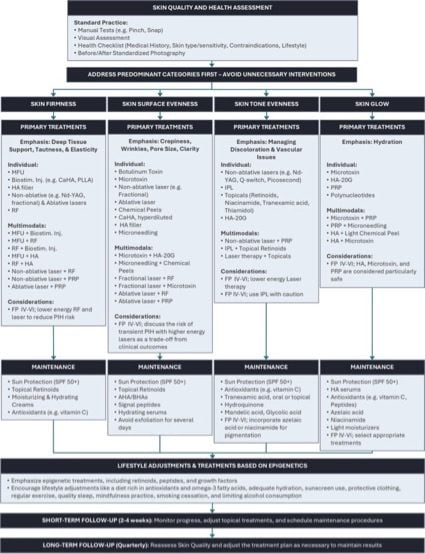
Reproduced from: Kerscher M, et al. How to Treat Skin Quality… J Cosmet Dermatol. 2025;24(Suppl 4):e70359, under CC BY 4.0. (See References)
This article was written by a guest contributor from our community. The views and clinical opinions expressed here belong to the author and do not necessarily reflect the opinions or endorsements of Dr Tim Ltd.
Dr Tim Pearce MBChB BSc (Hons) MRCGP founded his eLearning concept in 2016 in order to provide readily accessible BOTOX® and dermal filler online courses for fellow Medical Aesthetics practitioners. His objective was to raise standards within the industry – a principle which remains just as relevant today.
Our exclusive video-led courses are designed to build confidence, knowledge and technique at every stage, working from foundation level to advanced treatments and management of complications.
Thousands of delegates have benefited from the courses and we’re highly rated on Trustpilot. For more information or to discuss which course is right for you, please get in touch with our friendly team.