


• Mail us: support@drtimpearce.com
  • Trustpilot
Dr Tim Pearce, eLearningDr Tim Pearce, eLearningDr Tim Pearce, eLearning Dr Tim Pearce, eLearning
  • eLearning Courses
        • ELEARNING COURSES

        • Techniques
          • BOTOX® Foundation Course
          • Pro Tox
          • Dermal Fillers Foundation Course
          • 8D Lip Design
          • Julie Horne Directs, Dr Tim Injects – February 2023
          • Eyelash Enhancement Serum Course
          • Anatomy360
          • Art Codes
        • Complications
          • Botulinum Toxin Complications Mastery
          • Dermal Filler Complications Mastery
          • Elective Lip Reversal
        • Profinity
        • Wellness
          • How To Introduce Longevity To Your Aesthetics Clinic
        • Marketing
          • DCAM 2.0
          • Canva Mastery: A Step-by-Step Guide
          • Email Marketing Course
          • Industry Photography Secrets
          • How to find your voice with video
        • Other Services
          • DPP for V300 Service
        • Packages
          • Foundation eLearning Package – SAVE 10%
          • Complications eLearning Package – SAVE 10%
          • Techniques eLearning Package – SAVE 20%
          • Marketing eLearning Package – SAVE 20%
          • Full eLearning Package – SAVE 35%
        • Reviews and Testimonials
        • FAQ – Online Courses
  • Downloads
        • Complications
          • 13 Extra Risky Injection Areas: Facial Vessel Map
          • Aspirating Experiment Test Results
          • Bruising Checklist: Prevent & Minimise Bruises from Injectables
          • Dermal Filler Complications: The Essential Guide
          • Delayed Onset Nodules: How To Diagnose And Treat
          • Diagnosing Complications: 7 Steps To Great Advice
          • Emergency Reversal Protocol
          • How To Avoid Causing a Lateral Rectus Palsy From Botulinum Toxins
          • Hyalase Consent Form: Downloadable Template
          • Lumps in Lips Guide: How to Diagnose, Manage & Treat
          • Tear Trough Oedema Protocol
          • Does Covid-19 Vaccine Cause Dermal Filler Reactions?
        • Injection Techniques
          • 26 Essential Injection Patterns For Botulinum Toxin
          • Botox Calculator
          • BOTOX Lesson – Gummy Smile
          • BOTOX Lesson – Hooded Eyes
          • Frequently Used Filler Volumes Facial Map
          • How To Improve Your Needle Control: 6-Step Blueprint
          • How to Prepare BOTOX – Step by Step Guide
        • Consultation Skills
          • Body Dysmorphia & Modification Checklist
          • Is It Safe To Treat? 5-Step Contraindication Check List
          • Medical Model For Cosmetic Procedures: An Essential Guide
        • Lips
          • Lip Consultation Question Checklist
          • Lip Anatomy Lesson
          • Common Needle/Cannula Choices For Lips
          • Lip Filler Aftercare Pack for Your Patients
          • Lip Design Blueprint – 4 Steps To Perfect Lip Augmentation
          • Master the Basics of Julie Horne’s Lip Technique
        • Longevity
          • Does HRT Increase Cancer Risk? Guide for Clinicians
          • Educating Patients About How Sugar Exacerbates Aging
          • How to Reduce Biological Age for Your Patients
        • Business & Marketing
          • Annual Profit Calculator
          • 5 Steps to Create a Successful Aesthetics Business
          • Injector’s Cheat Sheet – 7 Social Media Post Types
          • 7 Deadly Hashtag Sins
          • 7 Secret Locations to get Instagram Followers
          • 9 Video Marketing Mistakes
          • 15 Easy Instagram Reels Ideas
          • 3 Time-Saving Hacks for Social Media
          • Personal Branding Starter Kit
          • Value Audit Template: Price-per-1ml
          • World’s Top 5 Filler Brands – Survey Results
  • Products
    • Artistic Anatomy Poster Collection
    • Top 3 Posters Bundle
    • Original Anatomy Poster
    • Beautiful Lip Anatomy Poster
    • Download Pack – Forms & Leaflets
  • Blog
    • Meet the Writers
  • About
    • Dr Tim Pearce
    • Miranda Pearce
    • Careers & Recruitment
    • Webinars
    • Become a Model
  • Contact
  • Login

Login

What’s Actually Happening Under the Skin When You Inject

Blogs

  • ALL
  • Complications
  • Injection Techniques
  • Consultation Skills
  • Lips
  • Business & Marketing
You may be interested
Bright Light, Better Mood: The Role of Light Therapy in Perinatal and Nonseasonal Depression

Bright Light, Better Mood: The Role of Light Therapy in Perinatal and Nonseasonal Depression

March 19, 2026

Facial Muscle Anatomy for Botulinum Toxin

Facial Muscle Anatomy for Botulinum Toxin

March 12, 2026

Biostimulators vs. Energy-Based Devices: Clinical Guide to Long-Term Skin Rejuvenation

Biostimulators vs. Energy-Based Devices: Clinical Guide to Long-Term Skin Rejuvenation

March 17, 2026

When stress becomes visible: physiology of visceral fat accumulation

When stress becomes visible: physiology of visceral fat accumulation

March 10, 2026

30 Seconds of Cold Water Exposure Reduced Sickness Absence by 29%

30 Seconds of Cold Water Exposure Reduced Sickness Absence by 29%

March 5, 2026

What’s Actually Happening Under the Skin When You InjectDr Tim Pearce
December 4, 2025

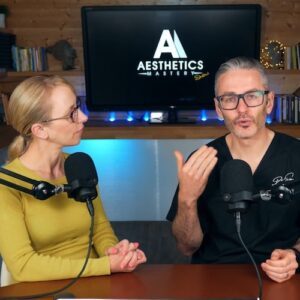
Aesthetics Mastery Show Dr Tim + Miranda PearceHere’s something that took me years to properly internalise: the face you’re injecting is fundamentally different from every other part of the body. Not slightly different, but fundamentally. Once you grasp why, your entire approach to treatment design changes.

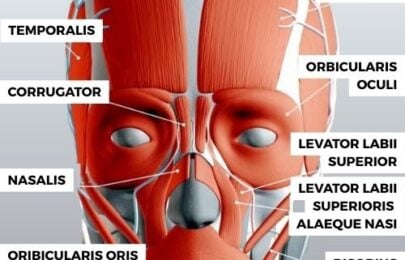
Most muscles connect bone to bone. They move the skeleton. Biceps, quadriceps, deltoids, all following that same blueprint. But facial muscles run from bone to skin. Their job isn’t locomotion, it’s communication – moving the skin surface so you can signal fear, joy, suspicion, attraction to the people around you without saying a word.

This distinction matters because we’re not sculpting clay, we’re injecting a moving, communicating structure. The aesthetic result in a photograph is one thing. The aesthetic result when your patient laughs, frowns, or raises an eyebrow, is something else entirely.

The 60/35/5 rule for lip arteries

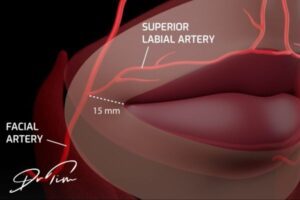
3D lip anatomy showing superior labial artery position
The superior labial artery lies just beneath the orbicularis oris – understanding depth in millimeters is crucial for safe lip injections

Where exactly is the superior labial artery when you push your needle into the lip?

Clinical papers describe it running above or within the vermilion border. But its relationship to the orbicularis oris muscle follows a more useful pattern: 60% of the time it sits beneath the muscle, 35% within the muscle itself, and about 5% above. That variability can occur in the same patient, the vessel wiggles around along its course.

Picture a histological cross-section. The orbicularis oris runs down the centre, with hypodermic fat anterior to it, then dermis. Posterior to the muscle, that’s where the artery typically lives. Your injection lands on that anterior surface whether you approach horizontally or vertically. Stay superficial, and you’re progressively moving away from where the vessel usually sits.

The 2-3% anomaly you might see pulsating

Julie Horne shared a video showing an artery visibly pulsating near the wet-dry border – not where you’d expect it and not deep. It was right there at the surface.

This is a caliber persistent artery, an anomaly first documented in the 1970s, present in roughly 2-3% of patients. Julie estimates she sees it in about two out of every fifty patients, which aligns with the published data. The vessel penetrates the submucosa without losing diameter, ending up much more superficial than normal anatomy would suggest.

Practically, this means the normal position of the labial artery isn’t at the wet-dry border. But it can be, and that’s the tension we navigate with every injection, probability versus possibility. The statistics suggest one thing; the patient in front of you might be the exception.

Why chin filler carries hidden complexity

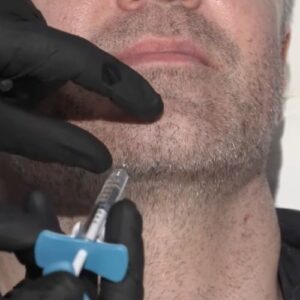
Aesthetic practitioner injecting chin filler in male patient with beard for chin augmentation procedure
Chin filler treatment being administered to a male patient. Practitioners should assess tissue space before injecting to reduce the risk of pressure-induced complications in bearded patients.

Two vessels matter in chin augmentation: the mental artery and the submental artery. For most procedures, particularly lower chin work, the submental artery is the one to respect.

It curves underneath the mandible, then supplies the anterior chin. Simple enough on a diagram. But those simplified textbook illustrations miss the structures this vessel feeds: the digastric, geniohyoid, mylohyoid, and stylohyoid muscles, all involved in stabilising the floor of your mouth when you swallow.

This is why patients with chin vascular complications sometimes report pain during swallowing. The ischemia affects muscles they didn’t know they had.

And then there’s the worst-case scenario. In some patients, an anastomosis exists between the sublingual artery and the submental artery. Chin augmentation typically involves high volumes. If that filler compromises the submental artery in a patient with this connection, you’re potentially affecting blood supply to the tongue. A necrotic tongue is one of the most debilitating injuries in aesthetic medicine, extremely difficult to manage, life-altering for the patient.

None of this means you shouldn’t augment chins. It means you should understand what you’re actually working around.

The midface is hanging, not sitting

I think of the anterior midface as hanging off the zygoma and maxilla. Those bony attachments support everything below, mouth, nose, chin, like scaffolding holding a structure in place.

The muscles of mastication work differently. They follow the traditional bone-to-bone pattern, which is why chewing doesn’t visibly move your skin surface the way smiling does. The anterior face and the lateral face have distinct functions, distinct anatomy.

When you start viewing fat pads and muscles as layered like tiles on a roof, stacking together, deep fat pads sitting on underlying muscles, the behaviour of injected product starts making more sense. Why does something migrate here but not there? Why does a treatment hold in one patient and shifts in another?

Forget individual ligaments. See the line.

Memorising ligaments one by one is the hard way. Understanding their distribution pattern is the shortcut that actually works.

Most facial ligaments fall along an angle between the lateral and anterior face. This line marks where communication anatomy transitions to mastication anatomy, a functional boundary overlaid on the structure.

Follow it: superior temporal septum, then the orbicularis oculi retaining ligament with its lateral orbital thickening, then the zygomatic cutaneous ligament at the angle of the zygoma (the strongest point on this line), then the upper masseteric cutaneous ligaments along the masseter, the mandibular septum below that, and finally the mandibular cutaneous ligament. One continuous system holding the anterior face where it belongs.

Once you see it as a line rather than a list, the anatomy clicks.

Platysmal bands and the asymmetry nobody warns you about

The platysma is a superficial sheet that collects into those vertical bands on the neck. Relax it with toxin, and in some patients you’ll see genuine improvement in jawline definition, the Nefertiti lift effect, named for that Egyptian queen’s famously elegant neck.

But the platysma doesn’t respect textbook boundaries.

The muscle fibres weave into the depressor anguli oris. Sometimes you can actually see where they’re connected. Inject high on the neck, and occasionally patients develop asymmetry when they smile, the mouth pulling differently on one side. It’s temporary, but it catches practitioners off guard because the anatomy in reality is messier than the anatomy in illustrations.

The lesson applies broadly: if you’re treating the lower face or neck, expect that muscles interweave in ways the diagrams simplify.

Static photographs tell half the story

One of the earlier mistakes most injectors make, myself included, is designing treatments around before and after photographs. You see the deflation, you add volume, you photograph again. The static result looks good.

Then the patient animates. They laugh, they frown, they raise their eyebrows in surprise. And sometimes what looked beautiful at rest becomes strange in motion.

The purpose of the face is communication. If you interrupt that, if the expressions that signal warmth or attention or interest become muted or distorted, you’ve compromised something more important than a contour line.

Effective treatment design means knowing depths, positions, how structures move. Ligaments, connective tissue, SMAS, muscles, arteries, veins, fat pads deep and superficial, nerves, glands, all of it factors in. Not because you need to recite it like an exam, but because you need to predict what your product will do in a living, moving face.

The goal isn’t avoiding injury, though that matters. The goal is harmonising movement, improving what’s unattractive while preserving the expressions your patient needs to connect with other people.

Watch the full Aesthetics Mastery Show

Top 6 Aesthetics Anatomy Lessons

In this episode, we’ve compiled Dr Tim’s top 6 anatomy lessons. Including lips, chin, platysmal bands, ligaments, and the lower face.

You can also subscribe to our YouTube channel for really useful regular tips and advice.  YouTube


FREE Complications Webinar

Want to overcome your fear of complications and confidently master anatomy?

Join us for one of Dr Tim's FREE upcoming webinars. .

Check dates here and save your spot

Complications Webinar
Complications webinar

Dr Tim Pearce eLearning

Dr Tim Pearce MBChB BSc (Hons) MRCGP founded his eLearning concept in 2016 in order to provide readily accessible BOTOX® and dermal filler online courses for fellow Medical Aesthetics practitioners. His objective was to raise standards within the industry – a principle which remains just as relevant today.

Our exclusive video-led courses are designed to build confidence, knowledge and technique at every stage, working from foundation level to advanced treatments and management of complications.

Thousands of delegates have benefited from the courses and we’re highly rated on Trustpilot. For more information or to discuss which course is right for you, please get in touch with our friendly team.


Share This Article
Facebook Twitter Pinterest Linkedin
Prev Post
Next Post

Related Articles

Bright Light, Better Mood: The Role of Light Therapy in Perinatal and Nonseasonal Depression Bestseller

Bright Light, Better Mood: The Role of Light Therapy in Perinatal and Nonseasonal Depression

March 19, 2026

Bright Light, Better Mood: The Role of Light Therapy in Perinatal and Nonseasonal Depression
By Andrea Callaway
March 19, 2026

Bright Light, Better Mood: The Role of Light Therapy in Perinatal and Nonseasonal Depression

READ MORE
Biostimulators vs. Energy-Based Devices: Clinical Guide to Long-Term Skin Rejuvenation Bestseller

Biostimulators vs. Energy-Based Devices: Clinical Guide to Long-Term Skin Rejuvenation

March 17, 2026

Biostimulators vs. Energy-Based Devices: Clinical Guide to Long-Term Skin Rejuvenation
By Andrea Callaway
March 17, 2026

Biostimulators vs. Energy-Based Devices: Clinical Guide to Long-Term Skin Rejuvenation

READ MORE
Facial Muscle Anatomy for Botulinum Toxin Bestseller

Facial Muscle Anatomy for Botulinum Toxin

March 12, 2026

Facial Muscle Anatomy for Botulinum Toxin
By Andrea Callaway
March 12, 2026

Facial Muscle Anatomy for Botulinum Toxin

READ MORE

Popular Courses

BOTOX® Foundation Course

BOTOX® Foundation Course

Pro Tox

Pro Tox

8D Lip Design

8D Lip Design

SEE MORE

CONTACT US

    contact injection
    Dr Tim Pearce

    Improve your medical
    aesthetics business

    • Home
    • Courses
    • About
    • Contact
    • Dr Tim Limited Terms and Conditions of Sale
    • Privacy Policy
    • Website Terms Of Use
    • Careers
    Login Dr Tim Pearce Login
    © Copyright Dr Tim Ltd, 2025
    We use cookies on our website to give you the most relevant experience by remembering your preferences and repeat visits. Read More. By clicking “Accept All”, you consent to the use of ALL the cookies. However, you may visit "Cookie Settings" to provide a controlled consent.
    Cookie Settings Reject All Accept All
    Manage consent

    Privacy Overview

    This website uses cookies to improve your experience while you navigate through the website. Out of these, the cookies that are categorized as necessary are stored on your browser as they are essential for the working of basic functionalities of the website. We also use third-party cookies that help us analyze and understand how you use this website. These cookies will be stored in your browser only with your consent. You also have the option to opt-out of these cookies. But opting out of some of these cookies may affect your browsing experience.
    Necessary
    Always Enabled
    Necessary cookies are absolutely essential for the website to function properly. These cookies ensure basic functionalities and security features of the website, anonymously.
    CookieDurationDescription
    cookielawinfo-checkbox-analytics11 monthsThis cookie is set by GDPR Cookie Consent plugin. The cookie is used to store the user consent for the cookies in the category "Analytics".
    cookielawinfo-checkbox-functional11 monthsThe cookie is set by GDPR cookie consent to record the user consent for the cookies in the category "Functional".
    cookielawinfo-checkbox-necessary11 monthsThis cookie is set by GDPR Cookie Consent plugin. The cookies is used to store the user consent for the cookies in the category "Necessary".
    cookielawinfo-checkbox-others11 monthsThis cookie is set by GDPR Cookie Consent plugin. The cookie is used to store the user consent for the cookies in the category "Other.
    cookielawinfo-checkbox-performance11 monthsThis cookie is set by GDPR Cookie Consent plugin. The cookie is used to store the user consent for the cookies in the category "Performance".
    viewed_cookie_policy11 monthsThe cookie is set by the GDPR Cookie Consent plugin and is used to store whether or not user has consented to the use of cookies. It does not store any personal data.
    Functional
    Functional cookies help to perform certain functionalities like sharing the content of the website on social media platforms, collect feedbacks, and other third-party features.
    Performance
    Performance cookies are used to understand and analyze the key performance indexes of the website which helps in delivering a better user experience for the visitors.
    Analytics
    Analytical cookies are used to understand how visitors interact with the website. These cookies help provide information on metrics the number of visitors, bounce rate, traffic source, etc.
    Advertisement
    Advertisement cookies are used to provide visitors with relevant ads and marketing campaigns. These cookies track visitors across websites and collect information to provide customized ads.
    Others
    Other uncategorized cookies are those that are being analyzed and have not been classified into a category as yet.
    SAVE & ACCEPT