



• Mail us: support@drtimpearce.com
  • Trustpilot
Dr Tim Pearce, eLearningDr Tim Pearce, eLearningDr Tim Pearce, eLearning Dr Tim Pearce, eLearning
  • eLearning Courses
        • ELEARNING COURSES

        • Techniques
          • BOTOX® Foundation Course
          • Pro Tox
          • Dermal Fillers Foundation Course
          • 8D Lip Design
          • Julie Horne Directs, Dr Tim Injects – February 2023
          • Eyelash Enhancement Serum Course
          • Anatomy360
          • Art Codes
        • Complications
          • Botulinum Toxin Complications Mastery
          • Dermal Filler Complications Mastery
          • Elective Lip Reversal
        • Profinity
        • Wellness
          • How To Introduce Longevity To Your Aesthetics Clinic
        • Marketing
          • DCAM 2.0
          • Canva Mastery: A Step-by-Step Guide
          • Email Marketing Course
          • Industry Photography Secrets
          • How to find your voice with video
        • Other Services
          • DPP for V300 Service
        • Packages
          • Foundation eLearning Package – SAVE 10%
          • Complications eLearning Package – SAVE 10%
          • Techniques eLearning Package – SAVE 20%
          • Marketing eLearning Package – SAVE 20%
          • Full eLearning Package – SAVE 35%
        • Reviews and Testimonials
        • FAQ – Online Courses
  • Downloads
        • Complications
          • 13 Extra Risky Injection Areas: Facial Vessel Map
          • Aspirating Experiment Test Results
          • Bruising Checklist: Prevent & Minimise Bruises from Injectables
          • Dermal Filler Complications: The Essential Guide
          • Delayed Onset Nodules: How To Diagnose And Treat
          • Diagnosing Complications: 7 Steps To Great Advice
          • Emergency Reversal Protocol
          • How To Avoid Causing a Lateral Rectus Palsy From Botulinum Toxins
          • Hyalase Consent Form: Downloadable Template
          • Lumps in Lips Guide: How to Diagnose, Manage & Treat
          • Tear Trough Oedema Protocol
          • Does Covid-19 Vaccine Cause Dermal Filler Reactions?
        • Injection Techniques
          • 26 Essential Injection Patterns For Botulinum Toxin
          • Botox Calculator
          • BOTOX Lesson – Gummy Smile
          • BOTOX Lesson – Hooded Eyes
          • Frequently Used Filler Volumes Facial Map
          • How To Improve Your Needle Control: 6-Step Blueprint
          • How to Prepare BOTOX – Step by Step Guide
        • Consultation Skills
          • Body Dysmorphia & Modification Checklist
          • Is It Safe To Treat? 5-Step Contraindication Check List
          • Medical Model For Cosmetic Procedures: An Essential Guide
        • Lips
          • Lip Consultation Question Checklist
          • Lip Anatomy Lesson
          • Common Needle/Cannula Choices For Lips
          • Lip Filler Aftercare Pack for Your Patients
          • Lip Design Blueprint – 4 Steps To Perfect Lip Augmentation
          • Master the Basics of Julie Horne’s Lip Technique
        • Longevity
          • Does HRT Increase Cancer Risk? Guide for Clinicians
          • Educating Patients About How Sugar Exacerbates Aging
          • How to Reduce Biological Age for Your Patients
        • Business & Marketing
          • Annual Profit Calculator
          • 5 Steps to Create a Successful Aesthetics Business
          • Injector’s Cheat Sheet – 7 Social Media Post Types
          • 7 Deadly Hashtag Sins
          • 7 Secret Locations to get Instagram Followers
          • 9 Video Marketing Mistakes
          • 15 Easy Instagram Reels Ideas
          • 3 Time-Saving Hacks for Social Media
          • Personal Branding Starter Kit
          • Value Audit Template: Price-per-1ml
          • World’s Top 5 Filler Brands – Survey Results
  • Products
    • Artistic Anatomy Poster Collection
    • Top 3 Posters Bundle
    • Original Anatomy Poster
    • Beautiful Lip Anatomy Poster
    • Download Pack – Forms & Leaflets
  • Blog
    • Meet the Writers
  • About
    • Dr Tim Pearce
    • Miranda Pearce
    • Careers & Recruitment
    • Webinars
    • Become a Model
  • Contact
  • Login

Login

Why injection depth matters more than avoiding the eyelid

Blogs

  • ALL
  • Complications
  • Injection Techniques
  • Consultation Skills
  • Lips
  • Business & Marketing
You may be interested
Bright Light, Better Mood: The Role of Light Therapy in Perinatal and Nonseasonal Depression

Bright Light, Better Mood: The Role of Light Therapy in Perinatal and Nonseasonal Depression

March 19, 2026

Longevity vs. Quick Fixes: Why We Must Stop Selling ‘Units’ and Start Selling ‘Anti-Aging Solutions’

Longevity vs. Quick Fixes: Why We Must Stop Selling ‘Units’ and Start Selling ‘Anti-Aging Solutions’

March 24, 2026

Facial Muscle Anatomy for Botulinum Toxin

Facial Muscle Anatomy for Botulinum Toxin

March 12, 2026

Biostimulators vs. Energy-Based Devices: Clinical Guide to Long-Term Skin Rejuvenation

Biostimulators vs. Energy-Based Devices: Clinical Guide to Long-Term Skin Rejuvenation

March 17, 2026

When stress becomes visible: physiology of visceral fat accumulation

When stress becomes visible: physiology of visceral fat accumulation

March 10, 2026

Why injection depth matters more than avoiding the eyelidDr Tim Pearce
November 11, 2025

Eyelid ptosis from botulinum toxin ranks as the most feared facial complication. You can’t cover an eyelid droop with makeup. Patients experience disruption in their daily lives. The eyelid can drop so low that vision becomes obstructed, you literally can’t see directly in front of you. This causes significant upset for both patients and clinicians.

Learning to avoid this complication starts with understanding exactly what occurs anatomically when toxin reaches the wrong muscle.
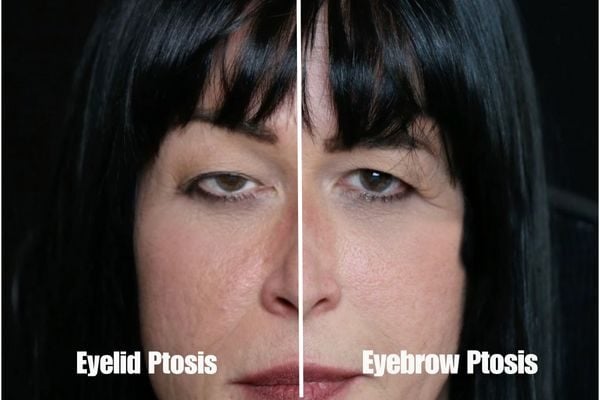
Comparison image showing eyelid ptosis versus eyebrow ptosis from botulinum toxin injection demonstrating different types of complications
Split comparison showing eyelid ptosis (left) where upper lid droops covering the iris versus eyebrow ptosis (right) where the brow position drops causing tired appearance

The orbital membrane: your safety boundary

The orbital membrane represents the boundary between the orbit and the rest of the face. Most structures we worry about sit behind this membrane. This gives you a critical clue about preventing toxin from entering this danger zone.

Understanding which muscles can be affected, and in what order, changes how you approach treatment around the eye.

Three muscles that control eyelid position

The deepest muscle attaches directly to the sclera. The superior rectus muscle pulls the eye back and lets you look toward the sky. This muscle sits at the foundation of the system that controls upward gaze.

On top of that sits the tarsal muscle, sometimes called Muller’s muscle. This smooth muscle sits between the levator palpebrae superioris and the superior rectus. Being smooth muscle means it doesn’t respond to conscious control. You can’t actively tell yourself to contract Muller’s muscle.

But if you’re stressed, anxious, recently frightened, or taking stimulants, that muscle becomes more active. People’s eyes widen in certain circumstances because of this muscle. We can treat complications affecting Muller’s muscle with a sympathomimetic drug that simulates adrenaline’s action on that same tissue.

Above that muscle sits the one most commonly affected by botulinum toxin complications. Look at the anatomy and you see why. Once toxin passes through the fat, the first structure it contacts is the levator palpebrae superioris.

Where the levator palpebrae actually sits

Many injectors understandably assume that injecting the eyelid causes eyelid ptosis. Actually, injecting the eyelid causes the eyelid to open. You need to get toxin behind the eyelid to directly affect the muscle that pulls the eyelid open.

Look at where this muscle actually resides. It sits on top of the superior rectus muscle but passes all the way back into the globe. The structure runs deep, probably 4 to 5 centimeters before it touches the back of the orbit. This is where toxin needs to reach to cause the complication we worry about.

What this tells you about injection technique

Avoiding the eyelid won’t help you avoid eyelid ptosis. Depth matters. Specifically, depth in relationship to the orbital membrane.

If you wanted to cause ptosis, what would you do? You’d stick a needle straight through orbicularis oculi, through the orbital membrane, into the superior surface above the globe. Any injection even remotely similar to this increases the chance of causing this problem.

Think about how to inject in a way that steers clear of this error.

Understanding corrugator supercilii injection depth

When injecting above the eye, you’re treating corrugator supercilii in most cases, sometimes orbicularis oculi too. You can change your technique to reduce risk.

Corrugator supercilii needs to be understood through its origin and insertion. Its origin sits on the bone just above the nasal bone. Its insertion sits in the skin near the mid-pupillary line. This tells you about where the muscle runs. Between origin and skin surface sits a relatively straight line. That’s where you should be injecting.

You should be able to test this by having the patient contract the muscle. Then you need to follow the depth of the muscle. This is the part clinicians sometimes don’t get taught well: how do you follow muscle depth?

You don’t simply inject the same way along the muscle. You need to start deep, pointing medially toward the origin of the muscle. This gives you a much higher chance that toxin will reside within the muscle structure itself.

Look at how depth affects the needle’s ability to stay within the corrugator supercilii versus getting underneath it. The moment the needle tip sits under the muscle instead of within the muscle, all toxin spreads underneath and toward the eye. You immediately get a massively increased risk just by being half a millimeter too deep underneath the corrugator supercilii.

A lot of attention needs to go toward staying in the muscle.
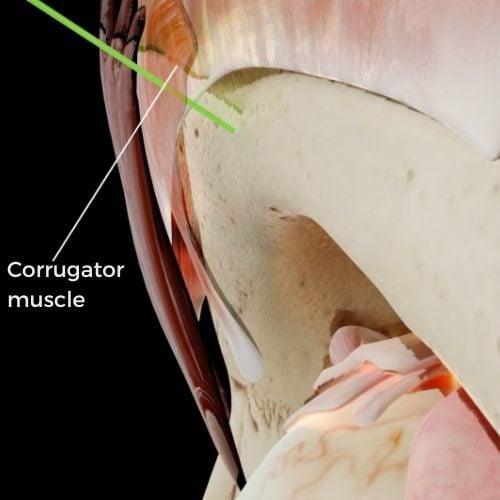
3D anatomical diagram showing corrugator supercilii muscle with needle trajectory for botulinum toxin injection demonstrating proper depth and angle to prevent eyelid ptosis
Anatomical illustration of corrugator supercilii muscle showing proper needle depth and trajectory from deep medial origin to superficial lateral insertion for safe botulinum toxin injection

Think of the muscle like a vein you’re trying to cannulate

When you take blood and approach a vein, you try to get into the tube. Your needle sits parallel with the vein, pointing in the direction the vein travels.

You can do the same with muscle. If you know the muscle goes from superficial to deep, you can point in that direction with your needle. Needles coming medially toward the origin at a deep injection point most medially, then intermediate, then very superficial, this follows the tract of the muscle perfectly.

This approach massively reduces your risk of ptosis.

The step-by-step injection pattern

Start with the most medial point. Your needle points toward the origin on the bone. This should be your deepest injection.

Move to an intermediate point. Still pointing medially but at intermediate depth now.

Finish at the most lateral point. Here you’re very superficial, right where the muscle inserts into the skin near the mid-pupillary line.

This pattern follows corrugator supercilii’s natural path from deep medial origin to superficial lateral insertion.

Adding orbital rim pressure for extra safety

For an additional safety step, apply orbital rim pressure while you inject. When you finish, roll away from the eye.

This technique creates a physical barrier that helps prevent any potential spread toward the orbital structures behind the membrane.

What matters most

Follow the track of the muscle. It runs deep medially and superficial laterally. Point your needle parallel with the muscle, toward the origin. Stay within the muscle body by matching your depth to where that muscle sits at each point along its length.

The levator palpebrae superioris sits 4 to 5 centimeters deep, behind the orbital membrane. Getting toxin there requires passing through multiple layers. Your technique should make that journey impossible.

Half a millimeter matters. Under the corrugator supercilii creates a pathway toward complications. Within the corrugator supercilii keeps everything where it belongs.

The vodka and coke principle applies here too

Small differences in depth create exponentially larger differences in outcomes. Just like adding one shot to two different drinks makes the gap between them much more apparent, being slightly too deep transforms a safe injection into a risky one.

The boundary between safe and unsafe is precise. Respect that boundary through careful attention to anatomical depth at every injection point.

FREE Complications Webinar

Want to overcome your fear of complications and confidently master anatomy?

Join us for one of Dr Tim's FREE upcoming webinars. .

Check dates here and save your spot

Complications Webinar
Complications webinar

Dr Tim Pearce eLearning

Dr Tim Pearce MBChB BSc (Hons) MRCGP founded his eLearning concept in 2016 in order to provide readily accessible BOTOX® and dermal filler online courses for fellow Medical Aesthetics practitioners. His objective was to raise standards within the industry – a principle which remains just as relevant today.

Our exclusive video-led courses are designed to build confidence, knowledge and technique at every stage, working from foundation level to advanced treatments and management of complications.

Thousands of delegates have benefited from the courses and we’re highly rated on Trustpilot. For more information or to discuss which course is right for you, please get in touch with our friendly team.


Share This Article
Facebook Twitter Pinterest Linkedin
Prev Post
Next Post

Related Articles

Longevity vs. Quick Fixes: Why We Must Stop Selling ‘Units’ and Start Selling ‘Anti-Aging Solutions’ Bestseller

Longevity vs. Quick Fixes: Why We Must Stop Selling ‘Units’ and Start Selling ‘Anti-Aging Solutions’

March 24, 2026

Longevity vs. Quick Fixes: Why We Must Stop Selling ‘Units’ and Start Selling ‘Anti-Aging Solutions’
By Andrea Callaway
March 24, 2026

Longevity vs. Quick Fixes: Why We Must Stop Selling ‘Units’ and Start Selling ‘Anti-Aging Solutions’

READ MORE
Bright Light, Better Mood: The Role of Light Therapy in Perinatal and Nonseasonal Depression Bestseller

Bright Light, Better Mood: The Role of Light Therapy in Perinatal and Nonseasonal Depression

March 19, 2026

Bright Light, Better Mood: The Role of Light Therapy in Perinatal and Nonseasonal Depression
By Andrea Callaway
March 19, 2026

Bright Light, Better Mood: The Role of Light Therapy in Perinatal and Nonseasonal Depression

READ MORE
Biostimulators vs. Energy-Based Devices: Clinical Guide to Long-Term Skin Rejuvenation Bestseller

Biostimulators vs. Energy-Based Devices: Clinical Guide to Long-Term Skin Rejuvenation

March 17, 2026

Biostimulators vs. Energy-Based Devices: Clinical Guide to Long-Term Skin Rejuvenation
By Andrea Callaway
March 17, 2026

Biostimulators vs. Energy-Based Devices: Clinical Guide to Long-Term Skin Rejuvenation

READ MORE

Popular Courses

BOTOX® Foundation Course

BOTOX® Foundation Course

Pro Tox

Pro Tox

8D Lip Design

8D Lip Design

SEE MORE
Dr Tim Pearce

Improve your medical
aesthetics business

  • Home
  • Courses
  • About
  • Contact
  • Dr Tim Limited Terms and Conditions of Sale
  • Privacy Policy
  • Website Terms Of Use
  • Careers
Login Dr Tim Pearce Login
© Copyright Dr Tim Ltd, 2025
We use cookies on our website to give you the most relevant experience by remembering your preferences and repeat visits. Read More. By clicking “Accept All”, you consent to the use of ALL the cookies. However, you may visit "Cookie Settings" to provide a controlled consent.
Cookie Settings Reject All Accept All
Manage consent

Privacy Overview

This website uses cookies to improve your experience while you navigate through the website. Out of these, the cookies that are categorized as necessary are stored on your browser as they are essential for the working of basic functionalities of the website. We also use third-party cookies that help us analyze and understand how you use this website. These cookies will be stored in your browser only with your consent. You also have the option to opt-out of these cookies. But opting out of some of these cookies may affect your browsing experience.
Necessary
Always Enabled
Necessary cookies are absolutely essential for the website to function properly. These cookies ensure basic functionalities and security features of the website, anonymously.
CookieDurationDescription
cookielawinfo-checkbox-analytics11 monthsThis cookie is set by GDPR Cookie Consent plugin. The cookie is used to store the user consent for the cookies in the category "Analytics".
cookielawinfo-checkbox-functional11 monthsThe cookie is set by GDPR cookie consent to record the user consent for the cookies in the category "Functional".
cookielawinfo-checkbox-necessary11 monthsThis cookie is set by GDPR Cookie Consent plugin. The cookies is used to store the user consent for the cookies in the category "Necessary".
cookielawinfo-checkbox-others11 monthsThis cookie is set by GDPR Cookie Consent plugin. The cookie is used to store the user consent for the cookies in the category "Other.
cookielawinfo-checkbox-performance11 monthsThis cookie is set by GDPR Cookie Consent plugin. The cookie is used to store the user consent for the cookies in the category "Performance".
viewed_cookie_policy11 monthsThe cookie is set by the GDPR Cookie Consent plugin and is used to store whether or not user has consented to the use of cookies. It does not store any personal data.
Functional
Functional cookies help to perform certain functionalities like sharing the content of the website on social media platforms, collect feedbacks, and other third-party features.
Performance
Performance cookies are used to understand and analyze the key performance indexes of the website which helps in delivering a better user experience for the visitors.
Analytics
Analytical cookies are used to understand how visitors interact with the website. These cookies help provide information on metrics the number of visitors, bounce rate, traffic source, etc.
Advertisement
Advertisement cookies are used to provide visitors with relevant ads and marketing campaigns. These cookies track visitors across websites and collect information to provide customized ads.
Others
Other uncategorized cookies are those that are being analyzed and have not been classified into a category as yet.
SAVE & ACCEPT