


• Mail us: support@drtimpearce.com
  • Trustpilot
Dr Tim Pearce, eLearningDr Tim Pearce, eLearningDr Tim Pearce, eLearning Dr Tim Pearce, eLearning
  • eLearning Courses
        • ELEARNING COURSES

        • Techniques
          • BOTOX® Foundation Course
          • Pro Tox
          • Dermal Fillers Foundation Course
          • 8D Lip Design
          • Julie Horne Directs, Dr Tim Injects – February 2023
          • Eyelash Enhancement Serum Course
          • Anatomy360
          • Art Codes
        • Complications
          • Botulinum Toxin Complications Mastery
          • Dermal Filler Complications Mastery
          • Elective Lip Reversal
        • Profinity
        • Wellness
          • How To Introduce Longevity To Your Aesthetics Clinic
        • Marketing
          • DCAM 2.0
          • Canva Mastery: A Step-by-Step Guide
          • Email Marketing Course
          • Industry Photography Secrets
          • How to find your voice with video
        • Other Services
          • DPP for V300 Service
        • Packages
          • Foundation eLearning Package – SAVE 10%
          • Complications eLearning Package – SAVE 10%
          • Techniques eLearning Package – SAVE 20%
          • Marketing eLearning Package – SAVE 20%
          • Full eLearning Package – SAVE 35%
        • Reviews and Testimonials
        • FAQ – Online Courses
  • Downloads
        • Complications
          • 13 Extra Risky Injection Areas: Facial Vessel Map
          • Aspirating Experiment Test Results
          • Bruising Checklist: Prevent & Minimise Bruises from Injectables
          • Dermal Filler Complications: The Essential Guide
          • Delayed Onset Nodules: How To Diagnose And Treat
          • Diagnosing Complications: 7 Steps To Great Advice
          • Emergency Reversal Protocol
          • How To Avoid Causing a Lateral Rectus Palsy From Botulinum Toxins
          • Hyalase Consent Form: Downloadable Template
          • Lumps in Lips Guide: How to Diagnose, Manage & Treat
          • Tear Trough Oedema Protocol
          • Does Covid-19 Vaccine Cause Dermal Filler Reactions?
        • Injection Techniques
          • 26 Essential Injection Patterns For Botulinum Toxin
          • Botox Calculator
          • BOTOX Lesson – Gummy Smile
          • BOTOX Lesson – Hooded Eyes
          • Frequently Used Filler Volumes Facial Map
          • How To Improve Your Needle Control: 6-Step Blueprint
          • How to Prepare BOTOX – Step by Step Guide
        • Consultation Skills
          • Body Dysmorphia & Modification Checklist
          • Is It Safe To Treat? 5-Step Contraindication Check List
          • Medical Model For Cosmetic Procedures: An Essential Guide
        • Lips
          • Lip Consultation Question Checklist
          • Lip Anatomy Lesson
          • Common Needle/Cannula Choices For Lips
          • Lip Filler Aftercare Pack for Your Patients
          • Lip Design Blueprint – 4 Steps To Perfect Lip Augmentation
          • Master the Basics of Julie Horne’s Lip Technique
        • Longevity
          • Does HRT Increase Cancer Risk? Guide for Clinicians
          • Educating Patients About How Sugar Exacerbates Aging
          • How to Reduce Biological Age for Your Patients
        • Business & Marketing
          • Annual Profit Calculator
          • 5 Steps to Create a Successful Aesthetics Business
          • Injector’s Cheat Sheet – 7 Social Media Post Types
          • 7 Deadly Hashtag Sins
          • 7 Secret Locations to get Instagram Followers
          • 9 Video Marketing Mistakes
          • 15 Easy Instagram Reels Ideas
          • 3 Time-Saving Hacks for Social Media
          • Personal Branding Starter Kit
          • Value Audit Template: Price-per-1ml
          • World’s Top 5 Filler Brands – Survey Results
  • Products
    • Artistic Anatomy Poster Collection
    • Top 3 Posters Bundle
    • Original Anatomy Poster
    • Beautiful Lip Anatomy Poster
    • Download Pack – Forms & Leaflets
  • Blog
    • Meet the Writers
  • Podcasts
  • About
    • Dr Tim Pearce
    • Miranda Pearce
    • Careers & Recruitment
    • Webinars
    • Become a Model
  • Contact
  • Login

Login

Necrosis After Fillers – 5-Goal Safety Framework

Blogs

  • ALL
  • Complications
  • Injection Techniques
  • Consultation Skills
  • Lips
  • Business & Marketing
You may be interested
Vertical vs Horizontal Lip Injection Techniques – What the Evidence Really Shows

Vertical vs Horizontal Lip Injection Techniques – What the Evidence Really Shows

January 29, 2026

Platelet-Rich Plasma (PRP) and Platelet-Rich Fibrin (PRF) in Skin Rejuvenation After 40

Platelet-Rich Plasma (PRP) and Platelet-Rich Fibrin (PRF) in Skin Rejuvenation After 40

January 27, 2026

Restoration of Older Lips: The Psychology, Aesthetics, and Anatomy You Need to Understand

Restoration of Older Lips: The Psychology, Aesthetics, and Anatomy You Need to Understand

January 22, 2026

New Technologies in the Field of Facial Aesthetics and Body Contouring

New Technologies in the Field of Facial Aesthetics and Body Contouring

January 20, 2026

Why I Still Treat Tear Troughs: A Response to Dr. Gavin Chan’s Viral Video

Why I Still Treat Tear Troughs: A Response to Dr. Gavin Chan’s Viral Video

January 15, 2026

Necrosis After Fillers – 5-Goal Safety FrameworkDr Tim Pearce
October 30, 2025

What Is Necrosis and Why You Should Never See It

The Complete 5-Goal Framework for Injectors

Necrosis represents the worst possible outcome for any aesthetic patient. While it’s the complication that haunts every injector’s nightmares, there are five strategic goals you can implement that will dramatically reduce your risk of ever seeing this devastating complication in your clinic.

These aren’t just theoretical concepts, they represent a complete, systematic approach to safety that addresses every stage of the patient journey, from prevention through diagnosis, treatment, and recovery.

Understanding the Patient Journey Concept

Before diving into the five goals, we must accept a fundamental reality: we cannot lower the risk of vascular injury to zero. There will always be some probability of occurrence.

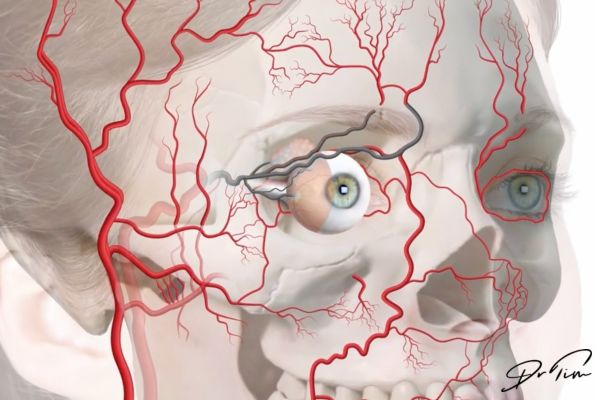
Anatomical illustration of facial blood vessel network showing arterial patterns aesthetic injectors must understand to prevent vascular occlusion
Understanding facial blood vessel anatomy is essential for preventing vascular occlusion during aesthetic injections. Injecting at 90 degrees to vessels rather than parallel reduces the risk of entering and occluding major arteries

This acceptance isn’t defeatist, it’s realistic and allows us to build proper protective systems. This means we need a system that puts the patient in the best possible case scenario at every point along the whole patient journey.

The patient journey is crucial to understand because safety is never just about the injection technique or whether you did one safety step. It encompasses every decision and action from consultation through follow-up.

Strategic Goal #1: Make Sure Vascular Occlusions Stay Small

Since we can’t prevent every vascular occlusion, the first strategic goal is ensuring that if you’re going to have a vascular occlusion, it’s a small one.

The Core Principle

Inject in such a way that even if you’re in a vessel, you don’t spend so long in that vessel that you cause a massive vascular occlusion.

Practical Implementation Techniques

  1. Use cannulas with constant directional changes. Using a cannula while moving in all sorts of directions, as many directions as possible, and sliding in and out reduces the severity of any potential occlusion.
  2. Strategic product distribution. Think carefully about how much product you put in any particular area. You can do multiple small boluses on the periosteum instead of one big one, for example.
  3. Keep the needle moving. Keeping the needle moving is a valid way of distributing the risk across multiple areas.

Understanding the Trade-Off

This technique lowers the risk of severity of vascular occlusion, which is different from the frequency of vascular occlusion. In fact, keeping the needle moving doesn’t decrease the frequency of vascular occlusion, it actually increases it.

But the hope is that the severity becomes so small that it’s almost insignificant if you block a vessel.

Important note: There’s a lot to unpack about this strategy, and it may not be as protective as intended depending on how practitioners are implementing it.

Strategic Goal #2: Lower the Frequency of Vascular Occlusion

Many practitioners get confused between severity and frequency, but it’s crucial to separate these concepts because many of our safety steps are actually pulling in opposite directions.

The moving needle technique increases frequency but decreases severity of vascular occlusion. Understanding these trade-offs is essential for making informed technique decisions.

Detection Through Enhanced Aspiration

If you are about to inject, is there anything you can do that would detect a high-risk needle placement?

Aspiration provides one answer. It’s not 100% protective, but you will detect probably around 50% of the time that you’re intravascular.

Maximizing Aspiration Effectiveness

You can increase detection rates further by:

  1. Maintaining negative pressure in the syringe .Having negative pressure established before injection improves detection capability.
  2. Making small movements while aspirating . Doing small movements in the area you’re about to inject scans a greater area for vessel position.

The “Old Medicine” Principle

Anyone who’s ever taken blood knows this old medicine principle: if you put your needle in to take blood and try to draw back and nothing comes out, move your needle.

As you scan a greater area for the position of your artery or vessel if you’re taking blood. It’s a simple way of slightly nudging the risk in your favor in terms of detecting intravascular placement.

It doesn’t matter if you’re in a tiny vessel that doesn’t aspirate because those are not the ones that cause large vascular occlusions. We want to detect intravascular placement in large, named vessels, and this technique helps accomplish that.

The 90-Degree Injection Principle

You can also lower the frequency of vascular occlusion by always injecting in a way that makes it hard to occlude vessels.

For example, if you’re injecting at 90 degrees to a vessel, even if you do go through that vessel, you’ll spend far less time in it than if you’re injecting parallel to the vessel and enter the vessel.

This represents another simple way of decreasing the frequency of vascular occlusion.

Strategic Injection Depth

Depth of injection is another way to decrease frequency, as long as you always inject in the plane where the vessels are least likely to be.

The safest injection planes:

  • Upper dermis
  • Periosteum (as long as you’re not near foramina)
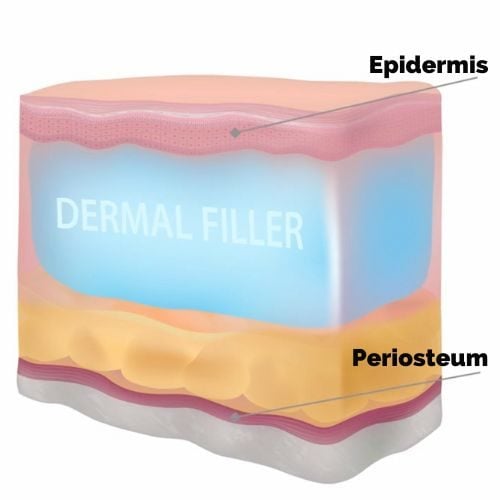
Cross-section diagram showing epidermis and periosteum safe injection planes for dermal filler with minimal vascular risk
The safest injection planes for dermal filler are the upper epidermis and periosteum (avoiding foramina), where blood vessels are least likely to be present, reducing vascular occlusion risk.


When injecting in these planes, you will always be injecting where vessels are less likely to be. This provides another anatomical way of reducing risk.

The Reality Check

Even if you do all of these steps and all the others that you can add to it, there is still another issue: we are probably going to get a vascular occlusion one day anyway.

This brings us to the critical importance of the remaining three strategic goals.

Strategic Goal #3: Diagnose Quickly

We need to have systems and processes that enable us to diagnose a blocked vessel as soon as possible.

The Power of Immediate Capillary Refill Checking

One of the simplest things to do is to check capillary refill immediately after every injection.

Real-World Evidence

This systematic approach produces measurable results. At our previous clinic, SkinViva, there were 27 vascular occlusions on record, all of them were diagnosed and treated immediately. All clinicians were constantly being trained to check capillary refill before you discharge the patient.

Making It Effortless

When you get into the swing of this, it’s effortless because you’re always cleaning the skin anyway, as you push on it, you just observe blood flow.

Quick diagnosis is not quite enough alone. This leads us to the fourth strategic goal.

Strategic Goal #4: Diagnose Comprehensively

Quick diagnosis must be accompanied by comprehensive diagnosis. There’s an issue seen many times in clinical networks: clinicians will get the diagnosis correct, but they will underdiagnose how severe it is.

A Real-World Example of Underdiagnosis

Someone injects a small area of the lip, they get a vascular occlusion which they identify through pallor in the lip, and they initiate a reversal process and send the patient home. Then it turns out 24 hours later that the patient has vascular compromise affecting their chin and their lower neck.

This was all down to underdiagnosis.

Why Underdiagnosis Happens

This is something you will see play out even in small vascular occlusions, they initially seem smaller than they actually are. At least in observed cases, there’s an initial diagnosis, and over the course of a couple of hours you realize the area is a little bit bigger than what you first thought.

So it’s very important to spend time diagnosing comprehensively.

Hidden Tissue Injury

The most obvious example of underdiagnosis is when you actually have deeper tissue injury that you can’t see.

Examples of hidden injury:

  • A chin injection that affects the tongue
  • A lip injection that affects the nose
  • A nose injection that affects the septum

These are all examples where the injury is actually worse than you first think, so it’s really important to spend some time getting a comprehensive diagnosis.

Strategic Goal #5: Reverse Comprehensively

The final strategic goal addresses treatment intensity and duration.

The Product Selection Foundation

If you’ve used a non-reversible product, which you would have done if you had thought hard about how to reduce severity, then you will have the chance to reverse the process.

The Undertreatment Problem

Some clinicians undertreat at this point. While this opinion is hard to prove scientifically, it’s believed to be better to overtreat than undertreat vascular occlusions.

Evidence from clinical networks shows vascular occlusions where practitioners followed a relatively low-dose protocol, for example, a 1500-unit vial, discharge the patient, see them back in 24 hours, and those patients still got necrotic injuries.

The Comprehensive Reversal Protocol

The recommendation is to keep your patient with you until you have capillary refill restored, so long as you have the type of product that you can do this with, then release.

Complete protocol:

  1. You should see blood flow back into the lips
  2. Keep going in all the areas that are affected
  3. Use repeated high-dose hyaluronidase injections
  4. Apply massage and warm compress
  5. Continue until blood flow is normal

Timeline Expectations

Cases have been reported where this process has gone on for 8 to 12 hours with one vascular occlusion.

However, if you’ve injected small amounts and done everything you can do to reduce the severity, this is unlikely. The vascular occlusions typically seen take around 90 minutes to 2 hours before blood flow starts to return, though there will be some exceptions.

It depends a lot on how you’ve injected.

How the Five Goals Work Together

These strategic goals create a comprehensive safety system:

Goals 1-2 (Prevention):

  • Reduce severity if occlusions occur
  • Reduce frequency of occurrence
  • Create multiple preventive layers

Goals 3-4 (Detection):

  • Diagnose quickly through systematic checking
  • Diagnose comprehensively to understand full extent
  • Prevent underestimation of injury

Goal 5 (Treatment):

  • Reverse comprehensively with adequate intensity
  • Maintain treatment until restoration
  • Avoid premature discharge

Practical Implementation: Your Action Plan

Immediate Changes:

Prevention (Goals 1-2):

  • Review injection techniques for severity reduction
  • Practice enhanced aspiration with movement
  • Assess injection angles relative to vessels
  • Verify you’re working in safest tissue planes

Detection (Goals 3-4):

  • Implement mandatory capillary refill checks after every injection
  • Train all staff on comprehensive assessment
  • Create protocols for evaluating full extent of compromise
  • Establish systems for detecting hidden tissue injury

Treatment (Goal 5):

  • Stock adequate hyaluronidase supplies
  • Develop comprehensive reversal protocols
  • Plan for extended treatment sessions when needed
  • Establish clear discharge criteria based on capillary refill restoration

Learning from Real Cases

To understand how this process actually unfolds in real clinical situations, studying documented cases provides invaluable insight. These cases capture important details about complication progression and management that are rarely published in academic literature.

Real-world case studies reveal the nuances of:

  • How quickly compromise can extend beyond initial injection sites
  • The timeline of vascular occlusion development and resolution
  • Effective vs. ineffective treatment protocols
  • The importance of extended observation and treatment

Conclusion: A Complete Framework for Zero Necrosis

Necrosis is the worst outcome for any patient, but by following these five strategic goals, you can work toward never having a necrotic injury in your clinic.

The framework is comprehensive:

  1. Make occlusions small (severity reduction)
  2. Reduce occlusion frequency (prevention)
  3. Diagnose quickly (immediate detection)
  4. Diagnose comprehensively (full assessment)
  5. Reverse comprehensively (adequate treatment)

Each goal serves a specific function, and together they create a complete safety system that addresses the entire patient journey, from injection technique through diagnosis and treatment, ensuring patients remain in the best possible scenario at every point.

Clinics that implement these systematic approaches see vascular occlusions but not necrotic injuries. The difference lies not in avoiding all complications, but in having robust systems for managing them effectively when they occur.

By accepting that risk cannot be zero but building comprehensive systems to manage it, you can practice confidently, grow your skills, and protect every patient throughout their journey.

Ready to master the most common complications so that you can 10x your injecting skills and confidence? 

Register here for my next free webinar >

Aesthetics Mastery Show

How to reduce injury risk an injector – 5 simple steps you can do

Dr Tim says:

“I believe you can get through your whole injection career without ever causing a necrotic injury by following these 5 steps.”

Watch the full Aesthetics Mastery Show here.

YouTubeYou can also subscribe to our YouTube channel for really useful regular tips and advice.


Anatomy360 - The Ultimate 3D Anatomy Course

Understanding facial anatomy is crucial for precise filler placement and achieving natural, balanced results. Knowledge of anatomical structures and vascular supply not only helps in avoiding complications but also enhances the overall effectiveness of treatments.

Dr Tim Pearce's anatomy course delivers a thorough understanding of facial anatomy through 12 online lessons. Tim says:

“The problem is we’re taught anatomy in 2D textbooks, but real-life anatomy isn’t flat. In order to feel confident with injecting and to get that millimetre by millimetre precision that increases safety, we need more detail. That’s why I’ve created the ultimate Anatomy learning experience specifically for aesthetic injectors. It’s going to help you up-level your anatomy knowledge and boost your injection safety & confidence in a way that no cadaver course could ever.”


Anatomy360 Course
Anatomy360 Course

Dr Tim Pearce eLearning

Dr Tim Pearce MBChB BSc (Hons) MRCGP founded his eLearning concept in 2016 in order to provide readily accessible BOTOX® and dermal filler online courses for fellow Medical Aesthetics practitioners. His objective was to raise standards within the industry – a principle which remains just as relevant today.

Our exclusive video-led courses are designed to build confidence, knowledge and technique at every stage, working from foundation level to advanced treatments and management of complications.

Thousands of delegates have benefited from the courses and we’re highly rated on Trustpilot. For more information or to discuss which course is right for you, please get in touch with our friendly team.

Share This Article
Facebook Twitter Pinterest Linkedin
Prev Post
Next Post

Related Articles

Vertical vs Horizontal Lip Injection Techniques – What the Evidence Really Shows Bestseller

Vertical vs Horizontal Lip Injection Techniques – What the Evidence Really Shows

January 29, 2026

Vertical vs Horizontal Lip Injection Techniques – What the Evidence Really Shows
By Andrea Callaway
January 29, 2026

Vertical vs Horizontal Lip Injection Techniques – What the Evidence Really Shows

READ MORE
Platelet-Rich Plasma (PRP) and Platelet-Rich Fibrin (PRF) in Skin Rejuvenation After 40 Bestseller

Platelet-Rich Plasma (PRP) and Platelet-Rich Fibrin (PRF) in Skin Rejuvenation After 40

January 27, 2026

Platelet-Rich Plasma (PRP) and Platelet-Rich Fibrin (PRF) in Skin Rejuvenation After 40
By Andrea Callaway
January 27, 2026

Platelet-Rich Plasma (PRP) and Platelet-Rich Fibrin (PRF) in Skin Rejuvenation After 40

READ MORE
Restoration of Older Lips: The Psychology, Aesthetics, and Anatomy You Need to Understand Bestseller

Restoration of Older Lips: The Psychology, Aesthetics, and Anatomy You Need to Understand

January 22, 2026

Restoration of Older Lips: The Psychology, Aesthetics, and Anatomy You Need to Understand
By Andrea Callaway
January 22, 2026

Restoration of Older Lips: The Psychology, Aesthetics, and Anatomy You Need to Understand

READ MORE

Popular Courses

BOTOX® Foundation Course

BOTOX® Foundation Course

Pro Tox

Pro Tox

8D Lip Design

8D Lip Design

SEE MORE

CONTACT US

    contact injection
    Dr Tim Pearce

    Improve your medical
    aesthetics business

    • Home
    • Courses
    • About
    • Contact
    • Dr Tim Limited Terms and Conditions of Sale
    • Privacy Policy
    • Website Terms Of Use
    • Careers
    Login Dr Tim Pearce Login
    © Copyright Dr Tim Ltd, 2025
    We use cookies on our website to give you the most relevant experience by remembering your preferences and repeat visits. Read More. By clicking “Accept All”, you consent to the use of ALL the cookies. However, you may visit "Cookie Settings" to provide a controlled consent.
    Cookie Settings Reject All Accept All
    Manage consent

    Privacy Overview

    This website uses cookies to improve your experience while you navigate through the website. Out of these, the cookies that are categorized as necessary are stored on your browser as they are essential for the working of basic functionalities of the website. We also use third-party cookies that help us analyze and understand how you use this website. These cookies will be stored in your browser only with your consent. You also have the option to opt-out of these cookies. But opting out of some of these cookies may affect your browsing experience.
    Necessary
    Always Enabled
    Necessary cookies are absolutely essential for the website to function properly. These cookies ensure basic functionalities and security features of the website, anonymously.
    CookieDurationDescription
    cookielawinfo-checkbox-analytics11 monthsThis cookie is set by GDPR Cookie Consent plugin. The cookie is used to store the user consent for the cookies in the category "Analytics".
    cookielawinfo-checkbox-functional11 monthsThe cookie is set by GDPR cookie consent to record the user consent for the cookies in the category "Functional".
    cookielawinfo-checkbox-necessary11 monthsThis cookie is set by GDPR Cookie Consent plugin. The cookies is used to store the user consent for the cookies in the category "Necessary".
    cookielawinfo-checkbox-others11 monthsThis cookie is set by GDPR Cookie Consent plugin. The cookie is used to store the user consent for the cookies in the category "Other.
    cookielawinfo-checkbox-performance11 monthsThis cookie is set by GDPR Cookie Consent plugin. The cookie is used to store the user consent for the cookies in the category "Performance".
    viewed_cookie_policy11 monthsThe cookie is set by the GDPR Cookie Consent plugin and is used to store whether or not user has consented to the use of cookies. It does not store any personal data.
    Functional
    Functional cookies help to perform certain functionalities like sharing the content of the website on social media platforms, collect feedbacks, and other third-party features.
    Performance
    Performance cookies are used to understand and analyze the key performance indexes of the website which helps in delivering a better user experience for the visitors.
    Analytics
    Analytical cookies are used to understand how visitors interact with the website. These cookies help provide information on metrics the number of visitors, bounce rate, traffic source, etc.
    Advertisement
    Advertisement cookies are used to provide visitors with relevant ads and marketing campaigns. These cookies track visitors across websites and collect information to provide customized ads.
    Others
    Other uncategorized cookies are those that are being analyzed and have not been classified into a category as yet.
    SAVE & ACCEPT