


• Mail us: support@drtimpearce.com
  • Trustpilot
Dr Tim Pearce, eLearningDr Tim Pearce, eLearningDr Tim Pearce, eLearning Dr Tim Pearce, eLearning
  • eLearning Courses
        • ELEARNING COURSES

        • Techniques
          • BOTOX® Foundation Course
          • Pro Tox
          • Dermal Fillers Foundation Course
          • 8D Lip Design
          • Julie Horne Directs, Dr Tim Injects – February 2023
          • Eyelash Enhancement Serum Course
          • Anatomy360
          • Art Codes
        • Complications
          • Botulinum Toxin Complications Mastery
          • Dermal Filler Complications Mastery
          • Elective Lip Reversal
        • Profinity
        • Wellness
          • How To Introduce Longevity To Your Aesthetics Clinic
        • Marketing
          • DCAM 2.0
          • Canva Mastery: A Step-by-Step Guide
          • Email Marketing Course
          • Industry Photography Secrets
          • How to find your voice with video
        • Other Services
          • DPP for V300 Service
        • Packages
          • Foundation eLearning Package – SAVE 10%
          • Complications eLearning Package – SAVE 10%
          • Techniques eLearning Package – SAVE 20%
          • Marketing eLearning Package – SAVE 20%
          • Full eLearning Package – SAVE 35%
        • Reviews and Testimonials
        • FAQ – Online Courses
  • Downloads
        • Complications
          • 13 Extra Risky Injection Areas: Facial Vessel Map
          • Aspirating Experiment Test Results
          • Bruising Checklist: Prevent & Minimise Bruises from Injectables
          • Dermal Filler Complications: The Essential Guide
          • Delayed Onset Nodules: How To Diagnose And Treat
          • Diagnosing Complications: 7 Steps To Great Advice
          • Emergency Reversal Protocol
          • How To Avoid Causing a Lateral Rectus Palsy From Botulinum Toxins
          • Hyalase Consent Form: Downloadable Template
          • Lumps in Lips Guide: How to Diagnose, Manage & Treat
          • Tear Trough Oedema Protocol
          • Does Covid-19 Vaccine Cause Dermal Filler Reactions?
        • Injection Techniques
          • 26 Essential Injection Patterns For Botulinum Toxin
          • Botox Calculator
          • BOTOX Lesson – Gummy Smile
          • BOTOX Lesson – Hooded Eyes
          • Frequently Used Filler Volumes Facial Map
          • How To Improve Your Needle Control: 6-Step Blueprint
          • How to Prepare BOTOX – Step by Step Guide
        • Consultation Skills
          • Body Dysmorphia & Modification Checklist
          • Is It Safe To Treat? 5-Step Contraindication Check List
          • Medical Model For Cosmetic Procedures: An Essential Guide
        • Lips
          • Lip Consultation Question Checklist
          • Lip Anatomy Lesson
          • Common Needle/Cannula Choices For Lips
          • Lip Filler Aftercare Pack for Your Patients
          • Lip Design Blueprint – 4 Steps To Perfect Lip Augmentation
          • Master the Basics of Julie Horne’s Lip Technique
        • Longevity
          • Does HRT Increase Cancer Risk? Guide for Clinicians
          • Educating Patients About How Sugar Exacerbates Aging
          • How to Reduce Biological Age for Your Patients
        • Business & Marketing
          • Annual Profit Calculator
          • 5 Steps to Create a Successful Aesthetics Business
          • Injector’s Cheat Sheet – 7 Social Media Post Types
          • 7 Deadly Hashtag Sins
          • 7 Secret Locations to get Instagram Followers
          • 9 Video Marketing Mistakes
          • 15 Easy Instagram Reels Ideas
          • 3 Time-Saving Hacks for Social Media
          • Personal Branding Starter Kit
          • Value Audit Template: Price-per-1ml
          • World’s Top 5 Filler Brands – Survey Results
  • Products
    • Artistic Anatomy Poster Collection
    • Top 3 Posters Bundle
    • Original Anatomy Poster
    • Beautiful Lip Anatomy Poster
    • Download Pack – Forms & Leaflets
  • Blog
    • Meet the Writers
  • Podcasts
  • About
    • Dr Tim Pearce
    • Miranda Pearce
    • Careers & Recruitment
    • Webinars
    • Become a Model
  • Contact
  • Login

Login

Where’s the Artery? Mastering 3D Lip Anatomy for Safer Injections

Blogs

  • ALL
  • Complications
  • Injection Techniques
  • Consultation Skills
  • Lips
  • Business & Marketing
You may be interested
Platelet-Rich Plasma (PRP) and Platelet-Rich Fibrin (PRF) in Skin Rejuvenation After 40

Platelet-Rich Plasma (PRP) and Platelet-Rich Fibrin (PRF) in Skin Rejuvenation After 40

January 27, 2026

Restoration of Older Lips: The Psychology, Aesthetics, and Anatomy You Need to Understand

Restoration of Older Lips: The Psychology, Aesthetics, and Anatomy You Need to Understand

January 22, 2026

New Technologies in the Field of Facial Aesthetics and Body Contouring

New Technologies in the Field of Facial Aesthetics and Body Contouring

January 20, 2026

Why I Still Treat Tear Troughs: A Response to Dr. Gavin Chan’s Viral Video

Why I Still Treat Tear Troughs: A Response to Dr. Gavin Chan’s Viral Video

January 15, 2026

Laser Platforms vs. Standalone Systems in Clinic Practice

Laser Platforms vs. Standalone Systems in Clinic Practice

January 13, 2026

Where’s the Artery? Mastering 3D Lip Anatomy for Safer InjectionsDr Tim Pearce
October 28, 2025

When injecting lips, one question matters above all others: Where’s the artery? If you don’t know the answer, you shouldn’t be injecting. It’s that simple, and that critical.

The confusion around lip arterial anatomy has led to countless debates in aesthetic medicine, with many injectors operating on incomplete or incorrect mental models. Most discussions about lip injections are based on 2D models, but arteries live in 3D space. This fundamental misunderstanding creates unnecessary risk and limits injector confidence.

In this comprehensive guide, we’ll explore exactly where the superior labial artery really is, why so many injectors get it wrong, and how a true 3D understanding of lip anatomy can make your injections safer, more accurate, and more confident.

The Critical Debate: Where Is the Artery, Really?

The aesthetic community continues to debate the location of the labial artery, with different sources offering conflicting information. Some papers state the artery is in the vermilion border, while others claim it’s at the wet-dry border. So which is it?

The answer is neither, and this is where most injectors’ understanding falls short.

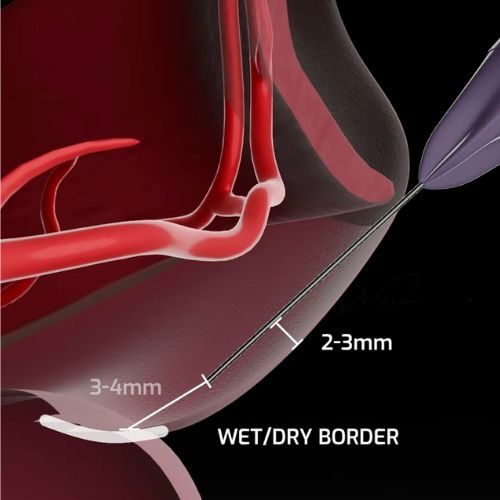
The reality is that the artery is actually 2 to 3mm above or 2 to 3mm behind both of these structures. It’s not sitting directly in the vermilion border or the wet-dry border, it’s positioned deeper in the tissue, away from both of these commonly referenced landmarks.

This distinction isn’t just academic, it’s the difference between injecting with confidence and injecting with anxiety, between understanding your risk profile and operating on misconceptions.

The Two Critical Aspects of Understanding

When developing your anatomical knowledge for safe lip injections, there are two essential components to consider:

1. Resolution of Understanding

What is the level of detail in your knowledge? Are you working with simplified 2D concepts, or do you have a high-resolution, detailed understanding of the three-dimensional relationships?

2. Three-Dimensional Anatomy

Understanding the layered, spatial relationships of structures, not just where they appear in flat diagrams, but how they relate to each other in actual depth and space.

Most injectors focus heavily on 2D representations without truly grasping the 3D reality. This creates a fundamental gap in understanding that affects technique selection and safety assessment.

Why the Horizontal vs. Vertical Debate Misses the Point

Consider the common debate about whether horizontal or vertical injections are safer. Many injectors argue that horizontal injections are safer because they believe this approach points away from the labial artery, which they think is located in the wet-dry border.

Safe Lip Filler Injection Technique and Natural Results

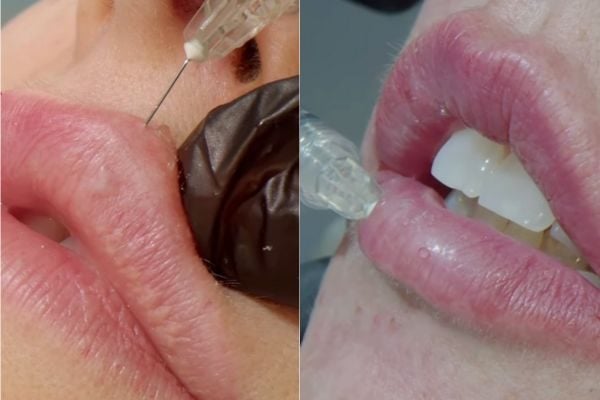
Side-by-side demonstration of proper lip filler injection technique showing safe needle entry point positioning to avoid the superior labial artery (left) and the resulting natural lip enhancement (right), illustrating the importance of 3D anatomical understanding and depth controlThis reasoning is flawed because it’s not based on 3D anatomy.

If you think horizontal injections are inherently safer because you’re pointing away from an artery in the wet-dry border, you’re actually operating on an incorrect mental model. The artery isn’t where you think it is, it’s 2 to 3mm above or behind those structures.

What most injectors don’t consider in the horizontal versus vertical debate is depth , and that’s the three-dimensional factor that matters most. This oversight is where much of the confusion originates.

The Layered Anatomy of the Lip: A Cross-Sectional View

To truly understand lip safety, you need to visualize the lip in cross-section. This perspective is vital because it provides the idea of depth that 2D diagrams cannot convey.

The Essential Layers (From Superficial to Deep)

  1. Dermis The outer skin layer, providing the visible surface of the lip.
  2. Hypodermis A very thin layer in the top lip, often where practitioners target fine line wrinkles. This layer is minimal in the lip compared to other facial areas.
  3. Orbicularis Oris Muscle Probably the most important structure of the lip for injectors to understand. This muscle has its origin on the maxilla or mandible and then branches out, reaching in four different sections across to the modiolus (where the two sides meet). This forms the biggest and strongest part of the mouth structure.
  4. Mucosa Located underneath the orbicularis oris muscle.
  5. Superior Labial Artery This is the structure most injectors worry about affecting. The artery tends to be found in the space between the orbicularis oris muscle and the mucosa.

The Artery’s True Position: What the Data Shows

When examining the research on where the superior labial artery tends to lie, the data has actually described its location quite consistently: nearly always at a depth of about 4 to 5mm typically.

This measurement is crucial because it’s much deeper than where most safety-conscious injectors are placing their needles when injecting the anterior portion of the lip.

The Vermilion Border: Your Most Important Reference Point

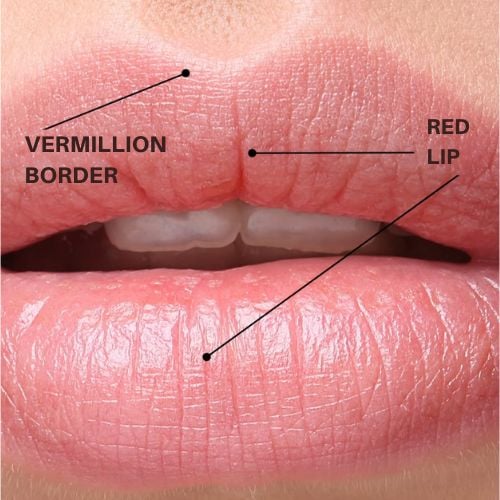
Understanding where the muscle sits is relatively straightforward when you grasp one key anatomical fact: the vermilion border is essentially where the orbicularis oris muscle curves around and has an insertion point into the skin.

The vermilion border represents the junction between:

  • The muscle insertion
  • Two types of tissue: the white lip (skin/dermis) and your mucosa

This meeting point is a very important reference point when injecting because everything is relative to that meeting point and the artery that lies underneath the muscle.

This reference can be used in many different ways to inject more accurately and safely.

Injection Accuracy: Understanding Needle Position Relative to Anatomy

When you examine detailed anatomical diagrams, you can see how needle position relates to the insertion point. Looking closely at proper injection technique, you can observe how the needle has been positioned purposefully:

  1. Slid underneath where the muscle is (which sits above)
  2. Into the volumetric part of the lip
  3. Anterior to the deeper structures

This insertion point is very important for accuracy.

Why Entry Point Matters

If you’re inserting a needle directly into the vermilion border, several problematic things occur:

  • Increased pain: You’re going through an area with greater sensitivity and more nerves
  • Muscle penetration: You’re sliding into the muscle itself, leading to more bruising
  • Potential complications: Some practitioners believe filler embedded in muscle (as opposed to other tissue types) may trigger more inflammatory reactions
  • This is why accuracy makes a huge difference , and why your understanding of 3D anatomy is so critical.

The Space Between: Why Depth Provides Your Safety Margin

When examining anatomical models created to scale, you can see there’s a relatively large amount of space on the average patient between:

  • Where your entry point is located
  • The depth of your needle

As long as you’re controlled about where the vessels tend to be, you have significant room for safe injection.

Superior Labial Artery Depth - 3D Lip Anatomy for Safe Injections
Detailed 3D anatomical illustration demonstrating that the superior labial artery sits 2-3mm behind the wet-dry border and 3-4mm deep within the lip tissue, not directly in the vermilion or wet-dry border as commonly misunderstood, critical knowledge for safe lip filler injection technique

This spatial understanding explains why injection angle may matter less than injectors think, your depth is the defining feature that makes you safer.

Should You Aspirate When Injecting Lips?

The aspiration debate continues in aesthetic medicine, with strong opinions on both sides. Here’s a balanced perspective:

  • The Position on Aspiration: Many experienced injectors aspirate nearly all the time, primarily out of muscle memory. However, it is absolutely possible to perform really safe procedures without aspirating, so long as you’re implementing other safety measures instead.
  • The key principle: It’s not really about whether you aspirate or not, it’s about the totality of all the different safety measures you take.

Aspiration can be one component of a comprehensive safety system, but it should never be your only safety measure. Multiple layers of protection, including proper depth, appropriate entry points, controlled injection speeds, and anatomical understanding, create true safety.

Learning from Experience: The Value of Mentorship

Professional development in lip injection technique is a never-ending process. A powerful example comes from observing very experienced injectors and understanding their decision-making.

A Real-World Example

When performing procedures under the direction of very experienced injectors, subtle differences in technique become apparent. For instance, when doing a vertical injection, less experienced injectors might stop injecting about a millimeter from the exit point of the needle.

However, more experienced practitioners often keep going a bit longer, which is actually where a lot of the gains are achieved.

This illustrates an important principle: It’s really useful to closely observe how experienced injectors perform procedures, then see if you can replicate their techniques and improve your understanding. Professional growth never ends, and continuous learning from peers and mentors accelerates skill development.

The 3D Mental Model: Putting It All Together

Creating an accurate 3D mental model of lip anatomy requires integrating several key concepts:

1. Spatial Relationships

Understanding where structures sit relative to each other in three dimensions, not just on a flat page.

2. Depth Awareness

Recognizing that the artery sits 4-5mm deep, behind the orbicularis oris muscle, significantly deeper than superficial injection planes.

3. Reference Point Utilization

Using the vermilion border as your primary landmark, knowing it represents the muscle insertion point and tissue transition.

4. Layer Visualization

Seeing the lip as a stack of distinct layers, dermis, thin hypodermis, orbicularis oris, mucosa, with the artery between muscle and mucosa.

5. Safe Injection Zones

Understanding that the anterior third of the lip, when injected at appropriate depths, provides significant safety margins from the artery.

Horizontal vs. Vertical: What Really Matters

After understanding true 3D anatomy, the horizontal versus vertical debate becomes less critical than commonly assumed. Here’s why:

With correct 3D understanding:

  • Both approaches can be safe when depth is controlled
  • The angle of entry matters less than injection depth
  • Staying anterior (toward the front) of the lip keeps you away from vessels regardless of angle
  • The key is understanding where you are in three-dimensional space

The real safety factor isn’t your angle of approach, it’s your depth control and staying in the anterior portion of the lip.

Practical Application: Building Confidence Through Understanding

With this 3D anatomical knowledge, you can now:

1. Make Informed Technique Decisions

Choose vertical or horizontal approaches based on aesthetic goals rather than unfounded safety concerns, knowing that depth control provides true safety.

2. Reduce Injection Anxiety

Understanding the actual arterial position (4-5mm deep, behind the muscle) helps you realize how much safe space exists in the anterior lip.

3. Improve Accuracy

Using the vermilion border as your primary reference point allows for more precise, controlled injections.

4. Enhance Patient Outcomes

Less anxiety and better technique lead to smoother procedures, less bruising, and superior aesthetic results.

5. Develop Better Safety Systems

Rather than relying on single safety measures (like aspiration alone), build comprehensive safety systems based on anatomical understanding.

The Danger Zones: What You Now Know

With proper 3D understanding, you can now identify the real danger zones:

Lower Risk Areas:

  • Anterior third of the lip (where most volumetric injections occur)
  • Superficial planes when properly controlled
  • Areas well anterior to the muscle insertion point

Higher Risk Considerations:

  • Deep injections approaching 4-5mm depth
  • Injections posterior to (behind) the orbicularis oris muscle
  • Areas where you lose awareness of your three-dimensional position

The key difference is that you now understand these zones based on actual anatomical relationships rather than simplified 2D concepts.

Moving Forward: Confident, Safe, Accurate Injections

The transformation from 2D to 3D thinking represents a fundamental shift in how you approach lip injections. You’re no longer guessing or operating on incomplete information, you have a true mental model of where structures actually exist in space.

Key Takeaways:

  1. The artery is NOT in the vermilion or wet-dry border , it’s 2-3mm above or behind these structures
  2. Depth matters more than angle for safety
  3. The vermilion border is your key reference point , it marks muscle insertion
  4. The artery sits 4-5mm deep , between muscle and mucosa
  5. Anterior lip injections have good safety margins when depth is controlled
  6. Multiple safety measures matter more than any single technique
  7. Continuous learning from experienced practitioners accelerates development

Conclusion: Knowledge Equals Confidence

Understanding where the artery really is, and equally important, where it isn’t, transforms your approach to lip injections. The 3D perspective eliminates much of the confusion that plagues 2D-based debates about technique safety.

You now know that the artery sits 4-5mm deep, behind the orbicularis oris muscle, approximately 2-3mm behind both the vermilion border and wet-dry border. You understand that depth control matters far more than injection angle, and that the anterior third of the lip provides significant safety margins for volumetric treatments.

This knowledge doesn’t just make you safer, it makes you more confident, more accurate, and ultimately more effective as an aesthetic practitioner. When you truly know where the artery is, you can inject lips with the certainty that comes from genuine anatomical understanding rather than hope based on incomplete information.

Watch the full Aesthetics Mastery Show

In this in-depth tutorial, Dr. Tim Pearce] breaks down the real 3D anatomy of the lips and shows you how to avoid crucial arteries while achieving safe, beautiful results.

You can also subscribe to our YouTube channel for really useful regular tips and advice.  YouTube


Dermal Filler & Lips eLearning Courses

If you want to increase your knowledge about safe and effective lip filler injectable treatments, Dr Tim Pearce offers a series of fabulous courses, from foundation and upwards:

  • 8D Lip Design
  • Elective Lip Reversal
  • Dermal Fillers Foundation Course
  • Dermal Filler Complications Mastery

In addition, browse our FREE downloadable resources.

Dr Tim Pearce eLearning

Dr Tim Pearce MBChB BSc (Hons) MRCGP founded his eLearning concept in 2016 in order to provide readily accessible BOTOX® and dermal filler online courses for fellow Medical Aesthetics practitioners. His objective was to raise standards within the industry – a principle which remains just as relevant today.

Our exclusive video-led courses are designed to build confidence, knowledge and technique at every stage, working from foundation level to advanced treatments and management of complications.

Thousands of delegates have benefited from the courses and we’re highly rated on Trustpilot. For more information or to discuss which course is right for you, please get in touch with our friendly team.

Share This Article
Facebook Twitter Pinterest Linkedin
Prev Post
Next Post

Related Articles

Platelet-Rich Plasma (PRP) and Platelet-Rich Fibrin (PRF) in Skin Rejuvenation After 40 Bestseller

Platelet-Rich Plasma (PRP) and Platelet-Rich Fibrin (PRF) in Skin Rejuvenation After 40

January 27, 2026

Platelet-Rich Plasma (PRP) and Platelet-Rich Fibrin (PRF) in Skin Rejuvenation After 40
By Andrea Callaway
January 27, 2026

Platelet-Rich Plasma (PRP) and Platelet-Rich Fibrin (PRF) in Skin Rejuvenation After 40

READ MORE
Restoration of Older Lips: The Psychology, Aesthetics, and Anatomy You Need to Understand Bestseller

Restoration of Older Lips: The Psychology, Aesthetics, and Anatomy You Need to Understand

January 22, 2026

Restoration of Older Lips: The Psychology, Aesthetics, and Anatomy You Need to Understand
By Andrea Callaway
January 22, 2026

Restoration of Older Lips: The Psychology, Aesthetics, and Anatomy You Need to Understand

READ MORE
New Technologies in the Field of Facial Aesthetics and Body Contouring Bestseller

New Technologies in the Field of Facial Aesthetics and Body Contouring

January 20, 2026

New Technologies in the Field of Facial Aesthetics and Body Contouring
By Andrea Callaway
January 20, 2026

New Technologies in the Field of Facial Aesthetics and Body Contouring

READ MORE

Popular Courses

BOTOX® Foundation Course

BOTOX® Foundation Course

Pro Tox

Pro Tox

8D Lip Design

8D Lip Design

SEE MORE

CONTACT US

    contact injection
    Dr Tim Pearce

    Improve your medical
    aesthetics business

    • Home
    • Courses
    • About
    • Contact
    • Dr Tim Limited Terms and Conditions of Sale
    • Privacy Policy
    • Website Terms Of Use
    • Careers
    Login Dr Tim Pearce Login
    © Copyright Dr Tim Ltd, 2025
    We use cookies on our website to give you the most relevant experience by remembering your preferences and repeat visits. Read More. By clicking “Accept All”, you consent to the use of ALL the cookies. However, you may visit "Cookie Settings" to provide a controlled consent.
    Cookie Settings Reject All Accept All
    Manage consent

    Privacy Overview

    This website uses cookies to improve your experience while you navigate through the website. Out of these, the cookies that are categorized as necessary are stored on your browser as they are essential for the working of basic functionalities of the website. We also use third-party cookies that help us analyze and understand how you use this website. These cookies will be stored in your browser only with your consent. You also have the option to opt-out of these cookies. But opting out of some of these cookies may affect your browsing experience.
    Necessary
    Always Enabled
    Necessary cookies are absolutely essential for the website to function properly. These cookies ensure basic functionalities and security features of the website, anonymously.
    CookieDurationDescription
    cookielawinfo-checkbox-analytics11 monthsThis cookie is set by GDPR Cookie Consent plugin. The cookie is used to store the user consent for the cookies in the category "Analytics".
    cookielawinfo-checkbox-functional11 monthsThe cookie is set by GDPR cookie consent to record the user consent for the cookies in the category "Functional".
    cookielawinfo-checkbox-necessary11 monthsThis cookie is set by GDPR Cookie Consent plugin. The cookies is used to store the user consent for the cookies in the category "Necessary".
    cookielawinfo-checkbox-others11 monthsThis cookie is set by GDPR Cookie Consent plugin. The cookie is used to store the user consent for the cookies in the category "Other.
    cookielawinfo-checkbox-performance11 monthsThis cookie is set by GDPR Cookie Consent plugin. The cookie is used to store the user consent for the cookies in the category "Performance".
    viewed_cookie_policy11 monthsThe cookie is set by the GDPR Cookie Consent plugin and is used to store whether or not user has consented to the use of cookies. It does not store any personal data.
    Functional
    Functional cookies help to perform certain functionalities like sharing the content of the website on social media platforms, collect feedbacks, and other third-party features.
    Performance
    Performance cookies are used to understand and analyze the key performance indexes of the website which helps in delivering a better user experience for the visitors.
    Analytics
    Analytical cookies are used to understand how visitors interact with the website. These cookies help provide information on metrics the number of visitors, bounce rate, traffic source, etc.
    Advertisement
    Advertisement cookies are used to provide visitors with relevant ads and marketing campaigns. These cookies track visitors across websites and collect information to provide customized ads.
    Others
    Other uncategorized cookies are those that are being analyzed and have not been classified into a category as yet.
    SAVE & ACCEPT