



• Mail us: support@drtimpearce.com
  • Trustpilot
Dr Tim Pearce, eLearningDr Tim Pearce, eLearningDr Tim Pearce, eLearning Dr Tim Pearce, eLearning
  • eLearning Courses
        • ELEARNING COURSES

        • Techniques
          • BOTOX® Foundation Course
          • Pro Tox
          • Dermal Fillers Foundation Course
          • 8D Lip Design
          • Julie Horne Directs, Dr Tim Injects – February 2023
          • Eyelash Enhancement Serum Course
          • Anatomy360
          • Art Codes
        • Complications
          • Botulinum Toxin Complications Mastery
          • Dermal Filler Complications Mastery
          • Elective Lip Reversal
        • Profinity
        • Wellness
          • How To Introduce Longevity To Your Aesthetics Clinic
        • Marketing
          • DCAM 2.0
          • Canva Mastery: A Step-by-Step Guide
          • Email Marketing Course
          • Industry Photography Secrets
          • How to find your voice with video
        • Other Services
          • DPP for V300 Service
        • Packages
          • Foundation eLearning Package – SAVE 10%
          • Complications eLearning Package – SAVE 10%
          • Techniques eLearning Package – SAVE 20%
          • Marketing eLearning Package – SAVE 20%
          • Full eLearning Package – SAVE 35%
        • Reviews and Testimonials
        • FAQ – Online Courses
  • Downloads
        • Complications
          • 13 Extra Risky Injection Areas: Facial Vessel Map
          • Aspirating Experiment Test Results
          • Bruising Checklist: Prevent & Minimise Bruises from Injectables
          • Dermal Filler Complications: The Essential Guide
          • Delayed Onset Nodules: How To Diagnose And Treat
          • Diagnosing Complications: 7 Steps To Great Advice
          • Emergency Reversal Protocol
          • How To Avoid Causing a Lateral Rectus Palsy From Botulinum Toxins
          • Hyalase Consent Form: Downloadable Template
          • Lumps in Lips Guide: How to Diagnose, Manage & Treat
          • Tear Trough Oedema Protocol
          • Does Covid-19 Vaccine Cause Dermal Filler Reactions?
        • Injection Techniques
          • 26 Essential Injection Patterns For Botulinum Toxin
          • Botox Calculator
          • BOTOX Lesson – Gummy Smile
          • BOTOX Lesson – Hooded Eyes
          • Frequently Used Filler Volumes Facial Map
          • How To Improve Your Needle Control: 6-Step Blueprint
          • How to Prepare BOTOX – Step by Step Guide
        • Consultation Skills
          • Body Dysmorphia & Modification Checklist
          • Is It Safe To Treat? 5-Step Contraindication Check List
          • Medical Model For Cosmetic Procedures: An Essential Guide
        • Lips
          • Lip Consultation Question Checklist
          • Lip Anatomy Lesson
          • Common Needle/Cannula Choices For Lips
          • Lip Filler Aftercare Pack for Your Patients
          • Lip Design Blueprint – 4 Steps To Perfect Lip Augmentation
          • Master the Basics of Julie Horne’s Lip Technique
        • Longevity
          • Does HRT Increase Cancer Risk? Guide for Clinicians
          • Educating Patients About How Sugar Exacerbates Aging
          • How to Reduce Biological Age for Your Patients
        • Business & Marketing
          • Annual Profit Calculator
          • 5 Steps to Create a Successful Aesthetics Business
          • Injector’s Cheat Sheet – 7 Social Media Post Types
          • 7 Deadly Hashtag Sins
          • 7 Secret Locations to get Instagram Followers
          • 9 Video Marketing Mistakes
          • 15 Easy Instagram Reels Ideas
          • 3 Time-Saving Hacks for Social Media
          • Personal Branding Starter Kit
          • Value Audit Template: Price-per-1ml
          • World’s Top 5 Filler Brands – Survey Results
  • Products
    • Artistic Anatomy Poster Collection
    • Top 3 Posters Bundle
    • Original Anatomy Poster
    • Beautiful Lip Anatomy Poster
    • Download Pack – Forms & Leaflets
  • Blog
    • Meet the Writers
  • Podcasts
  • About
    • Dr Tim Pearce
    • Miranda Pearce
    • Careers & Recruitment
    • Webinars
    • Become a Model
  • Contact
  • Login

Login

How to Treat Forehead Lines with Botox Without Freezing Facial Expression

Blogs

  • ALL
  • Complications
  • Injection Techniques
  • Consultation Skills
  • Lips
  • Business & Marketing
You may be interested
Platelet-Rich Plasma (PRP) and Platelet-Rich Fibrin (PRF) in Skin Rejuvenation After 40

Platelet-Rich Plasma (PRP) and Platelet-Rich Fibrin (PRF) in Skin Rejuvenation After 40

January 27, 2026

Restoration of Older Lips: The Psychology, Aesthetics, and Anatomy You Need to Understand

Restoration of Older Lips: The Psychology, Aesthetics, and Anatomy You Need to Understand

January 22, 2026

New Technologies in the Field of Facial Aesthetics and Body Contouring

New Technologies in the Field of Facial Aesthetics and Body Contouring

January 20, 2026

Why I Still Treat Tear Troughs: A Response to Dr. Gavin Chan’s Viral Video

Why I Still Treat Tear Troughs: A Response to Dr. Gavin Chan’s Viral Video

January 15, 2026

Laser Platforms vs. Standalone Systems in Clinic Practice

Laser Platforms vs. Standalone Systems in Clinic Practice

January 13, 2026

How to Treat Forehead Lines with Botox Without Freezing Facial ExpressionDr Tim Pearce
August 28, 2025

In aesthetic medicine, forehead lines are one of the most frequently requested areas for botulinum toxin (Botox) treatment. While patients often seek a smoother forehead to reduce signs of ageing, overtreating this area can lead to a lack of natural expression and a stiff or unnatural look. The key to effective treatment lies in understanding the anatomy and function of the frontalis muscle, as well as the delicate balance between facial muscle groups that control eyebrow movement and upper face dynamics.

This blog explores how medical aesthetic practitioners can treat forehead wrinkles with Botox while maintaining natural expression.

Understanding the Frontalis Muscle

FRONTALISThe frontalis muscle is the only elevator in the upper third of the face. It lifts the eyebrows and forms horizontal forehead lines, especially during expressions like surprise or concern. Anatomically, it originates from the galea aponeurotica and inserts into the skin above the eyebrows, with no bony attachments. This structural detail makes it particularly sensitive to the effects of botulinum toxin injections.

The muscle is not uniform in function. The upper fibres contribute to line formation, while the lower fibres are more directly involved in eyebrow elevation. This distinction matters clinically, as overtreating the lower frontalis, especially in patients who use it to compensate for eyelid hooding or dermatochalasis, may result in brow heaviness or even ptosis.

Sex-based anatomical variation is also relevant. Male patients often have a stronger, more fibrous frontalis that extends further into the scalp, which may require higher doses of Botox. Female patients typically have a narrower frontalis and a more defined brow arch, requiring a more tailored approach to preserve aesthetic proportions. In older patients, thinning of the skin and loss of underlying fat layers increase the visibility of forehead lines, while simultaneously heightening the risk of overcorrection.

Facial Muscles: Elevators and Depressors

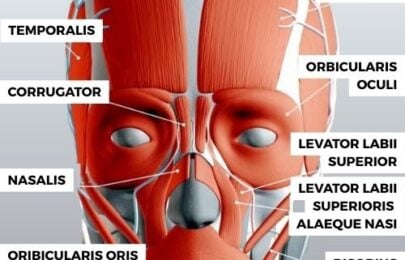
forehead frown linesSuccessful treatment of forehead lines with botulinum toxin depends on understanding the antagonistic relationship between the frontalis (elevator) and surrounding depressor muscles-  including the corrugator supercilii, procerus, and orbicularis oculi. When treating with Botox, clinicians must consider these facial muscle vectors to preserve natural eyebrow movement and prevent unwanted aesthetic outcomes.

This concept is known as botulinum rebalancing. By reducing the activity of the procerus and corrugator muscles, for instance, aesthetic clinicians can create a natural lift in the medial brow by allowing the frontalis to dominate. However, if only the frontalis is treated without modulating the depressors, patients may experience a drop in brow position or a flat, heavy appearance.

Injection Technique: Planning, Landmarks, and Safety Considerations

The ideal outcome of a forehead Botox treatment is softening of dynamic lines without erasing the patient’s ability to express themselves. This starts with a dynamic assessment. Observing how the brow moves during conversation and expression helps determine the most active regions of the frontalis muscle and informs safe and effective injection placement.

Most patients require between 10–20 units (if using Botox or Bocouture), or 25–50 Speywood units (for Azzalure). Men and patients with larger or more active foreheads often require higher doses. For women, a gentle V- or M-shaped injection pattern helps preserve the natural arch of the brow. In men, a straighter, horizontal placement may be more suitable to maintain masculine features.

All injections should maintain a 2 cm safety margin above the orbital rim to reduce the risk of brow ptosis. The toxin should be placed into the mid-depth of the frontalis, which sits approximately 3–5 mm beneath the skin surface. Injecting too superficially may lead to poor uptake, while deeper injections carry a higher risk of diffusion into adjacent structures.

Common Complications in Forehead Botox – and How to Avoid Them

Like any aesthetic procedure, forehead Botox treatments carry potential complications. Brow heaviness is among the most common and usually results from over-relaxation of the lower frontalis, particularly in patients who rely on this muscle to compensate for eyelid droop.

Another frequently encountered issue is asymmetrical brow elevation, or “Spock brow,” which occurs when the lateral frontalis remains active due to inadequate treatment. This can usually be corrected with a small additional dose of 1–2 units of toxin in the overactive area.

The most serious but rare complication is eyelid ptosis, which can occur if the toxin diffuses into the levator palpebrae superioris. This is more likely in patients with low-set brows, pre-existing eyelid issues, or incorrect injection technique near the orbital rim.

Patient selection and consultation are critical to preventing such outcomes. Older patients or those with dermatochalasis, previous blepharoplasty, or prominent brow descent should be approached with caution, and treatment modified or avoided accordingly.

The Importance of Clinical Reasoning

Treating the forehead should never be viewed as a “beginner” procedure. In fact, it is one of the most nuanced areas to treat, precisely because of the frontalis’s unique anatomical role and its interaction with adjacent muscle groups.

Rather than aiming to erase all lines, the goal of forehead Botox should be to soften excessive movement while preserving a patient’s natural ability to express emotion. Starting conservatively, and reassessing after two weeks, allows for incremental adjustment and significantly reduces the risk of overcorrection. Patients should also be educated on the difference between dynamic and static lines, and why deeper, etched rhytids may require complementary treatments like microneedling, skin boosters, or polynucleotides in addition to Botox.

This layered, reflective approach reinforces the importance of clinical judgement in aesthetic practice. As with any injectable treatment, it’s not just about the product, it’s about understanding what lies beneath the skin and how it functions.

Final Thoughts

Successful outcomes rely on more than product placement. They demand anatomical understanding, clinical sensitivity, and a respect for each patient’s unique facial dynamics. In short, the best Botox treatments don’t freeze the face – they refine it.

BOTOX (Botulinum Toxin) eLearning Courses

If you want to increase your confidence in botulinum toxin injections, or learn how to avoid and handle complications, Dr Tim Pearce offers two comprehensive courses that are highly rated by our delegates:
  • BOTOX® Foundation Course
  • Botulinum Toxin Complications Mastery
Both give CPD and certificates on completion. In addition, browse our FREE downloadable resources on complications.  

Dr Tim Pearce eLearning

Dr Tim Pearce MBChB BSc (Hons) MRCGP founded his eLearning concept in 2016 in order to provide readily accessible BOTOX® and dermal filler online courses for fellow Medical Aesthetics practitioners. His objective was to raise standards within the industry – a principle which remains just as relevant today.

Our exclusive video-led courses are designed to build confidence, knowledge and technique at every stage, working from foundation level to advanced treatments and management of complications.

Thousands of delegates have benefited from the courses and we’re highly rated on Trustpilot. For more information or to discuss which course is right for you, please get in touch with our friendly team.

Share This Article
Facebook Twitter Pinterest Linkedin
Prev Post
Next Post

Related Articles

Platelet-Rich Plasma (PRP) and Platelet-Rich Fibrin (PRF) in Skin Rejuvenation After 40 Bestseller

Platelet-Rich Plasma (PRP) and Platelet-Rich Fibrin (PRF) in Skin Rejuvenation After 40

January 27, 2026

Platelet-Rich Plasma (PRP) and Platelet-Rich Fibrin (PRF) in Skin Rejuvenation After 40
By Andrea Callaway
January 27, 2026

Platelet-Rich Plasma (PRP) and Platelet-Rich Fibrin (PRF) in Skin Rejuvenation After 40

READ MORE
Restoration of Older Lips: The Psychology, Aesthetics, and Anatomy You Need to Understand Bestseller

Restoration of Older Lips: The Psychology, Aesthetics, and Anatomy You Need to Understand

January 22, 2026

Restoration of Older Lips: The Psychology, Aesthetics, and Anatomy You Need to Understand
By Andrea Callaway
January 22, 2026

Restoration of Older Lips: The Psychology, Aesthetics, and Anatomy You Need to Understand

READ MORE
New Technologies in the Field of Facial Aesthetics and Body Contouring Bestseller

New Technologies in the Field of Facial Aesthetics and Body Contouring

January 20, 2026

New Technologies in the Field of Facial Aesthetics and Body Contouring
By Andrea Callaway
January 20, 2026

New Technologies in the Field of Facial Aesthetics and Body Contouring

READ MORE

Popular Courses

BOTOX® Foundation Course

BOTOX® Foundation Course

Pro Tox

Pro Tox

8D Lip Design

8D Lip Design

SEE MORE

CONTACT US

    contact injection
    Dr Tim Pearce

    Improve your medical
    aesthetics business

    • Home
    • Courses
    • About
    • Contact
    • Dr Tim Limited Terms and Conditions of Sale
    • Privacy Policy
    • Website Terms Of Use
    • Careers
    Login Dr Tim Pearce Login
    © Copyright Dr Tim Ltd, 2025
    We use cookies on our website to give you the most relevant experience by remembering your preferences and repeat visits. Read More. By clicking “Accept All”, you consent to the use of ALL the cookies. However, you may visit "Cookie Settings" to provide a controlled consent.
    Cookie Settings Reject All Accept All
    Manage consent

    Privacy Overview

    This website uses cookies to improve your experience while you navigate through the website. Out of these, the cookies that are categorized as necessary are stored on your browser as they are essential for the working of basic functionalities of the website. We also use third-party cookies that help us analyze and understand how you use this website. These cookies will be stored in your browser only with your consent. You also have the option to opt-out of these cookies. But opting out of some of these cookies may affect your browsing experience.
    Necessary
    Always Enabled
    Necessary cookies are absolutely essential for the website to function properly. These cookies ensure basic functionalities and security features of the website, anonymously.
    CookieDurationDescription
    cookielawinfo-checkbox-analytics11 monthsThis cookie is set by GDPR Cookie Consent plugin. The cookie is used to store the user consent for the cookies in the category "Analytics".
    cookielawinfo-checkbox-functional11 monthsThe cookie is set by GDPR cookie consent to record the user consent for the cookies in the category "Functional".
    cookielawinfo-checkbox-necessary11 monthsThis cookie is set by GDPR Cookie Consent plugin. The cookies is used to store the user consent for the cookies in the category "Necessary".
    cookielawinfo-checkbox-others11 monthsThis cookie is set by GDPR Cookie Consent plugin. The cookie is used to store the user consent for the cookies in the category "Other.
    cookielawinfo-checkbox-performance11 monthsThis cookie is set by GDPR Cookie Consent plugin. The cookie is used to store the user consent for the cookies in the category "Performance".
    viewed_cookie_policy11 monthsThe cookie is set by the GDPR Cookie Consent plugin and is used to store whether or not user has consented to the use of cookies. It does not store any personal data.
    Functional
    Functional cookies help to perform certain functionalities like sharing the content of the website on social media platforms, collect feedbacks, and other third-party features.
    Performance
    Performance cookies are used to understand and analyze the key performance indexes of the website which helps in delivering a better user experience for the visitors.
    Analytics
    Analytical cookies are used to understand how visitors interact with the website. These cookies help provide information on metrics the number of visitors, bounce rate, traffic source, etc.
    Advertisement
    Advertisement cookies are used to provide visitors with relevant ads and marketing campaigns. These cookies track visitors across websites and collect information to provide customized ads.
    Others
    Other uncategorized cookies are those that are being analyzed and have not been classified into a category as yet.
    SAVE & ACCEPT