
• Mail us: support@drtimpearce.com
  • Trustpilot
Dr Tim Pearce, eLearningDr Tim Pearce, eLearningDr Tim Pearce, eLearning Dr Tim Pearce, eLearning
  • eLearning Courses
        • ELEARNING COURSES

        • Techniques
          • BOTOX® Foundation Course
          • Pro Tox
          • Dermal Fillers Foundation Course
          • 8D Lip Design
          • Julie Horne Directs, Dr Tim Injects – February 2023
          • Eyelash Enhancement Serum Course
          • Anatomy360
          • Art Codes
        • Complications
          • Botulinum Toxin Complications Mastery
          • Dermal Filler Complications Mastery
          • Elective Lip Reversal
        • Profinity
        • Wellness
          • How To Introduce Longevity To Your Aesthetics Clinic
        • Marketing
          • DCAM 2.0
          • Canva Mastery: A Step-by-Step Guide
          • Email Marketing Course
          • Industry Photography Secrets
          • How to find your voice with video
        • Other Services
          • DPP for V300 Service
        • Packages
          • Foundation eLearning Package – SAVE 10%
          • Complications eLearning Package – SAVE 10%
          • Techniques eLearning Package – SAVE 20%
          • Marketing eLearning Package – SAVE 20%
          • Full eLearning Package – SAVE 35%
        • Reviews and Testimonials
        • FAQ – Online Courses
  • Downloads
        • Complications
          • 13 Extra Risky Injection Areas: Facial Vessel Map
          • Aspirating Experiment Test Results
          • Bruising Checklist: Prevent & Minimise Bruises from Injectables
          • Dermal Filler Complications: The Essential Guide
          • Delayed Onset Nodules: How To Diagnose And Treat
          • Diagnosing Complications: 7 Steps To Great Advice
          • Emergency Reversal Protocol
          • How To Avoid Causing a Lateral Rectus Palsy From Botulinum Toxins
          • Hyalase Consent Form: Downloadable Template
          • Lumps in Lips Guide: How to Diagnose, Manage & Treat
          • Tear Trough Oedema Protocol
          • Does Covid-19 Vaccine Cause Dermal Filler Reactions?
        • Injection Techniques
          • 26 Essential Injection Patterns For Botulinum Toxin
          • Botox Calculator
          • BOTOX Lesson – Gummy Smile
          • BOTOX Lesson – Hooded Eyes
          • Frequently Used Filler Volumes Facial Map
          • How To Improve Your Needle Control: 6-Step Blueprint
          • How to Prepare BOTOX – Step by Step Guide
        • Consultation Skills
          • Body Dysmorphia & Modification Checklist
          • Is It Safe To Treat? 5-Step Contraindication Check List
          • Medical Model For Cosmetic Procedures: An Essential Guide
        • Lips
          • Lip Consultation Question Checklist
          • Lip Anatomy Lesson
          • Common Needle/Cannula Choices For Lips
          • Lip Filler Aftercare Pack for Your Patients
          • Lip Design Blueprint – 4 Steps To Perfect Lip Augmentation
          • Master the Basics of Julie Horne’s Lip Technique
        • Longevity
          • Does HRT Increase Cancer Risk? Guide for Clinicians
          • Educating Patients About How Sugar Exacerbates Aging
          • How to Reduce Biological Age for Your Patients
        • Business & Marketing
          • Annual Profit Calculator
          • 5 Steps to Create a Successful Aesthetics Business
          • Injector’s Cheat Sheet – 7 Social Media Post Types
          • 7 Deadly Hashtag Sins
          • 7 Secret Locations to get Instagram Followers
          • 9 Video Marketing Mistakes
          • 15 Easy Instagram Reels Ideas
          • 3 Time-Saving Hacks for Social Media
          • Personal Branding Starter Kit
          • Value Audit Template: Price-per-1ml
          • World’s Top 5 Filler Brands – Survey Results
  • Products
    • Artistic Anatomy Poster Collection
    • Top 3 Posters Bundle
    • Original Anatomy Poster
    • Beautiful Lip Anatomy Poster
    • Download Pack – Forms & Leaflets
  • Blog
    • Meet the Writers
  • About
    • Dr Tim Pearce
    • Miranda Pearce
    • Careers & Recruitment
    • Become a Model
  • Contact
  • Login

Login

Lip Filler Migration: Why It Happens and How to Prevent It

Blogs

  • ALL
  • Complications
  • Injection Techniques
  • Consultation Skills
  • Lips
  • Business & Marketing
You may be interested
Lip Filler Migration: Why It Happens and How to Prevent It

Lip Filler Migration: Why It Happens and How to Prevent It

August 6, 2026

Non-Regulated Fillers in Gluteal Augmentation: The Illusion of Safety

Non-Regulated Fillers in Gluteal Augmentation: The Illusion of Safety

August 4, 2026

Vertical Versus Horizontal Lip Injection

Vertical Versus Horizontal Lip Injection

July 30, 2026

The Science Behind Microneedling: Are We Seeing A True Regeneration?

The Science Behind Microneedling: Are We Seeing A True Regeneration?

July 28, 2026

Upper Face Botulinum Toxin in Male Patients

Upper Face Botulinum Toxin in Male Patients

July 23, 2026

Lip Filler Migration: Why It Happens and How to Prevent ItDr Tim Pearce
August 6, 2026

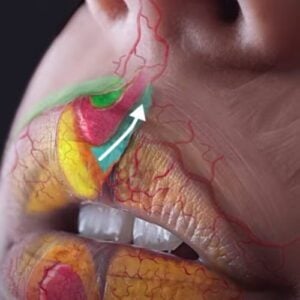
lip filler migration diagramThe loss of a defined vermilion border is one of the more frustrating long-term outcomes in lip filler work, partly because it tends to develop slowly enough that neither the injector nor the patient notices the shift in real time, and partly because the very feature being lost is the one that does most of the aesthetic work in the lip. A beautifully defined pink-white border is an essential component of lip beauty, and the rest of the work an injector does on volume, shape, and angle can be technically excellent and still produce a downgraded result if that border has been gradually erased by migrating product. Walking through any tourist destination where lip filler has been widely adopted makes this pattern hard to ignore once you have started looking for it.

Working out why filler migrates and what an individual injector can do to prevent it turns out to be a more demanding intellectual exercise than the typical “it’s the product” or “it’s the technique” debate, because the actual mechanism involves the interaction of anatomy, product behaviour, injection technique, and the physics of pressure inside a moving lip. The injectors who consistently keep the vermilion border intact over years of repeat treatment tend to be the ones who have built a careful mental model of all of those factors and have tested that model against their own clinical experience.

What a mental model actually is in injection practice

A mental model is the structured idea an injector holds in their head of how the different elements of a treatment relate to each other and produce the outcome they see in the chair. It is the cause-and-effect relationship between the fundamental truths of what is happening under the skin, built up from anatomy, product properties, and injection technique into a single working picture. Every injector has one, whether or not they have consciously articulated it, and the quality of that model is the single biggest factor in whether their decisions tend towards good long-term results or towards complications they cannot fully explain.

Mental models begin on the first day of anatomy training, usually as a two-dimensional layout where you know roughly where the arteries and the muscles sit. Over time and with practice that flat picture becomes a three-dimensional relationship between fat pads, muscles, nerves, and arteries, and that anatomical model then has to be combined with injection technique and product behaviour to predict what will happen at the six-week and six-month mark. The point of building this model is accuracy more than complexity, because the goal is to operate according to fundamental truths that allow you to predict the next treatment’s outcome with confidence.

Fundamental assumptions and how they shape decisions

The most useful question an injector can ask of their own mental model is what fundamental assumptions are sitting underneath it. Examples include the idea that a good filler integrates well within tissue in the first few minutes and therefore does not move out of place easily, or the alternative idea that filler is held in place by anatomical compartments and only stops moving when it hits a tissue boundary. Both of these explanations address the same clinical question of why a treatment holds its shape, and they predict different things about how to inject and which products to favour.

A third common assumption is that injection technique alone determines the result regardless of product choice, with the implication that all hyaluronic acid fillers behave essentially the same way in skilled hands. Different injectors weigh these competing assumptions differently and inject accordingly, and the value of articulating them is that it makes the underlying logic of a practice visible enough to be challenged with evidence from your own results.

How the Russian lip technique can produce migration

Dr Harris shared a thoughtful analysis on a closed Lip Masters Facebook group of why the Russian lip technique may produce migration over time, and the model he described is a useful worked example of fundamental assumptions in action. The technique he describes involves injection at 90 degrees across the vermilion border, which passes through the insertion of orbicularis oris into the lip body and leaves a small channel through that muscle. The argument is that those channels remain patent to some degree after injection, and that when the lip moves and pressure rises in the lip body, filler is squeezed back along the channels into the white part of the lip where the migrated appearance becomes visible.

The model rests on several fundamental assumptions. The first is that the Russian lip technique consistently crosses the vermilion border at 90 degrees, which is variable in practice because the term covers a range of techniques across the world, with some versions using a single entry point and multiple threads that change the number of channels through the muscle. The second is that the channels through orbicularis oris remain open long enough for movement-induced pressure to drive filler back along them. The third is that the filler itself is mobile enough to flow from a higher-pressure to a lower-pressure area, which depends heavily on how quickly that product integrates into the surrounding tissue.

Where small technique variations change the prediction

The migration analysis described above is highly sensitive to where exactly the needle enters the lip, and a shift of as little as two millimetres can change the structures the needle passes through. Anterior placement of the entry point keeps the needle in front of the orbicularis oris insertion, which removes the channel-through-muscle mechanism that the migration model relies on. The same Instagram-recognisable technique can therefore look identical to the viewer while producing fundamentally different anatomical results, depending on whether the practitioner has been trained to be two millimetres anterior or to enter directly at the visible border.

The entry point on the pink-white border should be in the pink, not directly in the middle, because that placement leaves a small wall of tissue between the deposited filler and the white part of the lip. That wall is the physical barrier that prevents filler from flowing back out of position when the lip moves, and it disappears the moment the entry point is moved a couple of millimetres posteriorly into the middle of the border.

A different mental model that points to a different compartment

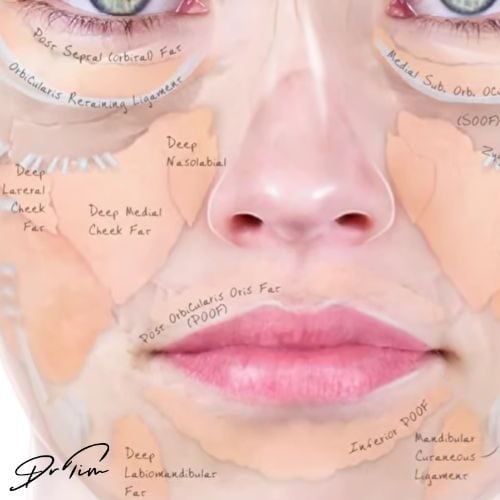
An alternative mental model of lip anatomy treats the lip as three main compartments, with the lip body sitting in front of orbicularis oris and the hypodermis sitting behind it. Under this model, if filler does spread through pressure gradients over time, the lower-resistance path leads underneath the muscle into the deep orbicularis fat pad. The route back through small channels into the white part of the lip becomes a less likely explanation under this framework. The clinical correlate is the patient who has had multiple treatments over years and still has a defined vermilion border but a slightly fuller spread underneath the muscle, which Dr Masser’s ultrasound work has demonstrated in imaging.

This model also implies that filler does not flow that easily across pressure differences in the short term, supported by the clinical observation that squeezing an area of just-injected filler does not usually produce flow back out of the needle track. That observation does not rule out migration as a long-term phenomenon, but it does shift the most likely route of that migration away from the channel-through-muscle explanation and towards spread underneath the muscle over months and years of repeat treatment.

Why product choice changes the migration picture

Tissue integration varies meaningfully between products, which means the assumption that all fillers behave the same way under the same technique tends to break down once you have used several products in the same hands over a long enough period. There is clinical experience of a previously used FDA-approved product producing more migration and loss of definition in the lip, with the switch to a different product resolving the same problem without any change in technique. Juvederm Volift integrates best in this clinical experience, and the difference often presents as subtle loss of definition, with the lip looking rounder and less crisply outlined over time.

The practical implication is that injection technique and product choice work together, with each one capable of compensating somewhat for the other and each one capable of undermining the other when poorly matched. A product that integrates quickly will tolerate a less than perfect entry point better than a product that stays mobile in tissue, and a perfectly anterior entry point will get more out of a product that holds its shape than one that spreads easily.

How to build and refine your own mental model

The development of a working mental model begins with theoretical knowledge, moves into clinical application, and then improves through deliberate reflection when the result you saw does not match what your model predicted. That mismatch is the most valuable diagnostic signal you have about your own assumptions, because it points directly at the part of your model that needs revising. Articulating the model out loud or in writing tends to expose gaps that go unnoticed when it sits silently in the back of the mind, and explaining the treatment plan to nervous patients in detail is a useful low-stakes way to do this articulation regularly.

Listening to other thoughtful injectors and intentionally clashing their model with your own is the part of this process that produces the biggest jumps in understanding, because the friction between two intelligent practitioners working from different assumptions tends to expose which assumptions are weaker than they looked. The anxiety of arriving at a conference and discovering that several respected experts disagree with what you currently believe is shared by every injector at some point in their career, and the way through that anxiety is to look for the underlying assumption each speaker is making and decide which one matches the evidence you have collected from your own patients.

Want to overcome your fear of complications, confidently master anatomy and 10x your injection skills? Join us for one of Dr Tim’s FREE upcoming webinars. 

Ready to master deep fat pad anatomy and transform your consultation approach?

Join Dr. Tim's upcoming webinar where you'll explore the specific locations and volumes of deep fat compartments, understand when to inject deep versus superficial layers, and develop the anatomical communication skills that build patient trust and improve treatment outcomes.

Register for the Free Webinar →

Learn to see facial anatomy the way expert injectors do, enabling treatment plans based on structural understanding rather than surface-level symptom chasing.

Anatomy Webinar
Dr Tim Consultation Anatomy

Dr Tim Pearce eLearning

Dr Tim Pearce MBChB BSc (Hons) MRCGP founded his eLearning concept in 2016 in order to provide readily accessible BOTOX® and dermal filler online courses for fellow Medical Aesthetics practitioners. His objective was to raise standards within the industry – a principle which remains just as relevant today.

Our exclusive video-led courses are designed to build confidence, knowledge and technique at every stage, working from foundation level to advanced treatments and management of complications.

Thousands of delegates have benefited from the courses and we’re highly rated on Trustpilot. For more information or to discuss which course is right for you, please get in touch with our friendly team.

Share This Article
Facebook Twitter Pinterest Linkedin
Prev Post

Related Articles

Non-Regulated Fillers in Gluteal Augmentation: The Illusion of Safety Bestseller

Non-Regulated Fillers in Gluteal Augmentation: The Illusion of Safety

August 4, 2026

Non-Regulated Fillers in Gluteal Augmentation: The Illusion of Safety
By Andrea Callaway
August 4, 2026

Non-Regulated Fillers in Gluteal Augmentation: The Illusion of Safety

READ MORE
Vertical Versus Horizontal Lip Injection Bestseller

Vertical Versus Horizontal Lip Injection

July 30, 2026

Vertical Versus Horizontal Lip Injection
By Andrea Callaway
July 30, 2026

Vertical Versus Horizontal Lip Injection

READ MORE
The Science Behind Microneedling: Are We Seeing A True Regeneration? Bestseller

The Science Behind Microneedling: Are We Seeing A True Regeneration?

July 28, 2026

The Science Behind Microneedling: Are We Seeing A True Regeneration?
By Andrea Callaway
July 28, 2026

The Science Behind Microneedling: Are We Seeing A True Regeneration?

READ MORE

Add your Comment

Popular Courses

BOTOX® Foundation Course

BOTOX® Foundation Course

Pro Tox

Pro Tox

8D Lip Design

8D Lip Design

SEE MORE

CONTACT US

    contact injection
    Dr Tim Pearce

    Improve your medical
    aesthetics business

    • Home
    • Courses
    • About
    • Contact
    • Dr Tim Limited Terms and Conditions of Sale
    • Privacy Policy
    • Website Terms Of Use
    • Careers
    Login Dr Tim Pearce Login
    © Copyright Dr Tim Ltd, 2025
    We use cookies on our website to give you the most relevant experience by remembering your preferences and repeat visits. Read More. By clicking “Accept All”, you consent to the use of ALL the cookies. However, you may visit "Cookie Settings" to provide a controlled consent.
    Cookie Settings Reject All Accept All
    Manage consent

    Privacy Overview

    This website uses cookies to improve your experience while you navigate through the website. Out of these, the cookies that are categorized as necessary are stored on your browser as they are essential for the working of basic functionalities of the website. We also use third-party cookies that help us analyze and understand how you use this website. These cookies will be stored in your browser only with your consent. You also have the option to opt-out of these cookies. But opting out of some of these cookies may affect your browsing experience.
    Necessary
    Always Enabled
    Necessary cookies are absolutely essential for the website to function properly. These cookies ensure basic functionalities and security features of the website, anonymously.
    CookieDurationDescription
    cookielawinfo-checkbox-analytics11 monthsThis cookie is set by GDPR Cookie Consent plugin. The cookie is used to store the user consent for the cookies in the category "Analytics".
    cookielawinfo-checkbox-functional11 monthsThe cookie is set by GDPR cookie consent to record the user consent for the cookies in the category "Functional".
    cookielawinfo-checkbox-necessary11 monthsThis cookie is set by GDPR Cookie Consent plugin. The cookies is used to store the user consent for the cookies in the category "Necessary".
    cookielawinfo-checkbox-others11 monthsThis cookie is set by GDPR Cookie Consent plugin. The cookie is used to store the user consent for the cookies in the category "Other.
    cookielawinfo-checkbox-performance11 monthsThis cookie is set by GDPR Cookie Consent plugin. The cookie is used to store the user consent for the cookies in the category "Performance".
    viewed_cookie_policy11 monthsThe cookie is set by the GDPR Cookie Consent plugin and is used to store whether or not user has consented to the use of cookies. It does not store any personal data.
    Functional
    Functional cookies help to perform certain functionalities like sharing the content of the website on social media platforms, collect feedbacks, and other third-party features.
    Performance
    Performance cookies are used to understand and analyze the key performance indexes of the website which helps in delivering a better user experience for the visitors.
    Analytics
    Analytical cookies are used to understand how visitors interact with the website. These cookies help provide information on metrics the number of visitors, bounce rate, traffic source, etc.
    Advertisement
    Advertisement cookies are used to provide visitors with relevant ads and marketing campaigns. These cookies track visitors across websites and collect information to provide customized ads.
    Others
    Other uncategorized cookies are those that are being analyzed and have not been classified into a category as yet.
    SAVE & ACCEPT