

Note:
This article was written by a guest contributor from our community. The views and clinical opinions expressed here belong to the author and do not necessarily reflect the opinions or endorsements of Dr Tim Ltd.
 Dr Tim Pearce
 Rachel Reynolds, MSN, NP-C
Nurse Practitioner in Delaware with a wide background in advanced regenerative treatments and evidenced-based practice. Rachel is passionate about widening the treatment options available to patients in the regenerative aesthetics space with a safe and ethical approach.
 The periorbital region — particularly the tear trough and infraorbital hollow — remains one of the most anatomically and technically challenging areas in aesthetic medicine. As we age, connective tissue is depleted and structural support diminished. Injectable approaches come with their own set of procedural considerations, particularly given the delicate suborbital anatomy. Hyaluronic acid fillers, platelet-rich plasma (PRP), and platelet-rich fibrin (PRF) each carry distinct risk profiles and sources of variability that clinicians routinely weigh when considering this area.
Wharton’s jelly (WJ), a gelatinous connective tissue derived from the umbilical cord, has attracted growing interest in the aesthetic space as a regenerative tissue allograft. Already in use within musculoskeletal medicine, its composition — including extracellular matrix proteins, multiple collagen types, and hyaluronic acid — has led researchers to explore its potential relevance in areas of facial soft tissue depletion.
Alongside these technical considerations, aesthetic medicine is undergoing a broader philosophical shift — from replacement and volumisation toward regeneration and biostimulation. Increasingly, both clinicians and patients are seeking approaches that aim not only to correct visible deficits, but to influence underlying tissue quality over time. Within this context, WJ is being explored not simply as another injectable option, but as part of a wider movement toward biologically aligned aesthetic interventions.
This article examines the biology of WJ, the existing evidence from other clinical fields, and the questions being explored as its use in the tear trough region is studied.
Wharton’s jelly is the specialised loose connective tissue that fills the umbilical cord, surrounding the umbilical vessels and providing structural cushioning during foetal development. It is composed primarily of a hydrated extracellular matrix (ECM) containing collagen (types I, III, and V, among others), hyaluronic acid, proteoglycans, and fibronectin — components also found in connective tissue in other areas of the body, including the face (Wang et al., 2021).
Clinically, WJ is sourced from umbilical cords donated following elective caesarean section. Donors are screened for communicable diseases prior to use as an allograft. Processing is designed to be minimal: the vascular and epithelial layers of the cord are removed, and the remaining WJ tissue is reduced in size and suspended in saline for delivery via syringe or cannula. Published scanning electron microscopy (SEM) imaging has been used to document the structural appearance of the collagen matrix before and after this processing (Davis et al., 2022).
In the United States, WJ allografts are classified under Section 361 of the Public Health Service (PHS) Act, which governs minimally manipulated human tissues. Under this framework, WJ is not classified as a drug or biologic requiring FDA pre-market approval, but as a human cellular and tissue-based product (HCT/P), subject to FDA oversight in areas including donor screening, processing standards, and labeling. This classification is the same regulatory category applied to other tissue transplants, such as corneal or tendon allografts.
The homologous use requirement — that a tissue perform the same basic function in the recipient as in the donor — is a factor clinicians and researchers consider when evaluating aesthetic applications. WJ functions as a cushioning connective tissue in the umbilical cord; with the ability to provide cushioning to areas of soft tissue depletion in the face.
Birth-derived tissues, including WJ, are described in the literature as immune-privileged. This is attributed to the low expression of major histocompatibility complex (MHC) class II antigens on cells resident within WJ, which is thought to limit adaptive immune responses (Najar et al., 2016). Researchers have noted this as a point of difference from autologous preparations such as PRP and PRF, which, while avoiding alloimmune concerns, introduce variability tied to the individual patient’s biology — including age, systemic health status, and medication use.
The majority of published evidence for flowable WJ allografts comes from musculoskeletal (MSK) medicine, with studies examining its use in knee osteoarthritis, hip pathology, shoulder conditions, and podiatric applications. A body of literature — currently encompassing over ten published papers — has reported on patient outcomes following WJ injection, with some studies describing clinically measured improvements of 30% or more following a single application in certain patient populations (Lai et al., 2024; Lai et al., 2024; Timmons et al., 2022). These studies vary in design, follow-up duration, and outcome measures, and the results reflect findings within those specific research contexts.
The knee has been the most extensively studied site. WJ’s ECM composition and function resemble those of articular cartilage, making it an ideal tissue to replace missing and damaged cartilage in the knee. Though intraarticular cartilage is weight-bearing, providing cushioning is the same function as soft connective tissues in the face, leading to WJ being able to provide the same supplemental cushioning.
The regenerative aesthetics field includes a range of products, from isolated exosomes to platelet concentrates and growth factor formulations. Research in regenerative biology has examined whether whole tissue preparations differ from isolated components, with some literature describing the extracellular matrix as providing not only collagen-rich structural architecture but functional biomolecules such as hyaluronic acid and other glycosaminoglycans (GAGs) — a concept sometimes framed as ‘instructive scaffolding’ (Badylak et al., 2009).
Exosome preparations represent a single cellular compartment and do not include the structural ECM context present in whole tissue. PRP and PRF preparations are derived from the patient’s own blood and therefore reflect individual variation in platelet count, growth factor concentration, and overall health — factors that researchers have noted introduce inter-patient variability. WJ, as a processed allograft from screened donors, may have some variability based on the donor, but the literature suggests high similarity of primary components across donor tissue.
Separately, platelet-derived growth factor (PDGF) preparations derived from non-human sources — including yeast-derived formulations — have been used off-label in the periorbital region. Cases of inflammatory reactions and oedema following such use have been reported in the literature; researchers have speculated on potential immunological explanations, though causation has not been confirmed (Sundaram et al., 2020).
Formal published evidence for WJ in facial aesthetics remains limited. An ongoing structured observational study examining WJ delivery in the tear trough region — using standardised grading tools including the MERS scale to characterise infraorbital depletion — represents one of the early attempts to document this application in a structured way. Observations at one-month follow-up have included clinical assessments of infraorbital appearance, skin quality, and tissue fullness. These observations are exploratory in nature and have not yet been subject to peer review or comparative analysis.
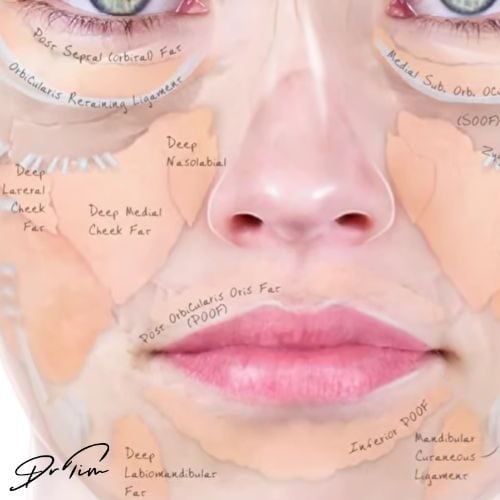
The tear trough is a technically complicated area for any injectable intervention. The skin is thin, the orbicularis oculi muscle is in continuous motion, and vascular and lymphatic structures are dense. These anatomical characteristics are relevant to how clinicians think about the behaviour of any substance placed in this region. Known considerations with hyaluronic acid fillers in this area include the Tyndall effect — a bluish discolouration caused by light scattering through superficially placed product — and product displacement associated with repetitive muscle movement (Hartstein et al., 2021). How a WJ allograft behaves in this environment over time is among the questions that structured research is beginning to explore.
As with any emerging aesthetic intervention, patient selection remains central to clinical decision-making. Individuals presenting with early to moderate infraorbital hollowing, skin thinning, or textural changes may represent a different treatment category than those requiring structural volume replacement or surgical correction.
Regenerative therapies may not provide the immediate, predictable volumisation associated with traditional fillers. Instead, they are often associated with gradual, progressive changes in tissue quality, hydration, and overall appearance.
Setting appropriate expectations is therefore critical. Patients seeking rapid or dramatic correction may be better suited to conventional approaches, while those aligned with subtle, natural-looking improvements may be more appropriate candidates for regenerative strategies. Transparent communication regarding the investigational nature of WJ in this application remains essential to informed consent.
The use of birth-derived tissues introduces important considerations related to safety, ethics, and transparency. WJ allografts are obtained from donated umbilical cords following elective caesarean section, with donor screening protocols designed to reduce the risk of communicable disease transmission. Processing standards aim to preserve structural integrity while maintaining regulatory compliance.
Clinicians have a responsibility to ensure patients understand the origin of the material, its classification, and its intended use. This includes distinguishing between minimally manipulated tissue products and biologics requiring FDA approval, as well as clarifying when applications are investigational or off-label.
Transparency in sourcing, handling, and clinical rationale is not only a regulatory obligation but a critical factor in establishing patient trust within regenerative medicine.
The interest in WJ for periorbital use reflects a broader clinical question: whether a tissue whose composition mirrors the ECM of the ageing face might behave differently in that environment than volumising agents or autologous preparations. Clinicians working in this space have noted that the infraorbital hollow involves cumulative loss of dermal and subdermal connective tissue — the same tissue category from which WJ is derived. Whether that structural correspondence has clinical relevance is a question the emerging evidence base has not yet answered.
Clinicians considering the anatomy of this application typically reflect on factors including tissue plane, depth of delivery, local tissue quality, and the movement dynamics of the periorbital musculature. Cannula-based delivery has been described as one approach in line with existing techniques used for PRP/PRF and certain filler protocols, though no standardised method for WJ in this region has been established.
A number of significant uncertainties remain. The longevity of any tissue integration following WJ injection in the face is not established. It is not yet known whether the allograft undergoes biointegration, acts as a temporary scaffold replaced by host tissue, or degrades without persistent structural change. Optimal delivery parameters, patient selection factors, and follow-up intervals have not been determined through controlled research. Whether the immune-privilege characteristics described in the musculoskeletal literature translate equivalently to the periorbital environment — which has distinct immunological and anatomical properties — is an open question.
Early observational data must also be interpreted with care. Post-injection oedema in the immediate period is a known phenomenon that can affect clinical appearance, making it difficult to distinguish tissue-level changes from transient effects without adequate follow-up and appropriate controls. The absence of comparator arms in early observations limits what can be inferred. Rigorous study design, including validated outcome measures, blinded assessment, and adequate follow-up duration, will be necessary before the clinical picture becomes clearer.
Clinicians engaging with this area are also navigating an evolving regulatory and professional landscape. While WJ allografts are available under Section 361 HCT/P classification, practitioners retain professional responsibility for informed consent, appropriate patient selection, and transparent communication regarding the investigational nature of periorbital application.
The growing interest in WJ also reflects a broader evolution in aesthetic medicine toward biostimulatory and regenerative approaches. Increasingly, patients and clinicians are prioritizing outcomes that preserve natural anatomy and support intrinsic tissue function rather than relying solely on exogenous volume replacement.
Whether WJ ultimately becomes a meaningful contributor within this paradigm will depend on the development of a robust evidence base. Its emergence, however, underscores an important shift in how aesthetic treatments are conceptualized — not only as corrective procedures, but as interventions that may influence the biology of ageing itself.
Wharton’s jelly represents a biologically complex extracellular matrix tissue being explored within the broader shift toward regenerative and biostimulatory aesthetics. While its composition and use in other medical fields provide a compelling foundation, its role in facial applications — particularly in the periorbital region — remains investigational.
As interest in natural, tissue-supportive outcomes continues to grow, the clinical relevance of WJ will depend on rigorous, peer-reviewed research clarifying its safety, behavior, and long-term outcomes in this uniquely delicate anatomical environment.
This article was written by a guest contributor from our community. The views and clinical opinions expressed here belong to the author and do not necessarily reflect the opinions or endorsements of Dr Tim Ltd.
Dr Tim Pearce MBChB BSc (Hons) MRCGP founded his eLearning concept in 2016 in order to provide readily accessible BOTOX® and dermal filler online courses for fellow Medical Aesthetics practitioners. His objective was to raise standards within the industry – a principle which remains just as relevant today.
Our exclusive video-led courses are designed to build confidence, knowledge and technique at every stage, working from foundation level to advanced treatments and management of complications.
Thousands of delegates have benefited from the courses and we’re highly rated on Trustpilot. For more information or to discuss which course is right for you, please get in touch with our friendly team.